
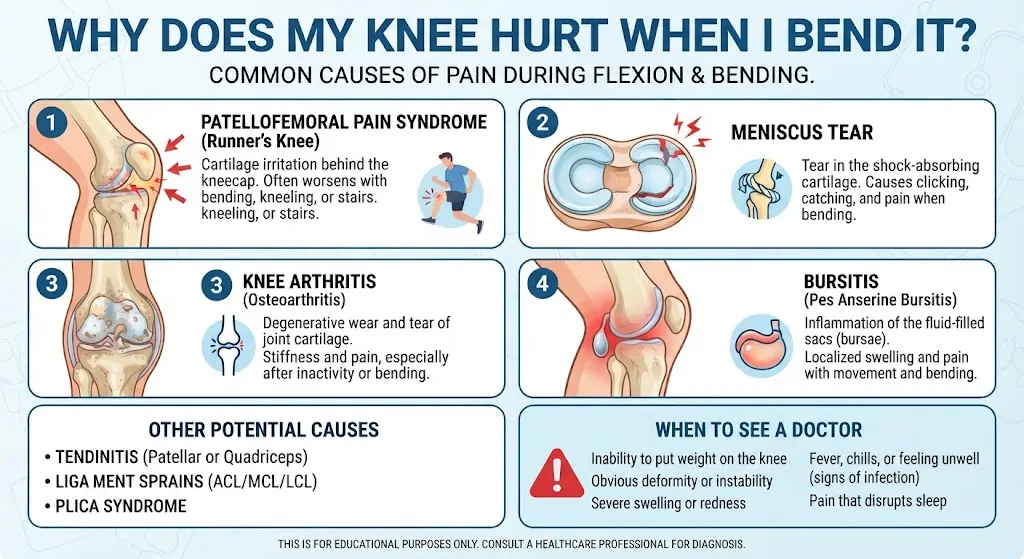
Pain with bending does not always mean you have a serious injury. It can develop from overuse, irritation around the kneecap, arthritis, or an injury to cartilage or a ligament. However, severe pain, significant swelling, or a knee that locks or cannot support your weight needs medical attention.
Understanding why your knee hurts when you bend it can help you choose sensible next steps. The location of the pain, how it began, and whether other symptoms are present can help a healthcare professional identify the likely cause and recommend appropriate treatment.
What Causes Knee Pain When Bending?
The knee bends under pressure during many normal activities. Pain may occur when the kneecap, cartilage, tendons, ligaments, or other joint structures become irritated or injured.
| Possible cause | Common clues |
|---|---|
| Patellofemoral pain | Pain around or behind the kneecap, often with stairs, squats, or prolonged sitting |
| Knee osteoarthritis | Stiffness after rest, aching with activity, and sometimes swelling |
| Meniscus tear | Pain along the inner or outer joint line, sometimes with catching or locking |
| Tendon irritation | Pain just below or above the kneecap, often aggravated by jumping or running |
| Ligament injury | Pain and swelling after twisting, a sudden change of direction, or a direct injury |
| Bursitis | Localized tenderness and swelling, sometimes after repeated kneeling |
These symptoms can overlap, so they cannot confirm a diagnosis by themselves.
1. Pain around or behind the kneecap
Patellofemoral pain often worsens when the knee is bent under load, such as during squats, stair climbing, or getting up from a low chair. It can also develop after a sudden increase in running, exercise, or other repetitive activity.
If your pain is most noticeable during squats, see this guide to why your knee hurts when you squat.
2. Meniscus injury
The meniscus is cartilage that helps cushion and stabilize the knee. A tear can occur during a twisting movement, particularly in sports, or develop gradually as the tissue changes with age. Deep bending or rotating the knee may aggravate symptoms, and some people experience swelling, catching, or restricted movement.
Learn about meniscus tear symptoms, treatment, and recovery to understand how these injuries are assessed and managed.
3. Knee osteoarthritis
Osteoarthritis involves changes in the joint cartilage and surrounding tissues. It may cause pain with bending, stiffness after sitting, and difficulty with stairs or standing up. Symptoms can vary from day to day and do not always match the degree of change seen on an X-ray.
For more information, explore knee arthritis causes, symptoms, and treatment options.
4. Tendon or ligament problems
Repeated jumping, running, or sudden increases in training can irritate the tendons around the kneecap. Ligament injuries are more likely after a forceful twist, impact, or sudden change in direction, especially when swelling or instability develops soon afterward.
Pain that starts after an injury deserves particular attention. This guide explains sharp knee pain after an injury and possible ACL or meniscus involvement.
Why Does My Knee Hurt More in Certain Positions?
The movement that triggers pain can offer clues, although it does not identify the cause on its own.
-
When straightening the knee: Pain or stiffness may follow irritation, swelling, or a joint injury. See why your knee hurts when you straighten it.
-
When climbing stairs: The kneecap and surrounding structures experience increased load. Compare the symptoms in knee pain when walking up stairs.
-
After sitting for a long time: Stiffness after rest can occur with arthritis or kneecap-related pain. Read about knee pain after sitting for a long time.
-
When twisting: Pain with a twisting movement may occur with a meniscus injury or other joint problem. Learn about why knee pain can occur when twisting.
-
Behind the kneecap: Pain in this area may be associated with patellofemoral problems. See common causes of pain behind the kneecap.
What Can You Do at Home?
If the pain is mild and there are no warning signs, temporarily reduce deep squats, kneeling, running, and other movements that aggravate it. Apply a cold pack wrapped in a towel for 15–20 minutes at a time if swelling or soreness develops. Keep the knee moving gently within a comfortable range rather than forcing it to bend through sharp pain.
Choose activity according to your symptoms. Gentle walking may be reasonable if you can bear weight without limping or worsening pain, but do not push through instability or catching. If a meniscus injury is suspected, understand whether walking on a torn meniscus can make it worse.
| Symptom pattern | Sensible next step |
|---|---|
| Mild pain after activity, improving with rest | Modify activity and monitor symptoms |
| Pain that keeps returning or limits daily movement | Arrange a clinical assessment |
| Swelling, catching, or recurring instability | Seek medical evaluation |
| Severe pain, inability to bear weight, or a locked knee | Seek urgent assessment |
Avoid starting strengthening exercises that intensify pain before the cause is clearer. For longer-term activity, low-impact exercises for people with joint pain may offer options that put less stress on the knee.
When Should You Seek Medical Care?
Arrange an appointment if knee pain persists, repeatedly returns, interferes with normal activities, or is accompanied by swelling or reduced movement. A clinician may examine the knee and recommend imaging when the history and examination suggest a fracture, significant injury, or another condition requiring further assessment.
Seek urgent medical care if you cannot bear weight, cannot move the knee, it locks and will not straighten, or major swelling develops after an injury. A hot, red knee with fever may indicate an infection and requires urgent evaluation. Sudden swelling without a clear explanation should also be assessed promptly; learn more about when a swollen knee may be dangerous.
Pain without a clear injury can still deserve evaluation, particularly if it persists or worsens. See common reasons for knee pain without an injury.
Frequently Asked Questions
1. Why does my knee hurt when bending but not walking?
Some knee conditions cause pain mainly when the joint is deeply bent or loaded. If symptoms persist, an examination can help identify the cause.
2. Can a meniscus tear heal without surgery?
Some tears, depending on their location and severity, can improve with nonsurgical treatment. Find out whether a meniscus tear can heal on its own.
3. Can physical therapy help knee pain?
Yes, tailored physical therapy can improve strength, movement, and function for many causes of knee pain. For selected meniscus injuries, physical therapy for a meniscus tear may be part of treatment.
4. Why does my knee lock when I bend it?
Locking or catching can occur with certain meniscus injuries or loose material inside the joint. A knee that becomes stuck and cannot straighten needs urgent assessment; see why a knee may lock when bending.
5. What if my knee feels like it might give way?
Instability can occur after ligament injuries or when pain affects muscle control. Read about why a knee may feel like it is giving out and arrange an assessment if it recurs.
6. Is fluid in the knee dangerous?
Fluid can build up after injury, inflammation, or arthritis. Sudden or substantial swelling, especially with fever, redness, or severe pain, needs prompt medical evaluation; learn when fluid on the knee may be dangerous.
7. Why does my knee hurt when walking downstairs?
Descending stairs places substantial demand on the knee and kneecap. Persistent pain may warrant an assessment; explore causes of knee pain when walking downstairs.
8. How do I know if a meniscus tear is getting worse?
Increasing pain, swelling, catching, or reduced movement may indicate that the knee needs reassessment, though these symptoms are not specific to a meniscus tear. See signs that a meniscus tear may be worsening.
9. Should I keep bending my knee if it hurts?
Gentle movement within a comfortable range may help prevent stiffness, but do not force deep bending or continue movements that cause sharp pain. Stop and seek advice if symptoms worsen.
10. How long does knee pain when bending last?
Minor irritation may settle over days to a few weeks, depending on the cause and activity level. Pain that persists, worsens, or limits normal movement should be evaluated rather than left untreated.
Conclusion
Knee pain when bending can result from kneecap irritation, arthritis, tendon problems, or a meniscus or ligament injury. Reduce aggravating activities, use gentle movement, and monitor symptoms. Seek medical care for persistent pain, and get urgent help for severe swelling, inability to bear weight, a locked knee, or a hot, red knee with fever.
Disclaimer: This article is provided for educational and informational purposes only.
This article is for education purpose only and is not a diagnosis or a substitute for medical advice.