
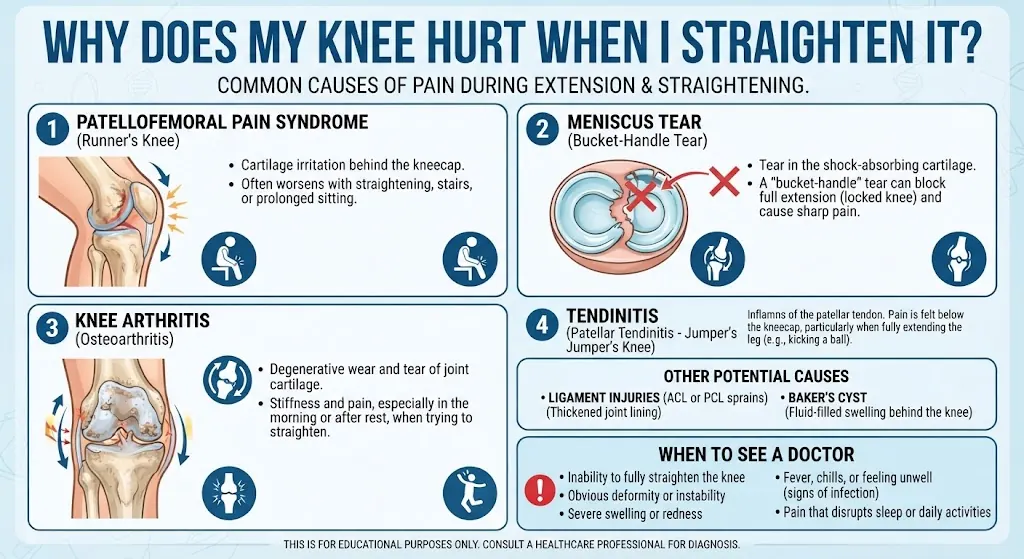
Pain during straightening does not automatically mean you have a serious injury. It can result from irritation around the kneecap, arthritis, tendon problems, or an injury involving cartilage or a ligament. However, significant swelling, a knee that becomes stuck, or an inability to bear weight can signal a problem that needs prompt medical attention.
Understanding why your knee hurts when you straighten it starts with when the pain occurs, where you feel it, and whether other symptoms are present. This guide explains common causes, safe steps to try at home, expected recovery, and when to seek medical care.
What Causes Knee Pain When Straightening the Leg?
Straightening the knee engages the joint surfaces, kneecap, tendons, and surrounding muscles. Pain can develop when one of these structures is irritated or injured. The movement that triggers the pain may offer clues, but symptoms alone cannot confirm a diagnosis.
1. Meniscus tear
The meniscus is a piece of cartilage that cushions the knee between the thighbone and shinbone. A tear may cause pain along the inner or outer joint line, swelling, catching, or difficulty fully straightening the leg. Symptoms may begin after twisting the knee or develop gradually as the tissue changes with age.
If the knee catches or feels physically blocked, arrange a medical assessment rather than repeatedly forcing it straight. Learn about meniscus tear symptoms and treatment options.
2. Knee arthritis
Osteoarthritis involves changes to the cartilage and other tissues within the joint. It can cause aching, stiffness after rest, reduced movement, and discomfort when standing or walking. Symptoms may be worse after activity or first thing in the morning.
Arthritis is one possible explanation, especially when symptoms develop gradually, but it is not the only cause. Knee arthritis symptoms and treatment options can help explain the condition.
3. Patellofemoral pain
Pain around or behind the kneecap may worsen when straightening the knee after sitting, using stairs, squatting, or increasing exercise. This pattern can occur when the joint between the kneecap and thighbone is irritated.
The discomfort is often felt at the front of the knee rather than directly along the joint line. See common causes of pain behind the kneecap for more detail.
4. Tendon irritation or a ligament injury
The quadriceps and patellar tendons help straighten the knee. Irritation can cause pain above or below the kneecap, particularly during repeated jumping, running, or forceful leg movements. A ligament injury is more likely after a sudden twist, impact, or awkward landing, sometimes with swelling or a feeling that the knee is unstable.
Pain following an injury should not automatically be treated as ordinary soreness. Read about knee ligament injuries and their symptoms to understand possible injury patterns.
5. Swelling or fluid inside the knee
Inflammation or fluid buildup can make the knee feel tight and limit full extension. Swelling may follow an injury, arthritis flare, or another joint condition. A knee that becomes suddenly swollen, hot, or red needs medical evaluation, particularly if you also have a fever.
Learn when fluid on the knee may be dangerous.
How the Symptoms Can Help Narrow Down the Cause
| Symptom pattern | Possible explanation |
|---|---|
| Pain around or behind the kneecap | Patellofemoral pain or arthritis |
| Pain along the inner or outer joint line | Meniscus or other joint problem |
| Pain above or below the kneecap | Tendon irritation |
| Swelling after twisting or impact | Meniscus or ligament injury, among other causes |
| Knee feels stuck and will not straighten | Mechanical blockage or significant joint problem |
These patterns are clues, not a diagnosis. A clinician may need to examine your knee and, depending on the findings, recommend imaging.
For a broader overview, see common causes of knee pain and when to see a doctor.
What Can You Do at Home?
If the pain is mild, you can still bear weight, and there are no warning signs, try reducing activities that aggravate the knee for a few days.
-
Modify activity: Temporarily avoid deep squats, running, jumping, and forceful knee extension. Knee pain when bending may have overlapping causes.
-
Use a cold pack: Apply it through a towel for 15–20 minutes at a time if the knee is sore or swollen.
-
Keep moving gently: Short, comfortable walks may be reasonable if they do not worsen symptoms. Stop if pain increases or the knee feels unstable.
-
Avoid forcing the joint: Do not push through sharp pain or try to unlock a knee that feels physically stuck.
-
Consider appropriate pain relief: Ask a pharmacist or clinician whether an over-the-counter medicine is suitable, especially if you have kidney disease, ulcers, heart disease, take blood thinners, or are pregnant.
Once pain settles, gradual strengthening may help, depending on the cause. Low-impact exercises for painful joints can provide general ideas, but stop any movement that increases symptoms.
When Should You Seek Medical Care?
| Level of concern | What to look for | What to do |
|---|---|---|
| Usually monitor briefly | Mild pain that improves with rest and no major swelling | Modify activity and watch for improvement |
| Arrange medical evaluation | Persistent pain, recurring swelling, reduced movement, or pain that interferes with daily activities | Book an appointment |
| Seek urgent care | Inability to bear weight, a knee that is locked, major swelling after injury, deformity, or a hot red knee with fever | Get prompt medical assessment |
If your knee hurts after a twist, read about sharp knee pain after an injury. If swelling is prominent, review when a swollen knee may be dangerous.
How Long Does Knee Pain Take to Improve?
Recovery depends on the cause and severity. Mild irritation may improve over several days with activity changes, while arthritis, tendon problems, or a meniscus injury may take weeks or longer to manage. Worsening symptoms, repeated locking, or ongoing difficulty straightening the leg deserve evaluation rather than indefinite home treatment.
A meniscus tear does not always require surgery, but healing depends on its location, type, and severity. Find out whether a meniscus tear can heal on its own and whether walking on a torn meniscus can make it worse.
Frequently Asked Questions
1. Why does my knee hurt only when I straighten it?
Pain may come from irritated tendons, the kneecap joint, arthritis, or a meniscus problem. The location and accompanying symptoms help guide evaluation.
2. Why can’t I fully straighten my knee?
Pain or swelling can limit movement, but a physical blockage can also prevent full extension. If the knee is stuck, seek prompt medical assessment rather than forcing it straight.
3. Can a meniscus tear cause pain when straightening the knee?
Yes. Some meniscus tears cause pain, catching, swelling, or restricted movement during extension. An examination is needed to determine whether a tear is responsible.
4. Why does my knee hurt when I straighten it after sitting?
Stiffness after sitting can occur with arthritis or pain around the kneecap. If it happens regularly or persists, discuss it with a clinician.
5. Why does my knee hurt when I straighten it and walk downstairs?
Stair descent places load on the kneecap joint and surrounding muscles. Patellofemoral pain and arthritis are possible causes, but other conditions can produce similar symptoms.
6. Can knee pain occur without swelling?
Yes. Tendon irritation, early joint problems, and some meniscus injuries may cause pain without visible swelling. No swelling does not rule out an injury.
7. Should I exercise if my knee hurts when straightening it?
Gentle movement may be reasonable when symptoms are mild and the knee is stable. Avoid painful or forceful exercises until the cause is clearer.
8. Does knee pain when straightening always mean arthritis?
No. Arthritis is one possibility, but tendon irritation, meniscus injuries, and kneecap-related pain can cause similar symptoms.
9. When might I need an MRI?
An MRI may be considered when an examination suggests a meniscus, ligament, or other soft-tissue injury and the result would affect treatment. It is not necessary for every case of knee pain.
10. What if the pain keeps returning?
Recurring pain can mean that the underlying cause has not resolved or that activity is repeatedly aggravating the knee. Arrange an evaluation if symptoms persist, worsen, or limit normal activities.
Conclusion
Knee pain when straightening the leg can arise from several conditions, ranging from temporary irritation to an injury that needs treatment. Modify painful activities, avoid forcing the knee, and seek care for persistent symptoms, locking, significant swelling, or difficulty bearing weight. The safest next step depends on how the pain started and what other symptoms occur.
Disclaimer: This article is provided for educational and informational purposes only.
This article is for education purpose only and is not a diagnosis or a substitute for medical advice.