
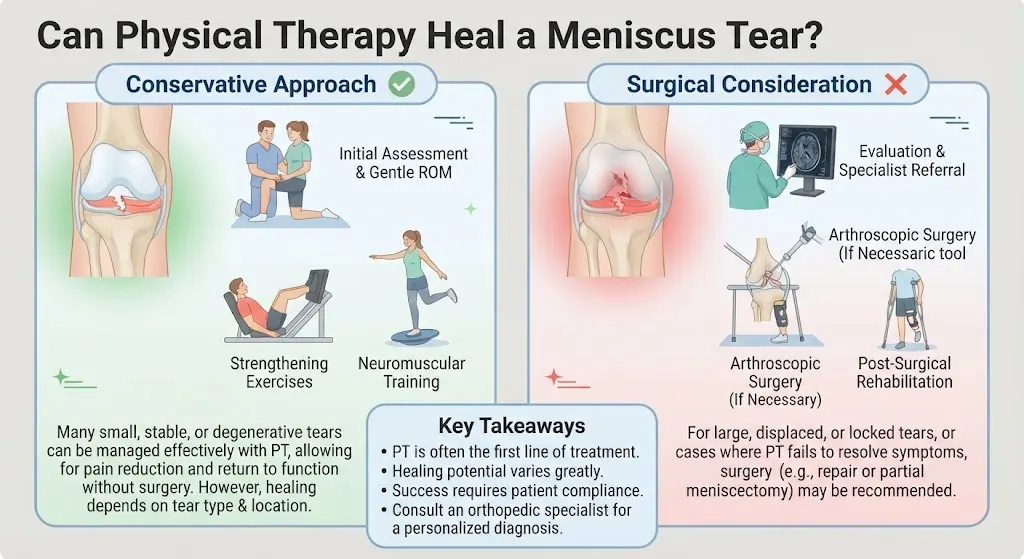
Physical therapy can help many people with a meniscus tear improve pain, movement, strength, and knee function. However, rehabilitation does not guarantee that the torn cartilage will physically heal. Whether a tear heals, remains stable, or continues to cause symptoms depends on its location, pattern, severity, and the condition of the knee.
Understanding how physical therapy works, which exercises may help, how long recovery can take, and when surgery may be considered can help you make informed decisions with your healthcare professional.
Can Physical Therapy Heal a Torn Meniscus Without Surgery?
Physical therapy can help manage many meniscus tears without surgery, but symptom improvement and tissue healing are not the same thing. A person may regain comfortable movement and return to daily activities even if the tear remains visible on imaging.
The meniscus is a C-shaped piece of cartilage that cushions the knee and helps distribute pressure. Its outer portion has a better blood supply than its inner portion, so some tears—particularly certain tears near the outer edge—have a greater chance of healing naturally. Tears in areas with limited blood supply are less likely to heal completely on their own.
Physical therapy supports recovery by improving muscle strength, joint control, flexibility, and tolerance for daily activities. It cannot reliably reconnect every torn piece of cartilage or remove a fragment that physically blocks knee movement.
For an overview of meniscus tear symptoms, treatment, and recovery, consider how symptoms and tear characteristics influence treatment choices.
Which Meniscus Tears May Respond to Physical Therapy?
The best treatment depends on more than the MRI report. Age, activity level, knee stability, arthritis, and whether the injury happened suddenly or developed gradually also matter.
| Tear or symptom pattern | How physical therapy may help | Important limitation |
|---|---|---|
| Small, stable tear | Build strength and improve movement | The tear may not fully heal |
| Degenerative tear associated with aging | Improve function and manage symptoms | Arthritis may also contribute to pain |
| Tear with mild swelling and stiffness | Gradually restore movement and strength | Progress depends on symptom response |
| Tear with persistent locking or a displaced fragment | May help surrounding strength | Mechanical blockage may require prompt specialist assessment |
Some tears caused by a sudden twisting injury occur alongside damage to other structures, such as the anterior cruciate ligament (ACL). These combined injuries may require a different rehabilitation plan. Learn about the differences between an ACL injury and a meniscus tear.
What Exercises Are Used in Meniscus Tear Rehabilitation?
Physical therapy usually begins with comfortable, controlled movements and progresses as pain and swelling settle. A physical therapist can adjust exercises to the tear, your symptoms, and any restrictions from your clinician.
Common rehabilitation exercises may include:
-
Heel slides: Gently bend and straighten the knee within a comfortable range to improve mobility.
-
Quadriceps sets: Tighten the thigh muscle while keeping the leg supported to help maintain muscle activation.
-
Straight-leg raises: Strengthen the thigh without repeatedly bending the knee, if you can perform them comfortably.
-
Bridges and hip-strengthening exercises: Build support around the leg and improve control during movement.
-
Sit-to-stand practice: Gradually rebuild the ability to rise from a chair when knee bending is tolerated.
These exercises are not suitable for every tear or stage of recovery. Deep squats, twisting, pivoting, and loaded knee bending may aggravate symptoms, particularly early on. For guidance on exercising safely with a meniscus tear, follow an individualized rehabilitation plan rather than copying a demanding routine.
How Should Rehabilitation Progress?
| Recovery stage | Typical focus | What to monitor |
|---|---|---|
| Early stage | Control swelling and restore comfortable movement | Increasing pain or swelling |
| Strengthening stage | Improve thigh, hip, and leg strength | Limping or difficulty with exercises |
| Functional stage | Practice stairs, balance, and controlled bending | Catching, instability, or pain afterward |
| Return to activity | Gradually increase work, sport, or exercise demands | Symptoms during activity and the following day |
Progress depends on the injury and your response. If an exercise causes sharp pain, new swelling, or worsening symptoms, stop and discuss the plan with your clinician or physical therapist.
For gentle activity options, explore low-impact exercises for painful joints. If bending triggers discomfort, knee pain when bending may also help you understand why the movement deserves attention.
How Long Does Physical Therapy Take to Help a Meniscus Tear?
Some people notice improved movement and function within several weeks, while others need a longer rehabilitation period. Recovery varies with the tear pattern, swelling, baseline strength, other knee conditions, and consistency with the treatment plan.
A symptom improvement does not necessarily mean the cartilage has healed. Some degenerative tears continue to appear on imaging even when pain and everyday function improve. Read about whether a meniscus tear can heal on its own and how long a torn meniscus may take to heal for more detail.
Walking may be possible with some tears, but pushing through pain or limping can make recovery harder. Review whether walking on a torn meniscus can make it worse and adjust activity to your symptoms and professional advice.
When Is Surgery Considered Instead of Physical Therapy?
Surgery is not automatically necessary for every meniscus tear. A clinician may recommend an initial course of rehabilitation for a stable tear, particularly when there is no true locking or major loss of function.
An orthopedic specialist may consider surgery when symptoms remain limiting despite appropriate treatment, a displaced tear restricts movement, or the injury occurs with other damage that affects knee stability. Decisions depend on the individual case; surgery also carries risks and requires recovery time.
Seek prompt medical evaluation if your knee becomes locked and you cannot fully straighten it. New or substantial swelling, repeated giving way, or worsening pain also warrants assessment. Learn about why a meniscus tear can cause knee locking, signs that a meniscus tear may be getting worse, and when meniscus surgery may be needed.
After a sudden injury, seek urgent care if you cannot bear weight, have severe pain, or develop a rapidly swollen knee. A hot, red knee with fever also needs urgent assessment.
Frequently Asked Questions
1. Can physical therapy heal a meniscus tear completely?
Some tears have a chance of healing, especially those in areas with a better blood supply. Physical therapy more reliably aims to improve strength, movement, and function than to guarantee complete cartilage healing.
2. Is physical therapy better than surgery for a meniscus tear?
Neither option is best for everyone. Rehabilitation may be appropriate for many stable or degenerative tears, while certain displaced tears or persistent mechanical symptoms may require surgical assessment.
3. Can I do physical therapy if my knee is swollen?
Gentle, appropriately selected rehabilitation may still be possible, but significant or increasing swelling should be assessed. A therapist can modify exercises until the cause and severity are clearer.
4. Should I keep walking with a torn meniscus?
Walking may be reasonable if you can do it comfortably without limping or worsening symptoms. Reduce the distance and seek professional advice if pain, swelling, or instability increases.
5. Why does my knee hurt when I twist it?
Twisting places rotational stress on the knee and can aggravate a meniscus tear or other knee injury. Avoid repeatedly testing the painful movement and arrange an evaluation if symptoms persist.
6. Can a meniscus tear exist without swelling?
Yes. Some tears cause pain or clicking without obvious swelling, while others cause substantial swelling. The absence of swelling does not rule out a meniscus injury.
7. What if my knee feels like it is giving way?
Giving-way sensations may occur because of pain, muscle weakness, or an associated injury. If this happens repeatedly, arrange an assessment and avoid activities where a sudden loss of support could cause a fall.
8. Can a meniscus tear be mistaken for arthritis?
Yes. Both can cause pain, stiffness, and difficulty bending the knee, and they can occur together. Learn about meniscus tears versus knee arthritis to understand the overlap.
9. What happens if a meniscus tear gets worse?
Symptoms may include increased pain, swelling, catching, or reduced movement, although symptoms alone cannot confirm that the tear has enlarged. Seek reassessment if function declines or new mechanical symptoms develop.
10. How can I tell whether my meniscus tear needs medical attention?
Arrange an evaluation for persistent pain, recurring swelling, or difficulty with daily activities. A locked knee, inability to bear weight after an injury, or a hot, red knee with fever requires urgent assessment.
Conclusion
Physical therapy can help many people with meniscus tears regain strength, mobility, and everyday function without surgery. However, improvement does not guarantee that the torn cartilage has fully healed. Work with a qualified clinician to choose suitable exercises, monitor symptoms, and determine whether further evaluation or surgery is appropriate.
Disclaimer: This article is provided for educational and informational purposes only.
This article is for education purpose only and is not a diagnosis or a substitute for medical advice.