
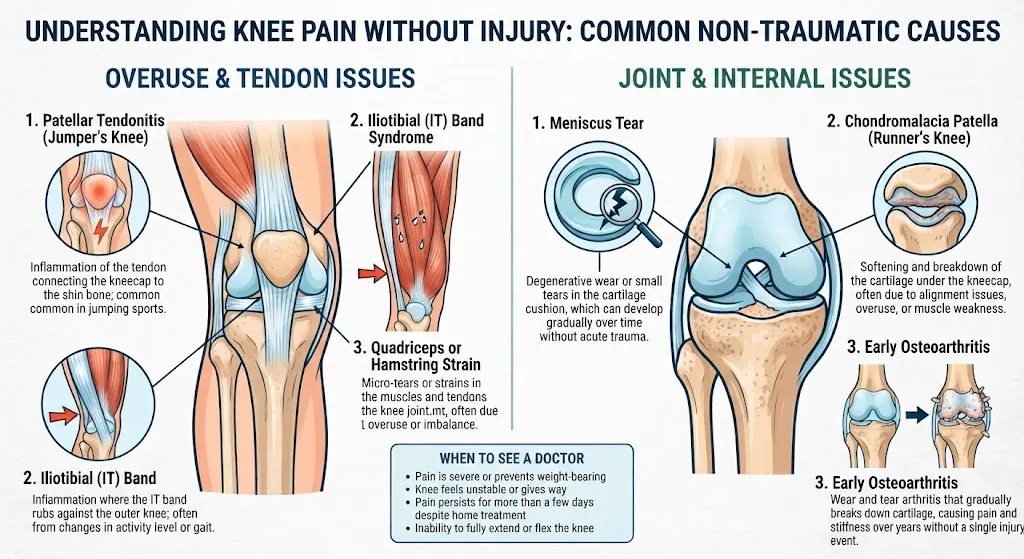
Knee pain without an obvious injury does not automatically mean something serious is happening. Common explanations include osteoarthritis, irritation around the kneecap, tendon problems, and changes in activity that place more stress on the joint. However, unexplained pain accompanied by warmth, significant swelling, fever, or difficulty bearing weight should not be ignored.
Understanding why your knee hurts without an injury can help you recognize possible causes, choose appropriate home care, and decide when to seek medical attention. The location of the pain, how long it lasts, and what makes it better or worse can all help guide the next steps.
What Causes Knee Pain Without an Injury?
Knee pain without a clear injury may result from gradual joint changes, irritation of surrounding tissues, inflammation, or repeated everyday stress. The cause is not always obvious from symptoms alone.
1. Knee osteoarthritis
Osteoarthritis is a common cause of knee pain, particularly as people get older. It involves changes in joint cartilage and the tissues around the joint, which can lead to aching, stiffness, and reduced movement.
You may notice pain after walking, climbing stairs, standing for long periods, or getting up after sitting. Morning stiffness can occur, although prolonged stiffness, warmth, or swelling may suggest other causes that need evaluation.
Explore knee arthritis symptoms, causes, and treatment options for more information about how arthritis affects movement.
2. Patellofemoral pain syndrome
Patellofemoral pain occurs around or behind the kneecap. It may develop when the knee is repeatedly loaded during activities such as stair climbing, squatting, running, or standing up from a chair.
Pain often increases when the knee is bent under load or after sitting with the knee bent for an extended period. This condition does not necessarily mean the cartilage is damaged.
3. Tendon irritation
Tendons connect muscles to bones and help the knee move. Repeated loading, sudden increases in exercise, or inadequate recovery between demanding activities may irritate a tendon even without a single identifiable injury.
Pain at the front of the knee, particularly just below the kneecap, can occur with patellar tendinopathy. Symptoms may become more noticeable when jumping, climbing stairs, or straightening the knee against resistance.
4. Meniscus problems
A meniscus can develop degenerative changes over time, sometimes without a memorable injury. This may cause pain along the inner or outer knee joint, stiffness, catching, or discomfort when bending and turning.
A lack of swelling does not rule out a meniscus problem. However, not every painful or clicking knee has a tear, and examination is often needed to determine whether further testing is appropriate.
5. Bursitis and other inflammatory conditions
Bursae are small, fluid-filled sacs that reduce friction around joints. Irritation of a knee bursa may cause localized tenderness and swelling, particularly near the front of the kneecap.
Inflammatory arthritis, gout, and other medical conditions can also cause knee pain without an injury. These conditions become more important to consider when symptoms start suddenly, the knee becomes hot or swollen, or multiple joints are affected.
Why Does My Knee Hurt Without Swelling?
Knee pain without swelling can still come from osteoarthritis, patellofemoral pain, tendon irritation, or a meniscus problem. Swelling is only one possible symptom, so its absence does not rule out a condition that needs treatment.
Pay attention to whether the pain is sharp, dull, constant, or triggered by a specific movement. For example, knee pain without swelling that repeatedly occurs during bending or walking may deserve evaluation even if the joint looks normal.
What Does the Location of Knee Pain Tell You?
The location of discomfort can help narrow down possible explanations, although it cannot confirm a diagnosis.
| Where the knee hurts | Possible causes | Helpful observation |
|---|---|---|
| Front or behind the kneecap | Patellofemoral pain, osteoarthritis | Pain with stairs, squatting, or prolonged sitting |
| Inner side of the knee | Osteoarthritis, meniscus problems, tendon irritation | Tenderness near the inner joint line |
| Outer side of the knee | Tendon irritation, iliotibial band-related pain, joint problems | Pain during walking or repeated bending |
| Back of the knee | Baker’s cyst, arthritis, tendon problems | Tightness or swelling behind the joint |
| Several joints | Inflammatory arthritis or another systemic condition | Pain or stiffness in other joints as well |
If symptoms are concentrated in one area, these guides may help you understand why the inside of your knee hurts, what causes pain on the outside of your knee, or why pain develops behind the kneecap.
Pain that occurs mainly after activity may have a different pattern from discomfort that appears during rest. If the pain is worse at night, review possible causes of knee pain at night.
What Does Research Say About Knee Pain Without an Injury?
Osteoarthritis is an important possible cause, but knee pain alone does not establish that diagnosis. The Centers for Disease Control and Prevention reported that approximately 33 million U.S. adults have osteoarthritis, which can affect the knees as well as other joints.
Clinical guidance also emphasizes that diagnosis depends on the symptom pattern and examination, not automatically on imaging. NICE guidance states that osteoarthritis can often be diagnosed clinically in adults aged 45 and older who have activity-related joint pain and either no morning stiffness or stiffness lasting no longer than 30 minutes. Atypical symptoms may require further investigation.
These findings are useful because they show why age and activity-related discomfort can provide clues without proving the cause. A younger adult can also experience knee pain without an obvious injury, and a person with arthritis may have symptoms that fluctuate.
How Can You Relieve Knee Pain at Home?
If the pain is mild, you can walk normally, and there are no warning signs, try a short period of conservative care.
-
Adjust painful activities. Temporarily reduce deep squats, repeated stair climbing, running, or prolonged standing if they aggravate symptoms.
-
Use ice for recent soreness or swelling. Apply a cold pack wrapped in a towel for 15–20 minutes at a time.
-
Keep the knee moving gently. Comfortable walking or gentle bending and straightening may help prevent stiffness. Do not force a movement that causes sharp pain.
-
Review recent changes. Increased walking, a new exercise routine, or spending more time standing may be contributing to the discomfort.
-
Consider medication cautiously. Topical anti-inflammatory medicines may help some people, but check with a clinician or pharmacist about contraindications, other medications, and safe use.
If pain is aggravated by sitting, consider why your knee hurts after sitting for a long time. If the knee feels stiff initially but becomes more comfortable after gentle movement, why knee pain may improve when you start walking may help you understand that pattern.
Should you exercise when your knee hurts?
Usually, gentle activity can be appropriate when symptoms are mild and movement remains comfortable. If arthritis is involved, strengthening the muscles around the knee and maintaining general fitness can improve function and help manage pain. Exercise should be adjusted to your abilities rather than stopped indefinitely.
Consider joint-friendly low-impact exercises such as gentle cycling, swimming, or walking on level ground if tolerated. Start gradually, and reduce the intensity if symptoms worsen or remain aggravated afterward.
When Should You See a Doctor for Knee Pain Without an Injury?
Arrange a medical appointment if knee pain lasts more than several days without improvement, repeatedly returns, interferes with sleep, or makes walking and daily activities difficult. Seek assessment sooner if pain is worsening or the knee becomes swollen.
Warning signs: when to seek care
| Level of concern | Symptoms | What to do |
|---|---|---|
| Monitor briefly | Mild pain that improves with rest and does not limit movement | Modify activity and watch for improvement |
| Routine medical evaluation | Persistent pain, recurring stiffness, or pain that limits daily activities | Schedule an appointment |
| Prompt or urgent assessment | New significant swelling, inability to bear weight, a locked knee, or marked instability | Seek prompt medical care |
| Emergency assessment | A hot, red, swollen knee with fever or feeling very unwell | Seek urgent emergency evaluation because joint infection is possible |
A sudden hot, swollen joint can indicate infection or another inflammatory condition, even without a known injury. Do not wait for home treatment to work if these symptoms develop.
During an examination, your clinician may ask when the pain began, whether it occurs during activity or rest, and whether you have stiffness or other symptoms. Depending on the findings, they may recommend physical therapy, medication, blood tests, or imaging. An MRI is not routinely necessary for every person with knee pain.
For more context, review the main causes of knee pain and when to seek medical care and when knee swelling may signal a more serious problem.
Frequently Asked Questions
1. Can knee pain without an injury be serious?
Yes, although many causes are manageable. Persistent pain, substantial swelling, fever, or difficulty bearing weight may indicate a problem that needs prompt evaluation.
2. Why does my knee hurt when I wake up?
Morning discomfort may result from joint stiffness, osteoarthritis, or inflammation. Stiffness that lasts a long time or affects multiple joints deserves medical assessment.
3. Can walking too much cause knee pain without an injury?
Yes. A sudden increase in walking or standing can exceed the knee’s current tolerance and irritate surrounding tissues. Reducing the workload temporarily and increasing activity gradually may help.
4. Can knee arthritis start without an injury?
Yes. Osteoarthritis can develop gradually over time without a specific accident. Symptoms may include activity-related pain, stiffness, and difficulty with stairs or prolonged walking.
5. Why does my knee hurt when bending but not when standing?
Bending changes the forces placed on the kneecap, cartilage, and other joint structures. Patellofemoral pain, osteoarthritis, and meniscus problems are possible explanations.
6. Can stress make knee pain worse?
Stress may contribute to muscle tension, disturbed sleep, and increased sensitivity to pain. However, it should not be assumed to be the sole cause of persistent knee symptoms.
7. Does knee pain without swelling mean there is no damage?
No. Some joint and tendon conditions cause pain without visible swelling. The overall symptom pattern and clinical examination matter more than swelling alone.
8. Should I use heat or ice for unexplained knee pain?
Ice may help with recent soreness or swelling, while gentle heat may ease stiffness in some people. Protect your skin, avoid extreme temperatures, and stop if either treatment worsens symptoms.
9. How long should knee pain without an injury last?
Minor irritation may improve within several days, but arthritis and other ongoing conditions can cause recurring symptoms. Seek medical advice if the pain persists, worsens, or limits normal activities.
10. Can knee pain without an injury go away on its own?
Yes, some mild cases improve with activity modification and time. Repeated or persistent pain should be evaluated so that an underlying condition is not overlooked.
Conclusion
Knee pain without an injury can result from osteoarthritis, kneecap-related pain, tendon irritation, meniscus changes, or inflammatory conditions. Monitor the pattern of symptoms, modify activities that aggravate the knee, and maintain gentle movement when comfortable. Seek medical attention for persistent pain and urgent care for a hot, swollen joint, inability to bear weight, or other serious warning signs.
Disclaimer: This article is provided for educational and informational purposes only.
This article is for education purpose only and is not a diagnosis or a substitute for medical advice.