
Not every painful squat means you have a serious knee injury. Pain can develop from increased training intensity, limited mobility, irritated tendons, or pressure around the kneecap. However, persistent pain, significant swelling, or a knee that locks or gives way deserves medical attention rather than repeated attempts to push through it.
Understanding why your knee hurts when you squat can help you adjust your movements, identify activities that may aggravate the problem, and decide when to seek professional care. The right approach depends on the underlying cause, your symptoms, and whether the pain began suddenly or developed gradually.
What Causes Knee Pain When Squatting?
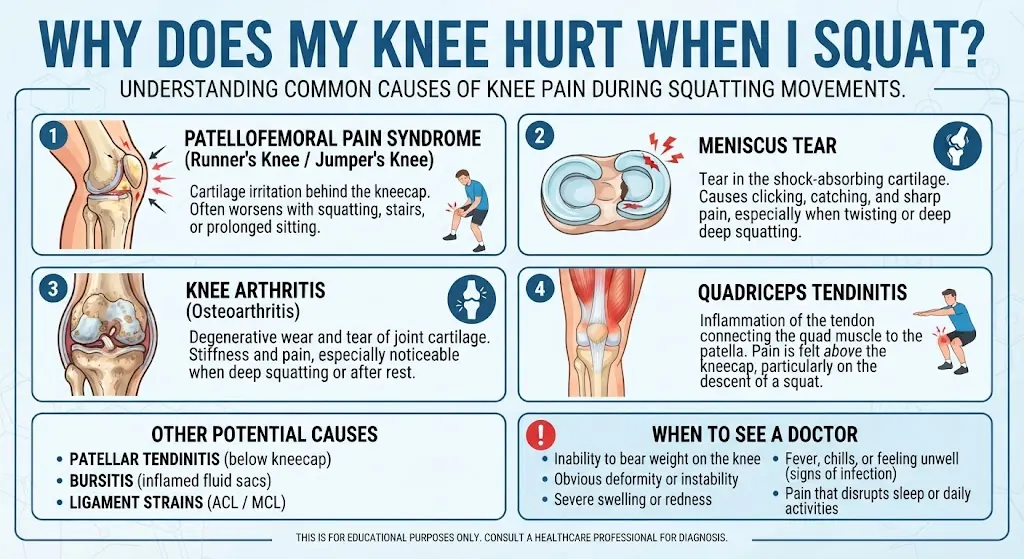
Knee pain during squats can result from several conditions, and the location of the pain is not enough to establish a diagnosis. Common possibilities include irritation around the kneecap, tendon problems, meniscus injuries, and knee arthritis.
1. Patellofemoral pain syndrome
Patellofemoral pain occurs around or behind the kneecap. It may feel like a dull ache that becomes more noticeable during deep squats, lunges, stair climbing, or standing after sitting for a long time.
This pain can develop when the knee is exposed to more activity or loading than it can comfortably tolerate. Read about why knee pain occurs when bending for additional clues about movement-related discomfort.
2. Patellar tendinitis
Patellar tendinitis, also called patellar tendinopathy, affects the tendon connecting the kneecap to the shinbone. Pain is often concentrated just below the kneecap and may worsen during jumping, running, or loaded squats.
Learn more about patellar tendonitis symptoms and treatment if the discomfort is concentrated in this area.
3. Meniscus tear
The meniscus is cartilage that helps cushion and stabilize the knee joint. A tear may cause pain along the inner or outer joint line, particularly when squatting, twisting, or turning on a planted foot.
Some people also experience swelling, catching, or locking. Explore meniscus tear symptoms and treatment options to understand how these injuries are evaluated.
4. Knee osteoarthritis
Osteoarthritis involves changes in the joint cartilage and surrounding tissues. Symptoms may include stiffness, aching during weight-bearing activities, and reduced comfort when bending the knee deeply.
Pain can be more noticeable after inactivity or repeated activity. This guide to knee arthritis causes, symptoms, and treatment explains common management options.
5. Training errors and movement changes
Increasing squat depth, resistance, repetitions, or training frequency too quickly can overload the knee. Poorly tolerated changes in technique, fatigue, and inadequate recovery may also contribute.
| Where your knee hurts | Possible explanation | Other clues |
|---|---|---|
| Around or behind the kneecap | Patellofemoral pain | Stairs and prolonged sitting may hurt |
| Just below the kneecap | Patellar tendinopathy | Pain with jumping or explosive movements |
| Inner or outer joint line | Meniscus injury or arthritis | Twisting pain, stiffness, or catching |
| Diffuse pain with stiffness | Arthritis or irritation | Symptoms after inactivity or loading |
These patterns are clues, not a diagnosis. Several conditions can produce similar symptoms.
Why Does Squatting Make Knee Pain Worse?
Squatting bends the knee while the muscles of the thigh and hip control your body’s movement. As you descend, the forces acting through the knee change with the depth of the squat, the load being lifted, and your movement technique.
Deep squats are not automatically harmful. However, a depth or weight that exceeds your current tolerance may aggravate an already sensitive knee.
Common aggravating factors include:
-
Increasing weights or repetitions too quickly.
-
Repeated deep squats despite worsening pain.
-
Returning to intense training before symptoms settle.
-
Poor recovery between demanding workouts.
-
Continuing exercises that cause sharp pain, swelling, or instability.
For broader injury-prevention advice, see how to prevent knee injuries during exercise.
What Can You Do at Home When Your Knee Hurts During Squats?
The first step is to reduce the movements that reproduce significant pain without unnecessarily stopping all activity.
Modify your squat
Temporarily reduce squat depth, resistance, or repetitions. You can try sitting down and standing up from a higher chair if that movement is comfortable. Stop if the exercise causes sharp pain, increasing symptoms, or a feeling that the knee will give way.
Keep moving within your limits
Walking on level ground or other comfortable, low-impact activities may help maintain mobility. If weight-bearing hurts, consider reducing it until the knee can be assessed.
See low-impact exercises for people with joint pain for alternative ways to stay active.
Use cold therapy if needed
Apply a cold pack wrapped in a towel for about 15–20 minutes to help relieve pain or swelling. Avoid placing ice directly on the skin.
Return to strengthening gradually
Once symptoms improve, progressive strengthening of the quadriceps and hip muscles may help restore knee function. Exercise selection should match your symptoms and the underlying cause.
Clinical practice guidelines recommend combined hip- and knee-targeted strengthening for patellofemoral pain. A 2020 review of those guidelines also highlights exercise as a central treatment approach.
| Activity | When it may be appropriate | When to modify or stop |
|---|---|---|
| Shallow bodyweight squat | Comfortable, controlled movement | Pain increases with each repetition |
| Walking on level ground | Walking is comfortable and stable | Limping or worsening pain develops |
| Resistance training | Light loads are tolerated | Sharp pain, instability, or swelling occurs |
| Deep weighted squat | After adequate recovery and progression | Symptoms recur at greater depth or load |
Avoid forcing a painful movement just to maintain your usual workout routine.
How Long Does Knee Pain From Squatting Take to Improve?
Recovery depends on the cause, severity, and how consistently aggravating activities are modified.
| Possible cause | General recovery expectations |
|---|---|
| Temporary overload | May improve over several days with reduced loading |
| Patellofemoral pain | Often requires several weeks or longer of progressive rehabilitation |
| Patellar tendinopathy | May take weeks to months of appropriately progressed loading |
| Meniscus injury | Varies from weeks to months, depending on the tear and treatment |
| Knee osteoarthritis | Usually requires ongoing symptom management rather than a fixed healing period |
These are general expectations, not guaranteed timelines. Persistent symptoms or worsening function warrant an assessment.
When Should You See a Doctor for Knee Pain When Squatting?
Symptoms you can monitor
Mild discomfort that improves after reducing activity, without swelling or instability, may be monitored briefly. Gradually return to activity only as symptoms allow.
Symptoms needing medical evaluation
Arrange an appointment if pain persists, repeatedly returns, limits daily activities, or is accompanied by swelling, painful clicking, or episodes of giving way.
You may also need an assessment for sharp knee pain after an injury or pain behind the knee.
Symptoms requiring urgent care
Seek urgent medical attention if you cannot bear weight after an injury, cannot move or straighten the knee, develop substantial swelling after trauma, or experience a hot, red knee with fever. These symptoms can indicate a significant injury or infection.
What Will a Doctor Check?
A clinician will ask when the pain started, where it occurs, what movements aggravate it, and whether there was a recent injury. They may examine knee movement, tenderness, stability, swelling, and your ability to squat or walk safely.
Imaging is not always necessary. X-rays may help assess arthritis or fractures, while MRI may be considered when a meniscus injury or other internal knee problem is suspected.
Depending on your symptoms, the clinician may also consider knee ligament injury symptoms or how to tell a meniscus tear from knee arthritis.
Frequently Asked Questions
1. Should I stop squatting if my knee hurts?
Temporarily stop or modify squats that cause significant pain. You can often maintain other comfortable activities while determining the cause.
2. Why does my knee hurt only during deep squats?
Deeper bending changes the forces through the knee and may aggravate sensitive joint structures. Reduce depth and seek an assessment if the pain persists.
3. Can weak muscles cause knee pain when squatting?
Reduced strength or coordination around the hip and knee may contribute to difficulty tolerating squats. Progressive strengthening can help, but pain can have other causes.
4. Is knee popping during squats normal?
Painless popping is common and does not necessarily indicate injury. Popping accompanied by pain, swelling, locking, or instability deserves evaluation.
5. Can I exercise with knee pain?
Often, yes, if you choose activities that do not significantly worsen symptoms. Avoid movements that produce sharp pain or make walking more difficult.
6. Do knee sleeves help during squats?
A sleeve may provide warmth or a sense of support, but it does not correct every underlying cause. Persistent pain should not be managed with a sleeve alone.
7. Does knee pain during squats mean I have a meniscus tear?
No. Patellofemoral pain, tendon irritation, arthritis, and other problems can cause similar symptoms. A clinical examination helps distinguish them.
8. Should I use ice or heat?
Cold therapy may help with recent pain or swelling. Gentle heat may feel more comfortable for stiffness without significant swelling, but neither treatment identifies or resolves every underlying cause.
9. When can I return to weighted squats?
Return gradually when daily activities and easier squat variations are comfortable and the knee is not becoming more swollen or painful. Increase one training variable at a time and stop if symptoms recur.
10. Can knee pain during squats go away on its own?
Mild symptoms caused by temporary overload may settle after activity modification. Pain from an injury or ongoing joint condition may need targeted treatment, so persistent or worsening symptoms should be assessed.
Conclusion
Knee pain when squatting can result from excessive training load, kneecap-related pain, tendon irritation, meniscus injury, or arthritis. Reduce painful loading, maintain comfortable movement, and return to strengthening gradually. Seek medical evaluation for persistent symptoms and urgent care for significant injury, inability to bear weight, a locked knee, or fever with a hot, swollen joint.
Disclaimer: This article is provided for educational and informational purposes only.
This article is for education purpose only and is not a diagnosis or a substitute for medical advice.