
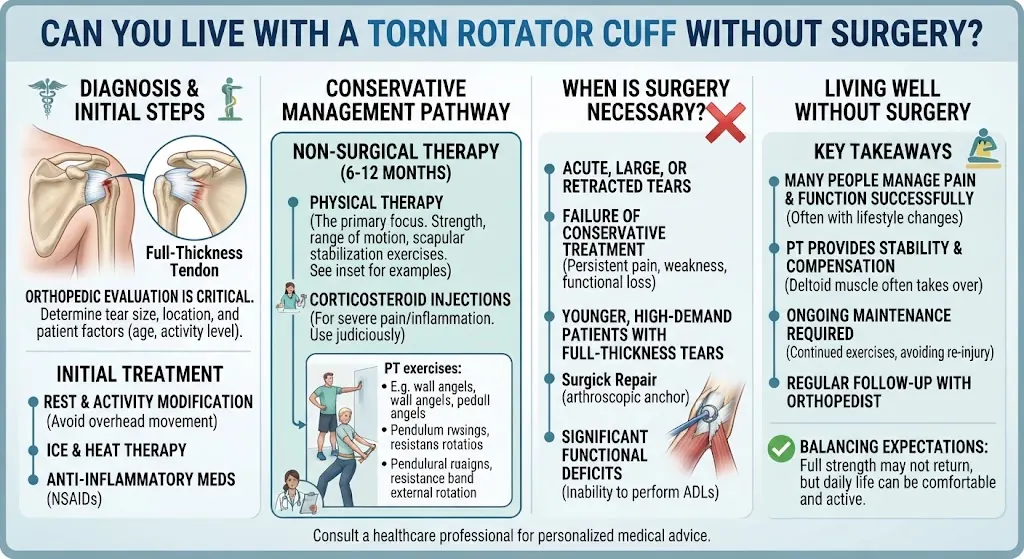
A torn rotator cuff does not automatically mean you need an operation. Some people improve with physical therapy, activity changes, and pain management, although improvement in symptoms does not necessarily mean the tendon has healed. The right approach depends on the tear’s size, cause, severity, and effect on your daily life.
This guide explains when you may be able to manage a torn rotator cuff without surgery, what conservative treatment can and cannot do, how recovery may progress, and which warning signs mean you should seek medical care.
Can You Live With a Torn Rotator Cuff Without Surgery?
Yes, many people can manage a torn rotator cuff without surgery. Nonsurgical treatment can reduce pain, improve strength in the surrounding muscles, and help restore useful shoulder movement. The goal is to make daily activities more comfortable while protecting the shoulder from further injury.
The outcome varies. A partial tear may respond well to rehabilitation, while a complete tear—particularly one caused by a sudden injury—may leave persistent weakness. For a broader overview of rotator cuff tear symptoms, treatment, and recovery, consider how pain and loss of function affect your own situation.
What determines whether surgery can be avoided?
| Factor | What it may mean |
|---|---|
| Partial tear | Often a reasonable candidate for initial nonsurgical treatment |
| Small full-thickness tear | Symptoms may improve, but the tendon may remain torn |
| Large or multiple-tendon tear | Greater risk of significant weakness and functional limitation |
| Gradual, age-related tear | Treatment often depends on pain, function, and activity goals |
| Sudden injury with major weakness | Prompt assessment is important because early treatment may matter |
| Physical demands | Overhead work and sports may be harder to resume without repair |
These are general patterns, not a way to determine your individual prognosis. A clinician can assess your strength, movement, injury history, and imaging when appropriate.
What Happens If You Do Not Have Surgery?
Without surgery, pain and function may improve even if the tendon remains damaged. The shoulder can sometimes compensate through rehabilitation and better coordination of the surrounding muscles.
However, some tears enlarge over time, and ongoing weakness can interfere with work, exercise, or personal care. Understanding what happens when a rotator cuff tear is left untreated can help you weigh the benefits of monitoring against the risks of delaying evaluation.
A nonsurgical plan may be less suitable if the shoulder remains very weak, symptoms keep worsening, or the tear followed a significant injury. Read about whether a rotator cuff tear can get worse without surgery for more detail on progression.
How Can You Manage a Torn Rotator Cuff Without Surgery?
Nonsurgical care usually combines symptom relief, gradual rehabilitation, and changes to activities that strain the shoulder. Treatment should match your symptoms and be adjusted if pain or weakness increases.
1. Modify activities without immobilizing the shoulder
Temporarily reduce heavy lifting, repetitive overhead work, and movements that trigger sharp pain. Avoid repeatedly testing the shoulder’s strength or pushing through worsening symptoms. Gentle, comfortable movement is usually preferable to keeping the arm completely still for long periods.
If you have pain when reaching upward, understanding why your shoulder hurts when you raise your arm may help you recognize movements to modify.
2. Use appropriate pain-relief strategies
A cold pack wrapped in a towel may help after an activity that aggravates pain; gentle heat may feel better when stiffness is the main problem. Do not apply either directly to your skin. Over-the-counter pain medicines may help some people, but they are not safe for everyone, particularly people with certain kidney, stomach, heart, or bleeding problems. Ask a healthcare professional or pharmacist what is appropriate for you.
These shoulder pain relief strategies you can try at home may help you stay more comfortable while you recover.
3. Consider physical therapy
A physical therapist can tailor exercises to preserve movement and strengthen muscles that support shoulder function. Exercises may begin with gentle range-of-motion work and progress to controlled strengthening as tolerated. Stop and seek advice if an exercise causes sharp pain, sudden weakness, or a lasting increase in symptoms.
Avoid copying a generic workout without knowing whether it suits your injury. This guide to exercises commonly used for shoulder pain relief and strength can help you understand the types of movement that may be included in a supervised plan.
4. Improve sleep and daily comfort
Shoulder pain can feel worse at night, particularly when you lie on the affected side. Try sleeping on your back or on the unaffected side while supporting the sore arm with a pillow. For more positioning ideas, see how to relieve rotator cuff pain at night.
Not every painful shoulder has a rotator cuff tear. Tendon inflammation and bursitis can cause overlapping symptoms, so it is useful to understand how shoulder tendonitis causes pain and recognize common shoulder bursitis symptoms.
What does nonsurgical recovery look like?
| Stage | Common focus | Important limitation |
|---|---|---|
| Early phase | Reduce aggravating activity and manage pain | Avoid prolonged complete immobilization unless advised |
| Rehabilitation | Restore comfortable movement and build strength gradually | Progress depends on symptoms and tear severity |
| Ongoing management | Maintain strength and adapt demanding activities | Persistent weakness may need reassessment |
There is no single recovery timeline. Some people notice improvement over several weeks, while others need months of consistent rehabilitation. A full-thickness tendon tear may remain structurally torn even when pain decreases.
How Is a Rotator Cuff Tear Diagnosed?
A clinician may assess your shoulder by asking how the pain started, checking your range of motion, and testing strength. X-rays can identify some bone changes but generally do not show the tendon itself; ultrasound or MRI may be used when the findings could affect treatment. Learn more about when an X-ray or MRI may help assess shoulder pain.
Shoulder weakness can have several causes, and pain alone cannot confirm a tear. If your arm feels unusually weak when lifting, review why your shoulder may feel weak when you raise your arm. Other conditions can mimic rotator cuff symptoms, including a labral injury; this comparison explains the difference between a shoulder labral tear and a rotator cuff tear.
When Should You Consider Surgery?
Surgery may be discussed if pain and weakness persist despite an appropriate course of nonsurgical treatment, if a tear is large, or if a sudden injury causes substantial loss of function. Your age, health, activity goals, tendon condition, and the likelihood of meaningful improvement all matter. See when a rotator cuff tear may need surgery for factors that can influence the decision.
| Treatment approach | Potential benefit | Main consideration |
|---|---|---|
| Activity changes and pain relief | Can reduce symptoms | Does not repair the tendon |
| Physical therapy | Can improve movement and function | Must be adapted to the tear |
| Surgical repair | May restore tendon attachment in suitable cases | Involves risks and a substantial rehabilitation period |
The broader decision may involve comparing nonsurgical and surgical shoulder pain treatments. If surgery is recommended, understanding what to prepare for before shoulder surgery can help you plan realistically. Recovery often takes months rather than days; read about the typical rotator cuff surgery recovery timeline, when you may be able to return to work, and when driving may be safe after surgery. Return to exercise also needs to follow the surgeon’s rehabilitation plan; see when you can exercise after rotator cuff surgery.
Warning Signs: When to Get Medical Help
-
Arrange a medical evaluation: Pain that persists, increasing weakness, difficulty dressing or reaching overhead, or symptoms that interfere with sleep.
-
Seek prompt assessment: Sudden shoulder pain and major weakness after a fall, lifting injury, or other trauma, especially if you cannot raise your arm.
-
Get urgent care: A visibly deformed shoulder, a cold or numb hand, or a red, hot shoulder with fever.
-
Call emergency services: Shoulder pain with chest pressure, shortness of breath, sweating, or faintness may signal a heart-related emergency. Do not assume this is a tendon problem; see when shoulder pain may be linked to heart problems.
Frequently Asked Questions
1. Can a torn rotator cuff heal on its own?
Some partial tears may improve symptomatically with time and rehabilitation. A full-thickness tear generally does not reattach to the bone without repair, even if the pain settles.
2. Can you live normally with a torn rotator cuff?
Many people maintain useful shoulder function without surgery, particularly when pain and weakness are mild. Heavy lifting, overhead work, and some sports may remain difficult.
3. How long can you wait before deciding on surgery?
There is no universal deadline. The appropriate timing depends on the injury, tear size, weakness, and response to treatment, so discuss persistent symptoms with a clinician rather than waiting indefinitely.
4. Will physical therapy make a rotator cuff tear worse?
A properly tailored program is generally intended to improve movement and function, not aggravate the injury. Exercises that cause sharp pain or worsening weakness should be stopped and reviewed with your therapist.
5. Should you keep using your arm with a torn rotator cuff?
Gentle movement and ordinary activities within your tolerance may be helpful. Avoid heavy loads and repeated movements that sharply increase pain until you have guidance about safe activity.
6. Is a torn rotator cuff worse at night?
It can be, particularly when pressure is placed on the affected shoulder. Supporting the arm with a pillow and avoiding the painful side may improve comfort.
7. Can a torn rotator cuff get bigger over time?
Yes, some tears enlarge, although progression is not inevitable. Worsening weakness, pain, or loss of movement warrants reassessment.
8. Do all rotator cuff tears show up on an X-ray?
No. X-rays can help identify bone-related causes of shoulder pain, but they do not directly show most tendon tears; other imaging may be needed.
9. What happens if pain improves but the tear remains?
Improved pain does not necessarily mean the tendon has healed. Continue appropriate exercises and monitoring, and seek review if weakness or activity limitations persist.
10. Can you exercise with a torn rotator cuff?
Often, yes, but the type and intensity should suit the injury. A clinician or physical therapist can help identify safe movements and when to progress.
Conclusion
You can often live with a torn rotator cuff without surgery, but the best approach depends on the tear and how it affects your strength and daily activities. Activity modification, suitable pain relief, and guided physical therapy may improve function, although they do not necessarily repair the tendon. Get assessed if symptoms persist or weakness increases, and seek prompt care after a sudden injury that makes it difficult to lift your arm.
Disclaimer: This article is provided for educational and informational purposes only
This article is for education purpose only and is not a diagnosis or a substitute for medical advice.