
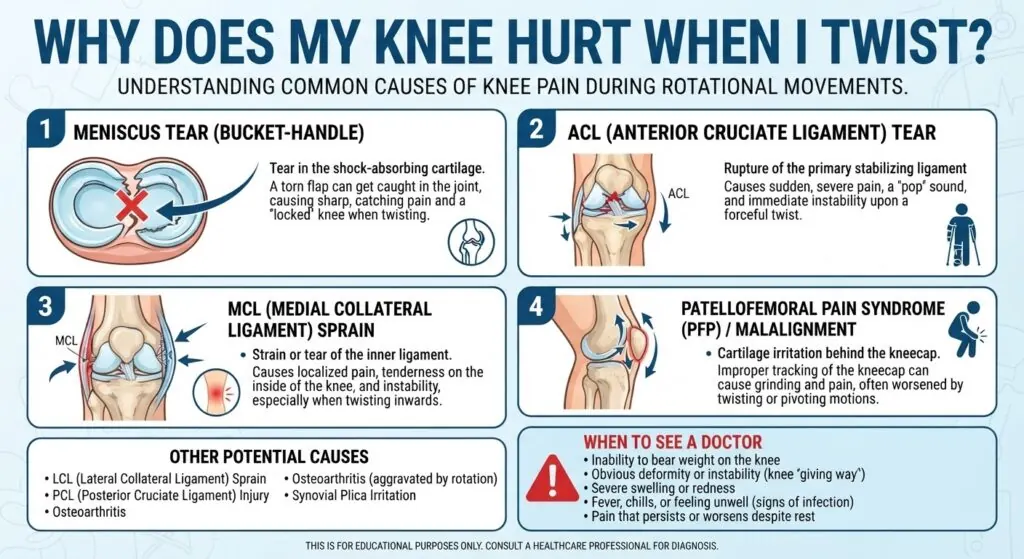
Twisting pain does not automatically mean you have a torn ligament or meniscus. The cause can range from temporary irritation to an injury that needs medical assessment. The location of the pain, how it started, and whether the knee swells, locks, or feels unstable can help guide the next step.
Understanding why your knee hurts when you twist can help you avoid movements that aggravate it, decide what to do at home, and recognize symptoms that should not be ignored. This guide explains common causes, safe initial care, recovery considerations, and when to seek medical help.
What causes knee pain when twisting?
Twisting places rotational stress on the knee. When your foot stays planted while your body turns, the meniscus, ligaments, kneecap, and surrounding tissues may experience extra force. Pain can develop after an injury or gradually from repeated loading.
| Possible cause | Typical clues | What to consider |
|---|---|---|
| Meniscus injury | Pain along the inner or outer joint line, catching, or swelling | May follow a planted-foot twist |
| Ligament injury | Pain with instability or a sudden pop | More concerning after a forceful pivot or sports injury |
| Kneecap-related pain | Pain around or behind the kneecap | May also hurt with stairs, squats, or prolonged sitting |
| Tendon or soft-tissue irritation | Localized tenderness | May follow repeated exercise or increased activity |
A meniscus tear is one possible explanation. The menisci are cartilage structures that help distribute load and cushion the knee. A tear may cause joint-line pain, swelling, catching, or difficulty bending fully, but symptoms alone cannot confirm the diagnosis.
A more forceful twist can injure a ligament, such as the anterior cruciate ligament (ACL). Learn about the differences between an ACL injury and a meniscus tear to understand why instability and the circumstances of an injury matter.
Not all twisting pain follows an obvious accident. Gradual irritation, arthritis, or pain around the kneecap may contribute. For broader possibilities, see common causes of knee pain and when to see a doctor.
What should you do if twisting hurts your knee?
If the pain started suddenly, stop the movement or activity that triggered it. Avoid repeatedly twisting the knee to test whether it still hurts. For a recent injury, rest from aggravating activity, apply a cold pack wrapped in a towel for 15–20 minutes at a time, and elevate the leg if swelling develops.
| Initial step | How to approach it | Why it may help |
|---|---|---|
| Relative rest | Temporarily avoid pivoting, running, and deep squats | Reduces aggravating load |
| Cold pack | Use a cloth barrier; do not apply ice directly to skin | May ease pain and swelling |
| Gentle movement | Bend and straighten only within a comfortable range | Helps limit stiffness |
| Gradual return | Increase activity only as symptoms allow | Helps avoid a flare-up |
Do not force movement through sharp pain, and do not use a brace to push through an injury. If you suspect a meniscus injury, guidance on walking with a torn meniscus and whether it can worsen the injury may help you think through activity limits.
When symptoms settle, gentle, low-impact activity may be more comfortable than running or sudden direction changes. These low-impact exercises for people with joint pain offer general options, but stop any movement that increases pain or swelling. A clinician or physical therapist can tailor exercises if pain persists.
When should you seek medical care?
The severity of symptoms and how the pain began matter more than twisting pain alone. A clinician may examine your knee’s movement, tenderness, stability, and swelling. Imaging is not always needed, but an X-ray or MRI may be considered depending on the suspected injury and examination findings.
Warning signs to watch for
| Symptom pattern | Recommended action |
|---|---|
| Mild pain that improves with rest and gentle movement | Monitor symptoms and avoid painful twisting |
| Persistent or worsening pain, recurring swelling, or reduced movement | Arrange a medical assessment |
| A hot, red, swollen knee with fever; major deformity; inability to bear weight; or a knee locked so it cannot move normally | Seek urgent medical care |
Significant swelling after an injury may need prompt assessment; review when a swollen knee may be dangerous. A knee that repeatedly catches or locks also deserves evaluation. Learn why a knee may lock when bending.
If pain followed a forceful twist, sudden pop, or rapid swelling, read about sharp knee pain after an injury and possible ACL or meniscus damage. A feeling that the knee is unstable or gives way can also signal a problem worth checking; see common causes of knee giving way.
Frequently asked questions
1. Does knee pain when twisting mean I have a meniscus tear?
No. A meniscus tear is one possibility, but ligament, tendon, kneecap, and arthritic problems can also cause pain. A clinical assessment helps distinguish them.
2. Can I have a meniscus tear without swelling?
Yes. Some meniscus injuries cause pain without obvious swelling. Read more about meniscus tears without swelling.
3. How can I tell arthritis from a meniscus tear?
Arthritis often causes stiffness and aching that develop gradually, while a meniscus tear may follow a twisting injury and cause catching or joint-line pain. However, symptoms overlap; compare meniscus tear versus knee arthritis.
4. Why does the inside of my knee hurt when I twist?
Pain on the inner side can come from the medial meniscus, ligaments, or other structures. Explore common causes of inner knee pain.
5. What if the pain is on the outside of my knee?
Outer knee pain can involve the lateral meniscus, ligaments, or nearby soft tissues. The causes of pain on the outside of the knee vary with the location and trigger.
6. Can a meniscus tear heal without surgery?
Some tears may improve with nonsurgical treatment, depending on their location, size, and symptoms. Find out when a meniscus tear may heal on its own.
7. How long does a twisted knee take to recover?
Recovery ranges from days for mild irritation to weeks or longer for more significant injuries. Persistent pain, swelling, or instability should be assessed rather than managed by time alone.
8. Should I exercise when twisting causes knee pain?
Avoid movements that reproduce sharp pain, especially pivoting and deep bending. Once symptoms improve, gradual strengthening may be appropriate; a physical therapist can guide progression.
9. Can knee pain happen without an injury?
Yes. Overuse, arthritis, and gradual tissue irritation can cause symptoms without a clear accident. See possible causes of knee pain without an injury.
10. What if my knee hurts when I bend or straighten it too?
Pain with bending or straightening can help a clinician understand which movements are affected, but it does not identify one cause on its own. See why knee pain occurs when bending and what can cause pain when straightening the knee.
Conclusion
Knee pain when twisting can result from several conditions, including meniscus or ligament injuries and irritation around the kneecap. Avoid painful pivoting, use gentle self-care for mild symptoms, and seek assessment for persistent pain, swelling, instability, or restricted movement. Urgent symptoms—especially inability to bear weight, a locked knee, or a hot swollen knee with fever—need prompt medical attention.
Disclaimer: This article is provided for educational and informational purposes only.
This article is for education purpose only and is not a diagnosis or a substitute for medical advice.