
Knee locking can occur with a meniscus tear, but not every episode of stiffness or catching means the meniscus is damaged. Some knees feel temporarily stuck because of pain or swelling, while a true mechanical blockage may indicate that tissue inside the joint is interfering with movement.
Understanding why a meniscus tear causes knee locking can help you recognize the difference between catching and a genuinely locked knee, understand which symptoms need medical attention, and learn what to do without potentially aggravating the injury.
How Can a Meniscus Tear Make Your Knee Lock?
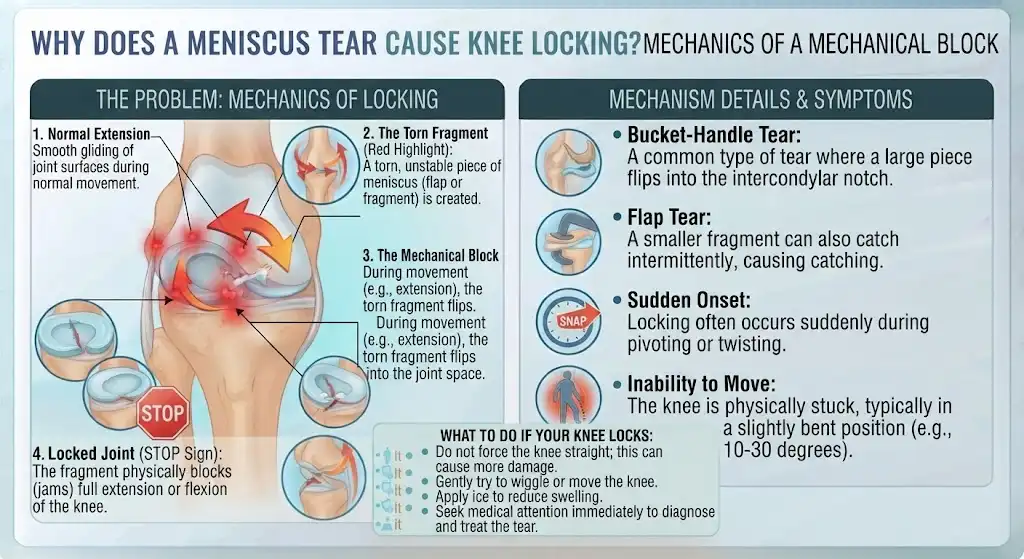
The meniscus is a C-shaped piece of tough cartilage in each knee that helps distribute weight, absorb impact, and support joint stability. A tear can cause locking when a loose or displaced portion of the cartilage moves into a position that physically obstructs normal knee movement.
A tear known as a bucket-handle meniscus tear is one example. In this injury, a long section of torn meniscus can flip toward the center of the joint and block the knee from fully straightening.
Other meniscus tears may cause clicking, catching, pain, or swelling without creating a true mechanical blockage. The location and shape of the tear matter, and symptoms alone cannot establish the type of injury.
For an overview of meniscus tear symptoms, treatment, and recovery, consider how pain, swelling, and movement limitations can occur together.
What Does Knee Locking From a Meniscus Tear Feel Like?
Meniscus-related locking can feel different from ordinary stiffness. You may experience:
-
A sudden sensation that the knee is caught or blocked.
-
Difficulty fully straightening the leg.
-
Catching or clicking during bending and straightening.
-
Pain along the inner or outer side of the knee.
-
Swelling that develops over several hours after an injury.
-
Discomfort when twisting, pivoting, squatting, or changing direction.
| Symptom | What it may suggest |
|---|---|
| Knee physically will not straighten | Possible mechanical blockage, including a displaced meniscus tear |
| Brief catching that releases with movement | May occur with a meniscus problem or other knee conditions |
| Stiffness after sitting that eases gradually | May reflect joint stiffness or swelling rather than true locking |
| Knee gives way unexpectedly | May involve pain-related muscle inhibition or ligament instability |
| Pain and swelling after twisting the knee | Possible meniscus injury, among other causes |
These patterns provide clues, not a diagnosis. For example, knee locking and catching when bending can have several causes, so a clinical examination may be needed.
Is a Locked Knee Always a Meniscus Tear?
No. A locked or stuck knee can also be associated with loose fragments of cartilage or bone, significant swelling, or other joint problems. Pain can sometimes make you reluctant to move the knee, which may feel like locking even when a physical obstruction is not present.
A twisting injury followed by catching or an inability to straighten the knee raises concern for a meniscus injury. Pain when twisting the knee can be a useful clue, but ACL injuries and meniscus tears can happen together. Other knee ligament injuries may also cause instability.
A meniscus tear can occur without obvious swelling or even with few symptoms, so the presence or absence of swelling alone cannot rule it in or out.
What Should You Do If Your Knee Locks?
If your knee becomes stuck, do not force it straight or repeatedly twist it to release the blockage. Stop the activity, keep the leg in a comfortable position, and arrange prompt medical assessment if you cannot fully straighten it.
For less severe symptoms, initial care may include avoiding pivoting, deep squats, kneeling, and movements that trigger catching. Ice wrapped in a towel may help ease discomfort and swelling. If you are unsure whether walking is safe, review whether walking on a torn meniscus can make it worse.
Treatment depends on the tear, symptoms, age, activity level, and overall knee health.
| Treatment option | When it may be considered |
|---|---|
| Activity modification and symptom management | Mild symptoms without persistent mechanical blockage |
| Physical therapy | When a clinician determines that guided rehabilitation is appropriate; physical therapy can help some meniscus tears |
| Surgery | May be considered for certain displaced tears, persistent mechanical symptoms, or injuries unlikely to improve with nonsurgical care |
Not every tear requires surgery. Some tears can improve without an operation, although healing depends on the tear’s location and blood supply. Learn whether a meniscus tear can heal on its own and how long meniscus recovery may take. A clinician can explain when meniscus surgery may be needed and whether exercise is appropriate with a meniscus tear.
When Is Knee Locking Urgent?
| Symptoms | Recommended action |
|---|---|
| Occasional mild catching that resolves, with normal movement | Monitor briefly and arrange an appointment if it recurs |
| Repeated locking, persistent pain, swelling, or reduced movement | Arrange prompt medical evaluation; worsening symptoms may indicate a more significant problem |
| Knee stuck and unable to straighten, inability to bear weight, major injury, or severe swelling | Seek urgent medical care |
| Hot, red knee with fever or feeling seriously unwell | Seek urgent assessment for possible infection |
A swollen knee that may be dangerous or fluid buildup inside the knee should be evaluated when swelling is severe, sudden, or accompanied by other warning signs. A clinician may examine your knee and order an MRI if needed to assess the meniscus and other structures. X-rays do not show the meniscus itself but may help identify bone problems.
Frequently Asked Questions
1. Can a meniscus tear cause the knee to lock completely?
Yes. A displaced tear, such as a bucket-handle tear, can physically block movement. A knee that remains stuck needs prompt medical assessment.
2. Does knee locking always mean surgery is needed?
No. Treatment depends on the tear and symptoms. Some injuries improve with nonsurgical care, while a persistent mechanical blockage may require a surgical opinion.
3. Can a meniscus tear cause locking without pain?
It is possible for a tear to cause catching or locking with little pain, but painless symptoms do not identify the cause. Repeated locking still deserves evaluation.
4. Can swelling make the knee feel locked?
Yes. Swelling can limit movement and make the knee feel stiff, although that is different from a physical blockage. Sudden or substantial swelling should be assessed.
5. Can a meniscus tear get worse?
Symptoms may worsen with repeated twisting or other aggravating activities, though not every tear progresses. Read about signs a meniscus tear may be getting worse.
6. Should I walk if my knee is locking?
Do not force walking through a locked knee or significant pain. Reduce weight-bearing and seek assessment if movement is blocked or walking is difficult.
7. What tests diagnose a meniscus tear?
A clinician usually considers the injury history and physical examination. MRI may be used when imaging is needed to assess soft tissues.
8. How is a meniscus tear different from an ACL tear?
Meniscus injuries often cause joint-line pain, catching, or locking; ACL injuries more commonly involve instability after a twisting injury. Symptoms overlap, and both can occur together.
9. Can exercises stop knee locking?
Exercises may improve strength and function in some knee conditions, but they cannot reliably remove a physical blockage. Get assessed before attempting exercises when the knee is truly locked.
10. When should I see a specialist?
Seek prompt care for repeated locking, persistent swelling, or difficulty straightening the knee. A knee that remains stuck or cannot bear weight needs urgent evaluation.
Conclusion
A meniscus tear can cause knee locking when displaced cartilage interferes with normal movement, but other knee conditions can produce similar symptoms. Avoid forcing a stuck knee, limit painful twisting, and seek prompt care if you cannot straighten it or bear weight. Early assessment helps determine the safest treatment and whether further imaging is needed.
Disclaimer: This article is provided for educational and informational purposes only.
This article is for education purpose only and is not a diagnosis or a substitute for medical advice.