
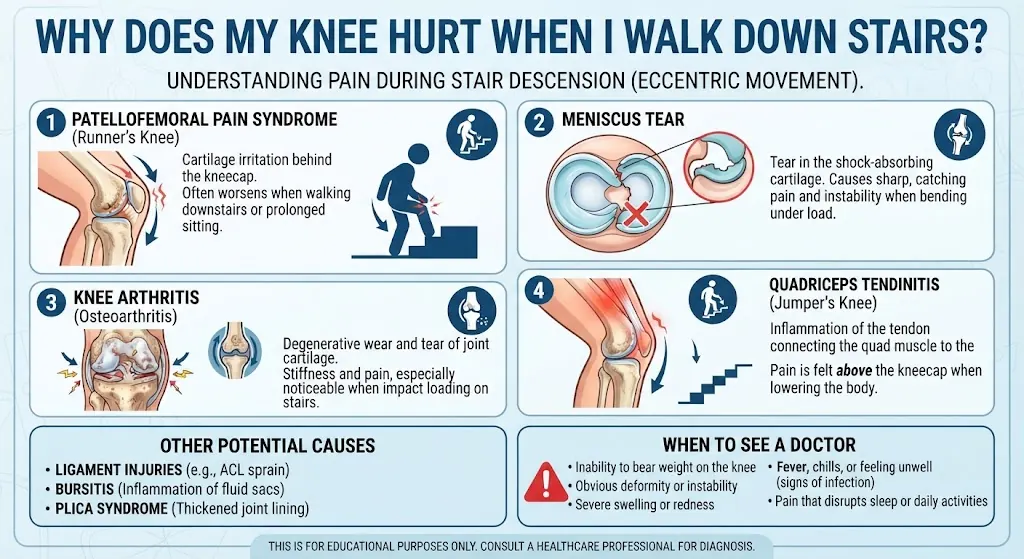
This pattern is common and does not automatically mean you have a serious knee injury. Pain around the kneecap can occur when the joint is under increased load, while arthritis, tendon irritation, and meniscus or ligament injuries can also contribute. New swelling, instability, or difficulty putting weight on the leg deserves closer attention.
Understanding why your knee hurts when you walk down stairs can help you choose safer activities and recognize when to seek care. The location of the pain, how it started, and whether your knee clicks, swells, or gives way are useful clues—but none can confirm a diagnosis on its own.
Why Does Walking Down Stairs Hurt Your Knee?
Walking downstairs requires the muscles around your knee to control your body as your weight moves onto the lower leg. The quadriceps work to slow the knee as it bends, increasing demand on the kneecap joint and surrounding tissues. If those structures are irritated or injured, descending stairs may hurt more than walking on level ground.
1. Patellofemoral pain
Patellofemoral pain occurs around or behind the kneecap. It may cause aching when walking downstairs, squatting, running, or standing up after sitting for a long time. A recent increase in exercise, repeated stair use, or changes in training may contribute.
Pain is often felt at the front of the knee rather than along one side of the joint. For more detail, see common causes of pain behind the kneecap.
2. Knee osteoarthritis
Osteoarthritis causes changes in the joint cartilage and surrounding tissues. It may lead to pain during weight-bearing activities, stiffness after rest, and reduced range of motion. Symptoms can be more noticeable on stairs because the knee must support and control body weight through a bent position.
Age, previous knee injuries, and other individual factors can affect risk. Learn about knee arthritis symptoms and treatment options.
3. Meniscus injury
The menisci are cartilage structures that help distribute load inside the knee. A tear may cause pain along the inner or outer joint line, swelling, catching, or difficulty fully bending or straightening the knee. Symptoms can follow a twisting injury, although age-related changes may also make the meniscus more vulnerable.
Stair pain alone does not establish that a tear is present. Read about meniscus tear symptoms, treatment, and recovery.
4. Tendon irritation or ligament injury
The patellar tendon below the kneecap and the quadriceps tendon above it help straighten the knee. Irritation may cause localized pain during repeated loading. Ligament injuries are more likely after a sudden twist, awkward landing, or direct impact and may involve swelling or a sense that the knee is unstable.
If the pain began suddenly after an injury, review how ACL injuries and meniscus tears differ.
How Can the Location of Your Knee Pain Help?
The pain location can help narrow down possible causes, especially when considered alongside swelling, stiffness, or the way the pain started.
| Where it hurts | Possible causes |
|---|---|
| Around or behind the kneecap | Patellofemoral pain or osteoarthritis |
| Along the inner or outer joint line | Meniscus or other joint problems |
| Just below the kneecap | Patellar tendon irritation |
| Behind the knee | Several causes, including a Baker’s cyst or other joint problems |
| Throughout a swollen knee | Injury, inflammation, or fluid buildup |
These patterns are not diagnostic. For a wider overview, see common knee pain causes and when to see a doctor. Pain behind the joint may also warrant a closer look at possible causes of sharp pain behind the knee.
What Can Help Relieve Knee Pain on Stairs?
If the pain is mild, you can walk safely, and there are no warning signs, temporarily reduce activities that make it worse.
-
Reduce stair use when possible. Use a handrail and take your time. Avoid repeatedly testing the painful movement.
-
Modify exercise. Pause deep squats, jumping, and running if they increase pain. Knee pain during squats may involve some of the same structures.
-
Try a cold pack. Apply it through a towel for 15–20 minutes if the knee is sore or swollen.
-
Keep movement comfortable. Gentle walking on level ground may be reasonable if it does not worsen symptoms. Low-impact exercises for joint pain offer general activity ideas.
-
Avoid forcing painful movement. Stop if your knee catches, locks, or feels as though it may give way.
If stiffness or discomfort also occurs after sitting, consider whether knee pain after sitting for a long time is part of the same pattern. Pain that begins without a clear injury may have several explanations; see common causes of knee pain without an injury.
When Should You Seek Medical Care?
| Level | Signs | Recommended action |
|---|---|---|
| Monitor briefly | Mild pain that improves with reduced activity and no significant swelling | Modify activities and monitor symptoms |
| Arrange an appointment | Pain that persists, returns frequently, limits stairs, or comes with recurring swelling | Seek clinical evaluation |
| Seek urgent care | Inability to bear weight, major swelling after injury, a locked knee, deformity, or a hot red knee with fever | Get prompt medical assessment |
A swollen knee may need evaluation, especially when swelling appears suddenly. Learn when knee swelling may be dangerous and when fluid buildup in the knee needs medical attention.
If your knee repeatedly locks or catches, read about why a knee may lock during movement. If it feels unstable, reasons a knee may feel like it is giving out may help you understand why an assessment matters.
How Is Knee Pain Diagnosed and Treated?
A clinician will usually ask when the pain began, where it occurs, and whether an injury, swelling, stiffness, or instability is present. They may examine your knee’s movement, tenderness, strength, and stability. Imaging is not always necessary; X-rays or an MRI may be considered when the history and examination suggest a specific problem.
Treatment depends on the cause. It may include activity adjustments, guided physical therapy, pain relief when appropriate, or additional treatment for an injury or arthritis. A meniscus tear does not always require surgery: whether a meniscus tear can heal on its own depends partly on the tear’s location and type. Physical therapy may also help improve strength and function in selected cases; see physical therapy for a meniscus tear.
Frequently Asked Questions
1. Why does my knee hurt going downstairs but not upstairs?
Descending stairs requires the quadriceps to control your body as the knee bends. This can increase demand on the kneecap joint and surrounding tissues, although other conditions may cause similar pain.
2. Is knee pain when walking downstairs a sign of arthritis?
It can be, particularly when pain occurs with stiffness or other weight-bearing activities. However, kneecap-related pain and tendon or meniscus problems can produce similar symptoms.
3. Should I stop using stairs if my knee hurts?
Reduce unnecessary stair use if it aggravates your symptoms, and use a handrail for support. Seek medical advice if pain persists, worsens, or makes walking unsafe.
4. Can weak thigh muscles cause knee pain on stairs?
Reduced muscle strength or control may contribute to discomfort around the kneecap. A clinician or physical therapist can help determine whether strengthening is appropriate for your symptoms.
5. Why does my knee hurt downstairs after running?
Running can increase the load on the knee and may aggravate an existing irritation or injury. Reduce running if it triggers pain and return gradually only as symptoms improve.
6. Can a meniscus tear cause pain when descending stairs?
Yes. A meniscus injury can cause pain with weight-bearing or bending, sometimes with swelling or catching. Stair pain alone cannot confirm a tear.
7. Should I use ice or heat for knee pain?
A cold pack may help with recent soreness or swelling. Gentle heat may feel soothing for stiffness, but avoid heat on a hot, red, or acutely swollen knee until it has been assessed.
8. When should I see a doctor for knee pain on stairs?
Arrange an appointment if pain keeps returning, limits daily activities, or does not improve with reasonable activity modification. Seek urgent care for major swelling, inability to bear weight, a locked knee, or a hot red knee with fever.
9. Can exercises make knee pain worse?
Yes, if they place too much load on irritated tissues or are progressed too quickly. Choose comfortable movements and stop exercises that cause sharp or increasing pain.
10. How long does knee pain on stairs take to improve?
Mild irritation may improve over days to a few weeks, while arthritis or structural injuries may take longer to manage. Recovery depends on the underlying cause, so persistent symptoms should be evaluated.
Conclusion
Knee pain when walking downstairs often relates to the extra control and load required as the knee bends, but several conditions can cause it. Temporarily modify painful activities, keep movement comfortable, and seek assessment for persistent pain or warning signs. Identifying the cause is the best way to choose appropriate treatment and return to stairs safely.
Disclaimer: This article is provided for educational and informational purposes only.
This article is for education purpose only and is not a diagnosis or a substitute for medical advice.