
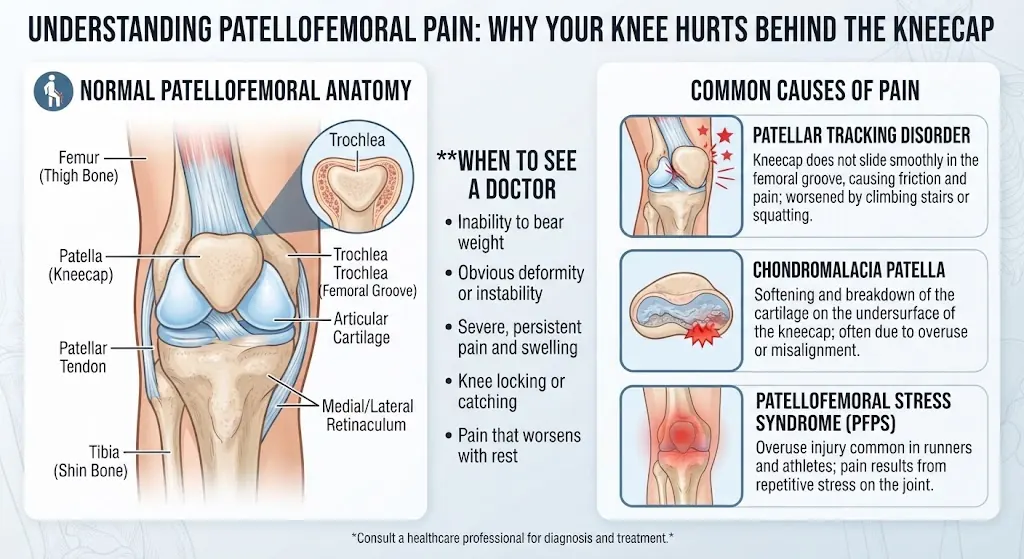
Pain behind the kneecap can make everyday activities such as climbing stairs, squatting, getting up from a chair, or sitting with your knees bent uncomfortable. You might notice a dull ache around the front of your knee, pressure beneath the kneecap, or a sharp pain when bending or straightening your leg. Sometimes, the discomfort develops gradually without a clear injury.
Knee pain behind the kneecap does not automatically mean you have arthritis or a torn structure. It can occur when the joint experiences more stress than it can comfortably tolerate, but cartilage changes, inflammation, tendon problems, and injuries can also contribute. The pattern of pain, associated symptoms, and how the problem started help determine whether it needs medical evaluation.
Understanding why your knee hurts behind the kneecap can help you choose appropriate next steps. This guide explains common causes, how to distinguish their symptoms, what you can safely try at home, how recovery may progress, and which warning signs should not be ignored.
## What Causes Pain Behind the Kneecap?
The kneecap, or patella, sits at the front of the knee and moves along a groove in the thighbone as you bend and straighten your leg. Pain around or behind it is often associated with patellofemoral pain, although several conditions can produce similar symptoms.
The most common possibilities include the following.
### 1. Patellofemoral pain syndrome
Patellofemoral pain syndrome (PFPS) is a frequent cause of pain around or behind the kneecap. It often develops when activities such as running, jumping, squatting, or climbing stairs place repeated stress on the joint.
Typical symptoms include:
– Aching behind or around the kneecap.
– Pain when walking upstairs or downstairs.
– Discomfort during squats or lunges.
– Increased pain after sitting with bent knees for a long time.
– Symptoms that worsen when training intensity increases.
Weakness in the hip or thigh muscles, changes in training volume, and reduced tolerance for repetitive loading may contribute. Pain does not necessarily mean the kneecap is permanently damaged.
### 2. Patellofemoral cartilage irritation or knee arthritis
The undersurface of the kneecap contains cartilage that helps the joint move smoothly. Irritation or cartilage degeneration can contribute to pain during repeated knee bending.
Osteoarthritis may be more likely with increasing age, previous knee injuries, or longstanding joint problems. Stiffness after rest, grinding sensations, and reduced movement can occur, but symptoms alone cannot confirm arthritis.
For a broader overview, see knee arthritis symptoms and treatment options.
### 3. Patellar tendinitis
Patellar tendinitis, also called patellar tendinopathy, affects the tendon connecting the kneecap to the shinbone. Pain usually occurs below the kneecap rather than deep behind it, especially during jumping, running, or forceful knee extension.
It commonly develops with repetitive loading, particularly in jumping sports. Learn more about patellar tendonitis symptoms and causes.
### 4. Meniscus or other knee injuries
A meniscus tear or ligament injury may cause knee pain after twisting, sudden direction changes, or a direct impact. These injuries are more likely when pain starts suddenly and is accompanied by swelling, catching, instability, or difficulty straightening the knee.
Pain location alone cannot reliably distinguish a meniscus injury from a kneecap-related problem. Review meniscus tear symptoms and treatment for additional context.
## How Can You Tell Which Knee Problem You Might Have?
The location and timing of pain can provide clues, but they cannot establish a diagnosis. Several knee conditions overlap in their symptoms.
| Possible cause | Common pain pattern | Typical aggravating activity |
| ——————— | ———————————————– | ———————————— |
| Patellofemoral pain | Aching behind or around the kneecap | Stairs, squats, prolonged sitting |
| Knee osteoarthritis | Aching, stiffness, sometimes grinding | Repeated movement or weight-bearing |
| Patellar tendinopathy | Localized pain below the kneecap | Jumping, running, forceful extension |
| Meniscus tear | Joint-line pain, sometimes catching or swelling | Twisting or pivoting |
| Knee ligament injury | Pain with possible instability or swelling | Sudden turns, impact, or sports |
These patterns are general clues, not diagnostic rules. For example, knee pain when bending and knee pain when straightening the leg can occur with several different conditions.
### Why does sitting make the pain worse?
Sitting with your knees bent for extended periods increases the time the kneecap remains in contact with the thighbone. If the joint is sensitive to this pressure, discomfort may develop during a movie, a long drive, or desk work.
This pattern is sometimes called the theater sign. Standing up, gently straightening the knee, and changing positions regularly may help. If the pain persists, knee pain after sitting for a long time offers further guidance.
### What do research findings suggest?
Clinical research on patellofemoral pain supports exercise-based rehabilitation, particularly strengthening the muscles around the hip and knee. However, the best program depends on the person’s symptoms, activity level, and physical capacity.
A useful principle is to adjust the amount of activity rather than assuming all movement is harmful. Pain that repeatedly increases during exercise or remains noticeably worse afterward suggests that the workload may need to be reduced.
## How Can You Relieve Pain Behind the Kneecap at Home?
For mild pain without significant injury or warning signs, start by reducing activities that reliably aggravate your knee while maintaining comfortable movement.
– Modify painful activities. Temporarily reduce deep squats, jumping, steep stairs, and running if they trigger symptoms.
– Apply ice when appropriate. Wrap an ice pack in a towel and apply it for 15–20 minutes to help manage pain after activity.
– Keep moving comfortably. Gentle walking or other tolerated movement can help prevent unnecessary stiffness.
– Build strength gradually. Hip and thigh strengthening may improve the knee’s ability to tolerate everyday loads.
– Review training changes. Avoid sudden increases in running distance, resistance, or workout frequency.
For practical options, explore low-impact exercises for joint pain and exercises for shoulder and neck posture only if you also have relevant upper-body symptoms; posture exercises are not a primary treatment for kneecap pain.
### Which activities should you modify?
| Activity | Suggested adjustment |
| ——————— | ————————————————- |
| Running or jumping | Reduce impact and training volume temporarily |
| Deep squats or lunges | Use a shallower, comfortable range |
| Stair climbing | Reduce unnecessary trips; use a handrail |
| Prolonged sitting | Change position and gently straighten the knee |
| Strength training | Use controlled movements and tolerable resistance |
Avoid pushing through sharp pain, substantial swelling, or a feeling that the knee is giving way. Guidance on exercises to avoid with a meniscus tear is relevant when a meniscus injury is suspected, but it should not replace an individualized assessment.
## When Should You See a Doctor?
Arrange a medical evaluation if the pain keeps returning, limits normal activities, worsens despite modifying activity, or does not begin improving after one to two weeks of appropriate self-care. Seek assessment sooner after a significant injury or if you cannot fully move the knee.
A clinician may ask how the pain started, examine your knee’s movement and stability, and assess nearby muscles and joints. Imaging is not always necessary for typical patellofemoral pain. X-rays may help assess bone and arthritis, while MRI may be considered when symptoms or examination findings suggest a meniscus, ligament, or other soft-tissue injury.
### Warning signs: When is knee pain urgent?
| Symptom | Recommended action |
| ———————————————————————- | ———————————— |
| Mild pain that improves with rest | Monitor symptoms and adjust activity |
| Persistent pain or recurring swelling | Arrange a medical evaluation |
| A hot, red, swollen knee with fever | Seek urgent medical care |
| Severe pain, major deformity, or inability to bear weight after injury | Seek urgent assessment |
| A locked knee that cannot straighten | Obtain prompt medical evaluation |
Sudden knee swelling with fever may indicate a joint infection and requires urgent assessment. Chest pain or shortness of breath accompanied by new leg swelling also requires emergency care.
## Frequently Asked Questions
### 1. Can pain behind the kneecap go away on its own?
Mild pain related to increased activity may improve with temporary activity modification and gradual rehabilitation. Persistent or worsening symptoms deserve evaluation.
### 2. Can walking make kneecap pain worse?
Yes. Long walks, hills, and stairs can aggravate symptoms when the knee is sensitive to repeated loading. Shorter, comfortable walks may be better tolerated.
### 3. Is pain behind the kneecap a sign of arthritis?
Not necessarily. Patellofemoral pain, tendon problems, and other conditions can produce similar symptoms. An examination helps determine the likely cause.
### 4. Why does my knee hurt when I go downstairs?
Descending stairs increases the demands on the muscles controlling the kneecap. Patellofemoral pain is one possible explanation, but other conditions can also cause discomfort.
### 5. Should I exercise with pain behind my kneecap?
Gentle, tolerable exercise may help, but movements that cause sharp pain or sustained symptom worsening should be modified. A physical therapist can recommend appropriate knee rehabilitation exercises only when the underlying condition makes that guidance applicable; knee-specific exercises are preferable for isolated knee pain.
### 6. How long does kneecap pain take to improve?
Mild symptoms may settle over several weeks, while persistent problems can take longer. Recovery depends on the cause, activity demands, and consistency of appropriate rehabilitation.
### 7. Can weak muscles cause pain behind the kneecap?
Reduced hip and thigh strength or endurance may contribute to poor tolerance of repeated knee loading. Strengthening can help, although weakness is not the only possible cause.
### 8. Do I need an MRI for pain behind the kneecap?
Usually not as the first step when symptoms suggest uncomplicated patellofemoral pain. MRI may be appropriate if a significant injury is suspected or symptoms remain unexplained.
### 9. Is knee popping with pain serious?
Painless popping is often harmless, but popping accompanied by swelling, locking, instability, or worsening pain warrants assessment. Sudden symptoms after a twisting injury deserve particular attention.
### 10. What should I avoid if my knee hurts behind the kneecap?
Temporarily limit deep knee bends, jumping, and other activities that consistently worsen pain. Avoid prolonged inactivity unless a clinician advises it, and increase activity gradually as symptoms improve.
## Conclusion
Pain behind the kneecap commonly relates to patellofemoral pain, but arthritis, tendon problems, and injuries are also possible. Modify aggravating activities, maintain comfortable movement, and return to strengthening gradually. Seek medical evaluation for persistent symptoms and urgent care for severe pain, fever with a swollen knee, or inability to bear weight after injury.
Disclaimer: This article is provided for educational and informational purposes only. It is not a substitute for professional medical advice, diagnosis, or treatment.
This article is for education purpose only and is not a diagnosis or a substitute for medical advice.