
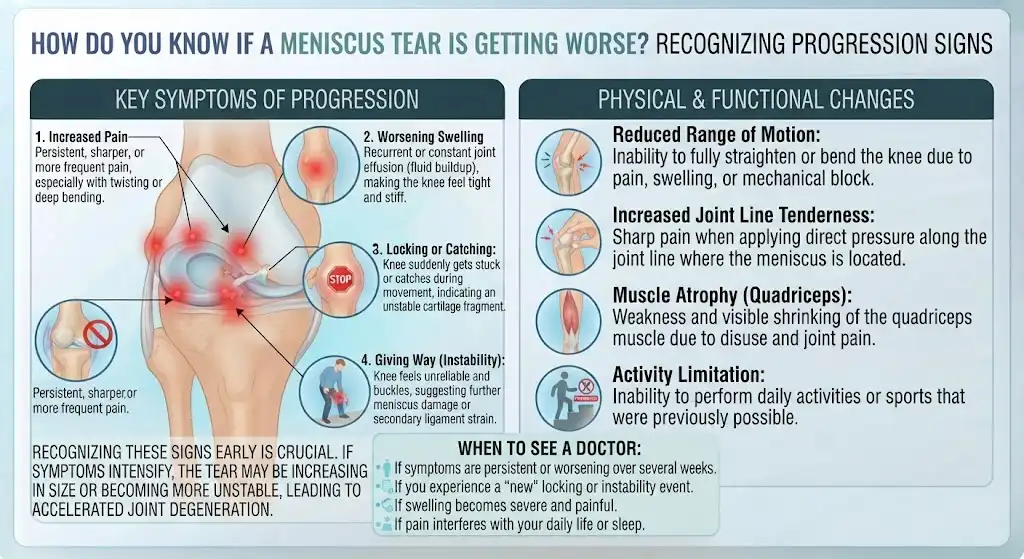
Signs that a meniscus tear may be worsening include increasing pain, recurrent swelling, new or worsening catching, reduced knee movement, and episodes of the knee giving way. However, symptoms can fluctuate during recovery, and a temporary increase in pain does not automatically mean the tear has enlarged. Other knee injuries and arthritis can cause similar symptoms.
Understanding how a meniscus tear changes over time can help you recognize warning signs, modify activities, and decide when to seek medical care. This guide explains which symptoms deserve attention, what may aggravate the injury, how clinicians assess progression, and when treatment needs to be reconsidered.
What Are the Signs That a Meniscus Tear Is Getting Worse?
A worsening meniscus tear may produce more frequent symptoms, greater limitations during everyday activities, or new mechanical problems. Look at the overall pattern rather than judging the injury by a single painful movement.
1. Knee pain is becoming more frequent or intense
Meniscus-related pain often occurs along the inner or outer joint line. It may worsen with twisting, pivoting, deep squatting, or bending the knee under load.
If pain begins occurring during ordinary walking, lasts longer after activity, or progressively interferes with daily tasks, arrange a medical assessment. These changes can indicate ongoing irritation or another knee problem, although pain intensity alone cannot establish whether the tear has enlarged.
2. Swelling keeps returning or becomes more pronounced
A torn meniscus can irritate the knee joint and trigger swelling. Swelling may develop over several hours after an injury or return following activities that load the knee.
Repeated swelling, especially when accompanied by increasing pain or reduced movement, deserves evaluation. A sudden, substantial increase in swelling after an injury may indicate additional damage.
3. Your knee catches, locks, or will not fully straighten
Catching can feel like a brief interruption during movement. True locking occurs when the knee becomes physically stuck and cannot fully straighten, potentially because a displaced piece of meniscus is obstructing movement.
New or worsening locking is particularly important. If your knee is stuck and you cannot straighten it, seek urgent medical assessment rather than forcing it through the blockage.
4. Your knee feels unstable or gives way
You may feel that your knee suddenly buckles while walking, turning, or stepping down. This can result from pain-related muscle inhibition, but it can also occur with ligament injuries or other structural problems.
Repeated giving-way episodes increase the risk of falling and further injury. If this develops after a knee injury, a clinician should evaluate the joint rather than assuming the meniscus is the only cause.
5. Walking, stairs, or squatting are becoming harder
A tear may become more noticeable when everyday movements repeatedly irritate the knee. You might struggle with knee pain when twisting, bending deeply, or getting up from a chair.
Difficulty with these activities does not prove the tear has progressed. However, worsening function is a reason to reassess your recovery plan.
How Can You Tell Whether Symptoms Are Worsening?
Tracking changes over several days can help you recognize patterns and explain them to a clinician.
| What to monitor | More reassuring pattern | Pattern that needs assessment |
|---|---|---|
| Pain | Gradually decreasing | Increasing or spreading into daily activities |
| Swelling | Settling between activities | Repeated or substantial swelling |
| Movement | Improving bending and straightening | New restriction or a locked knee |
| Walking | Improving comfort and stability | Limping or repeated giving way |
| Activity response | Symptoms settle with appropriate rest | Small activities repeatedly trigger significant symptoms |
These patterns are useful for monitoring, not for confirming whether the meniscus tear has physically enlarged. You can have a persistent tear with improving symptoms, or worsening symptoms without a larger tear.
For a broader explanation of how meniscus tear symptoms, treatment, and recovery fit together, consider how symptoms and function change together rather than relying on pain alone.
What Can Make a Meniscus Tear Worse?
Twisting on a planted foot, pivoting, deep squats, sudden changes of direction, and returning to sport before the knee is ready can aggravate symptoms. Repeatedly testing the knee with painful movements may also delay symptom improvement.
If walking hurts, reduce your distance and avoid uneven ground or movements that cause buckling. Guidance on whether walking on a torn meniscus can make it worse can help you understand why activity tolerance matters.
Avoid assuming that complete rest is always necessary. Depending on the injury, controlled movement and rehabilitation may help maintain strength and mobility. A physical therapist can determine whether exercising with a meniscus tear is appropriate for your symptoms and stage of recovery.
When Should You Seek Medical Care?
Seek urgent assessment if your knee becomes locked, you cannot bear weight, swelling develops rapidly after an injury, or pain is severe. A hot, red knee accompanied by fever also needs urgent evaluation because infection must be considered.
Arrange a routine medical appointment if pain keeps returning, swelling persists, your knee repeatedly gives way, or recovery stalls. Additional concerns include a swollen knee that may need medical attention and fluid building up inside the knee.
A clinician may assess tenderness, movement, swelling, and stability. MRI can help identify a meniscus tear when imaging is indicated, but findings must be interpreted alongside symptoms and examination. A tear seen on a scan does not automatically mean surgery is necessary.
Does a Worsening Meniscus Tear Always Need Surgery?
No. Treatment depends on the tear’s location and pattern, symptoms, age, activity demands, associated injuries, and response to nonsurgical care.
Many people begin with activity modification and physical therapy. Some tears may heal or become less symptomatic, while others remain symptomatic or require surgery. Learn about whether a meniscus tear can heal on its own, how long a torn meniscus may take to heal, and when meniscus surgery may be necessary.
A 2024 clinical practice guideline for acute meniscus injuries emphasizes appropriate examination and imaging, rehabilitation when suitable, and preserving as much functional meniscus tissue as possible when surgery is indicated. This supports individualized treatment rather than making decisions based on pain alone.
If symptoms persist despite rehabilitation, your clinician may reconsider the diagnosis or discuss other options, including physical therapy for a meniscus tear.
Frequently Asked Questions
1. Can a meniscus tear get worse without a new injury?
Yes, symptoms can worsen with repeated loading, and some tears may become more problematic during daily activities. However, worsening pain does not prove the tear has enlarged.
2. Can a meniscus tear worsen without swelling?
Yes. Pain, catching, stiffness, or restricted movement can occur without obvious swelling. The absence of swelling does not rule out a meniscus injury.
3. Can a meniscus tear cause knee locking?
Yes. A displaced tear can sometimes obstruct movement and prevent full straightening. A genuinely locked knee needs urgent assessment.
4. How do I distinguish a meniscus tear from knee arthritis?
A meniscus tear may cause joint-line pain, catching, and symptoms after twisting. Arthritis often causes activity-related pain and stiffness, but the conditions can overlap or occur together; examination helps distinguish them.
5. Could another injury be causing my worsening knee pain?
Yes. Ligament injuries and other knee conditions can produce similar symptoms. After an injury involving a pop, swelling, or instability, evaluation can help distinguish an ACL injury from a meniscus tear.
Conclusion
Increasing pain, recurrent swelling, locking, instability, and declining function can signal that a meniscus tear needs reassessment. Reduce painful activities, avoid forcing a locked knee, and seek timely care when symptoms worsen. If recovery has stalled, a clinician can review your diagnosis and help determine the safest next step.
Disclaimer: This article is provided for educational and informational purposes only.
This article is for education purpose only and is not a diagnosis or a substitute for medical advice.