
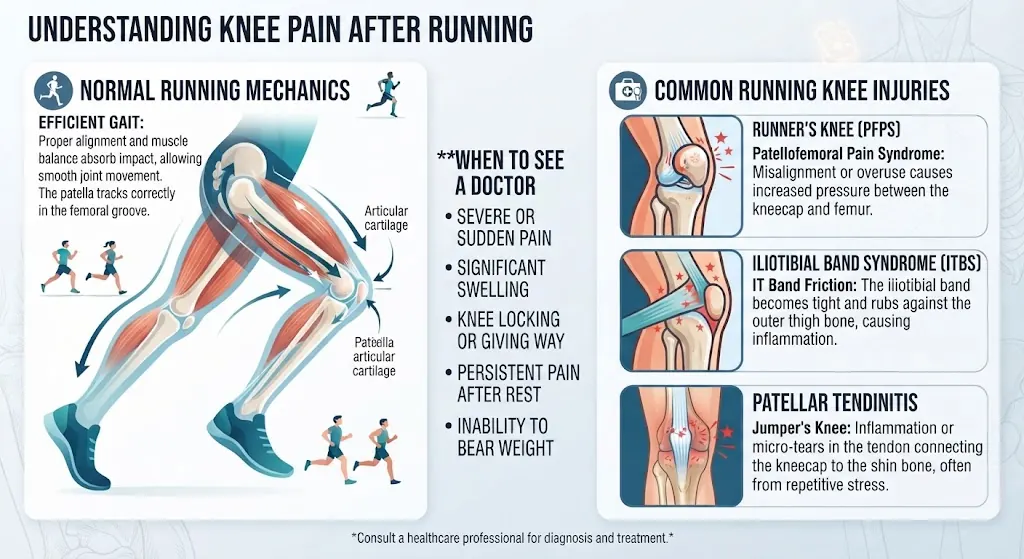
Knee pain after running does not automatically mean you have damaged a ligament or torn cartilage. Training changes, running technique, muscle weakness, and irritation of tissues around the knee can all contribute. However, persistent pain, significant swelling, or difficulty bearing weight should not be dismissed as ordinary post-workout soreness.
Understanding why your knee hurts after running can help you decide whether to modify your training, try conservative care, or seek a medical evaluation. This guide explains common causes, how symptoms differ, what you can safely do at home, how recovery may progress, and which warning signs need prompt attention.
What Causes Knee Pain After Running?
The cause often depends on where the pain occurs, when it starts, and whether swelling, stiffness, or instability accompanies it. Several conditions can produce similar symptoms, so pain location alone cannot establish a diagnosis.
1. Runner’s knee (patellofemoral pain)
Runner’s knee often causes pain around or behind the kneecap. It may worsen during longer runs, squats, stair climbing, or after sitting with your knee bent for a long time. Training increases, reduced hip or thigh strength, and changes in running mechanics may contribute.
2. Iliotibial (IT) band syndrome
Pain from IT band syndrome typically occurs along the outside of the knee. It may develop after a particular distance and become more noticeable during downhill running or repeated knee bending.
3. Patellar tendinopathy
This condition affects the tendon connecting the kneecap to the shinbone. Pain is commonly felt just below the kneecap and may increase with running, jumping, or other activities that load the tendon.
4. Meniscus or ligament injury
A meniscus injury can cause pain along the inner or outer joint line, sometimes accompanied by swelling, catching, or locking. Ligament injuries are more likely when pain follows a sudden twist, awkward landing, or collision, particularly if the knee feels unstable.
For a closer comparison, see how to tell a meniscus tear from knee arthritis and the differences between ACL and meniscus injuries.
5. Other possible causes
Osteoarthritis may cause activity-related pain and stiffness, particularly in people with previous knee injuries or age-related joint changes. Less commonly, a bone stress injury can cause localized pain that progressively worsens with weight-bearing. Pain that continues even after you stop running deserves attention rather than repeated attempts to run through it.
Where does your knee hurt after running?
The location provides useful clues, but it cannot confirm the underlying cause.
| Pain location | Possible explanation | Other clues |
|---|---|---|
| Around or behind the kneecap | Runner’s knee | Pain with stairs, squats, or prolonged sitting |
| Outside of the knee | IT band syndrome | Pain that develops during repetitive running |
| Just below the kneecap | Patellar tendinopathy | Tenderness with jumping or forceful push-off |
| Inner or outer joint line | Meniscus irritation or injury | Catching, swelling, or pain with twisting |
| Deep, localized bone pain | Possible stress injury | Pain that progressively worsens with impact |
If you have knee pain when twisting, pain behind the kneecap, or knee pain without swelling, these symptom patterns may help you describe the problem during an evaluation.
Why does running trigger knee pain?
Running places repeated loads on the knee. Pain can develop when your training load increases faster than your body can adapt, especially after adding hills, speed sessions, longer distances, or extra running days.
Other contributing factors include inadequate recovery, reduced hip and thigh strength, changes in footwear, and returning to exercise after a break. Running itself does not automatically damage healthy knees, and knee pain does not necessarily mean cartilage is wearing away.
Consider whether your symptoms began after a training change. If you also experience knee pain after sitting for a long time or knee pain when climbing stairs, mention these patterns to your clinician.
What should you do when your knee hurts after running?
For mild pain without significant swelling or injury, start by reducing activities that reproduce the discomfort.
-
Pause painful runs. Avoid speed work, hills, and long distances until symptoms settle.
-
Apply ice if helpful. Wrap an ice pack in a towel and apply it for up to 15–20 minutes at a time.
-
Keep moving comfortably. Gentle walking or easy cycling may be reasonable if it does not increase pain or swelling.
-
Resume strengthening gradually. Exercises for the quadriceps, hips, and gluteal muscles can support rehabilitation when appropriate.
-
Review your training. Check recent mileage increases, recovery days, terrain, and shoe changes.
You may benefit from low-impact exercises for painful joints or exercises for knee pain when bending, but choose movements that match your symptoms. A clinician or physical therapist can help select safe exercises.
Avoid aggressive stretching, deep squats, or exercises that provoke sharp pain. Over-the-counter pain medicines may help some people, but they have risks and may be unsuitable with certain medical conditions or medications. Ask a clinician or pharmacist if you are unsure.
How long does knee pain after running take to improve?
Recovery depends on the cause, severity, and whether you continue to stress the painful area. Mild overuse symptoms may settle within days, while persistent tendon problems or more substantial injuries can take weeks or longer.
| Symptom pattern | Sensible next step |
|---|---|
| Mild soreness that steadily improves | Reduce training and monitor symptoms |
| Pain that returns with each run | Pause running and reassess your training |
| Pain lasting several days without improvement | Consider a medical or physical therapy evaluation |
| Worsening pain, swelling, or instability | Seek prompt medical assessment |
These are practical guidelines, not guaranteed recovery timelines. A suspected meniscus tear that is getting worse or symptoms consistent with knee arthritis may require a different treatment plan.
When should you seek medical care?
Usually reasonable to monitor: Mild discomfort that improves with rest, without swelling, instability, or difficulty walking.
Arrange a medical evaluation: Pain that keeps returning, persists despite activity modification, interferes with everyday activities, or is accompanied by recurrent swelling. A clinician may assess your movement and strength and decide whether imaging is needed. Common causes of knee pain include problems that cannot be distinguished reliably by symptoms alone.
Seek urgent care: Severe pain, substantial or rapid swelling, a knee that locks or gives way, or inability to bear weight warrants prompt assessment. A hot, red knee accompanied by fever or feeling unwell needs urgent evaluation because infection is one possible cause. A suspected knee ligament injury following trauma should also be assessed.
How can you prevent knee pain from returning?
Build your running distance and intensity gradually instead of increasing both at once. Warm up with several minutes of brisk walking or easy jogging, allow recovery days, and maintain strength in the hips, thighs, and calves.
Replace worn footwear when needed, but do not assume that an expensive shoe or a particular running style will solve every knee problem. If pain repeatedly returns, a physical therapist can assess strength, mobility, running mechanics, and your training schedule. Persistent symptoms may need a more specific diagnosis before you resume full training.
Frequently Asked Questions
1. Is it normal for my knees to hurt after running?
Mild, temporary soreness can occur after unfamiliar or demanding exercise. Recurrent, sharp, worsening, or swollen-knee pain should not be treated as normal training soreness.
2. Should I keep running if my knee hurts?
Stop running if pain is sharp, increases during the run, changes your stride, or causes swelling. Return gradually once everyday movement is comfortable and symptoms are improving.
3. Why does my knee hurt after running but not while running?
Some symptoms emerge after exercise as the knee responds to repeated loading. However, delayed pain alone cannot identify the cause, so consider the pattern and whether it persists.
4. Why does my knee hurt when I bend it after running?
Bending loads several structures, including the kneecap, tendons, and meniscus. Pain with bending may have multiple causes and needs evaluation if persistent or accompanied by locking or swelling.
5. Can running cause a meniscus tear?
A sudden twist while running can injure the meniscus, although many running-related knee problems are caused by repetitive loading rather than a tear. Swelling, catching, or locking increases the need for assessment.
6. Can I walk with knee pain after running?
Gentle walking may be appropriate if you can bear weight comfortably and your symptoms do not worsen. Avoid walking through severe pain or significant swelling.
7. Do knee braces help running-related pain?
A brace may help certain conditions, but its usefulness depends on the cause of the pain. It should not be used to push through symptoms that require assessment.
8. Should I use ice or heat after running?
Ice wrapped in a towel may help with short-term pain and swelling. Heat may ease some stiffness, but avoid heating an acutely swollen or hot knee without medical guidance.
9. When can I start running again?
Resume with short, easy sessions when walking and ordinary daily activities are comfortable and swelling is absent or resolved. Increase training gradually and stop if pain returns or worsens.
10. Can knee pain after running mean arthritis?
It can be associated with osteoarthritis, but pain after running alone does not establish arthritis. Recurrent stiffness, activity-related pain, and a medical assessment can help clarify the cause.
If your symptoms include swelling, review when a swollen knee may be dangerous and whether fluid buildup in the knee needs medical attention. After a sudden injury, understanding sharp knee pain and possible ACL or meniscus damage may help you recognize why an examination matters. For more detail, see runner’s knee symptoms and causes, patellar tendinitis symptoms and treatment, why your knee may feel like it is giving out, and this guide to meniscus tear symptoms, treatment, and recovery.
Conclusion
Knee pain after running can result from training overload, irritation around the kneecap, tendon problems, or an injury involving the joint. Reduce painful activities, use gentle movement when comfortable, and return to running gradually rather than pushing through symptoms. If pain persists, repeatedly returns, or comes with swelling or instability, arrange an assessment to identify the cause and choose an appropriate recovery plan.
Disclaimer: This article is provided for educational and informational purposes only.
This article is for education purpose only and is not a diagnosis or a substitute for medical advice.