
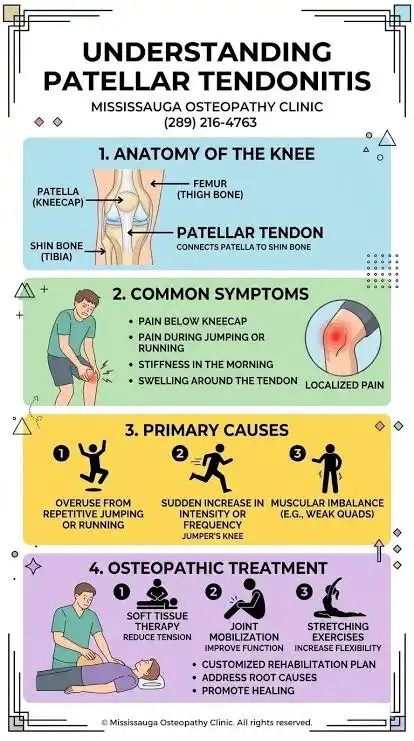
Although patellar tendonitis is common in activities involving repeated jumping, knee pain in this area does not always come from the tendon. Other conditions can cause similar symptoms, so persistent pain, significant swelling, or difficulty bearing weight deserves medical attention.
Understanding patellar tendonitis symptoms, causes, and treatment options can help you recognize common patterns, adjust activities safely, and understand when rehabilitation or a clinical evaluation may be needed.
What Is Patellar Tendonitis?
Patellar tendonitis, often called jumper’s knee, is a condition involving irritation and changes in the patellar tendon. This strong band of tissue connects the kneecap (patella) to the shinbone and helps transfer force from the thigh muscles to straighten the knee.
The condition is frequently associated with repeated loading during jumping, running, and rapid changes of direction. Long-lasting tendon pain may involve changes in the tendon’s structure rather than inflammation alone, which is why the term patellar tendinopathy is also used.
What Are the Symptoms of Patellar Tendonitis?
The most recognizable symptom is localized pain at the front of the knee, usually just below the kneecap. Symptoms may worsen when the tendon is loaded and improve when activity is reduced.
Common signs include:
- Tenderness when pressing the tendon below the kneecap.
- Pain during jumping, landing, running, or squatting.
- Discomfort when climbing stairs or rising from a chair.
- Stiffness after rest or at the beginning of exercise.
- Reduced tolerance for training or repeated knee bending.
Symptoms may initially appear only after exercise. As the condition persists, pain can occur during activity or routine tasks. However, severe swelling, a sudden popping sensation, or an inability to straighten the knee may suggest a more serious injury rather than typical tendonitis.
What Causes Patellar Tendonitis?
Patellar tendonitis usually develops when the tendon repeatedly handles more load than it can comfortably tolerate and recover from. It can occur in athletes and in people who increase physical activity after a period of relative inactivity.
Contributing factors can include:
- A sudden increase in jumping, sprinting, or running volume.
- Frequent deep squats or high-intensity lower-body workouts.
- Inadequate recovery between demanding sessions.
- Reduced leg strength or control during landing and knee bending.
- Training changes that exceed current conditioning.
Training errors are not the only explanation. Individual conditioning, previous knee problems, and the overall demands placed on the tendon may also influence symptoms. Pain around the kneecap can have other causes, including runner’s knee symptoms and treatment or other common causes of knee pain.
How Is Patellar Tendonitis Diagnosed?
A clinician will usually ask where the pain occurs, when it started, which activities aggravate it, and whether there was a sudden injury. An examination can assess tenderness, knee movement, strength, and the ability to load the tendon.
| Assessment | What it helps determine |
|---|---|
| Medical history and physical examination | Whether symptoms fit a tendon-related condition |
| Ultrasound | Tendon structure and possible thickening or other changes |
| MRI | Tendon and surrounding structures when further detail is needed |
| X-ray | Bone-related causes of pain, rather than tendon changes themselves |
Imaging is not always necessary. Tendon changes on a scan do not automatically prove that the tendon is causing the pain; findings must be considered alongside symptoms and examination.
What Is the Best Treatment for Patellar Tendonitis?
Treatment usually focuses on adjusting painful activities and progressively rebuilding the tendon’s ability to tolerate load. Complete rest for long periods may reduce conditioning, while continuing intense jumping or running through worsening pain can prolong symptoms.
1. Modify activity and manage pain
Temporarily reduce activities that sharply increase pain, such as repeated jumps, sprints, and deep loaded squats. Ice wrapped in a cloth may provide short-term comfort after activity, but it does not repair the tendon.
Pain medicines may help some people, but they have potential side effects and may not address the underlying tendon problem. Ask a clinician or pharmacist whether a medication is appropriate for you, particularly if you have other medical conditions or take other medicines.
2. Use progressive strengthening
Physical therapy commonly includes gradually progressed quadriceps and lower-body strengthening. Depending on symptoms and assessment, a program may begin with controlled isometric exercises and progress to slow resistance exercises before introducing running, jumping, and sport-specific drills.
Exercises should be adjusted if pain becomes sharp, worsens substantially, or remains elevated afterward. A physical therapist can help select suitable loads and monitor progression. Low-impact exercises for people with joint pain may help maintain general activity while high-impact training is reduced.
3. Return to sport gradually
Do not return to full-intensity jumping or competition simply because pain has improved at rest. Progression should consider pain during loading, strength, function, and how the knee responds afterward. Other conditions, including knee ligament injuries, may require a different rehabilitation plan.
Surgery is uncommon for typical patellar tendinopathy and is generally considered only when substantial symptoms persist despite an appropriate period of nonsurgical treatment and specialist assessment.
How Long Does Patellar Tendonitis Take to Heal?
Recovery varies with symptom duration, tendon capacity, training demands, and consistency with rehabilitation. Mild symptoms may improve over several weeks, while persistent tendinopathy can take months of progressive loading to improve.
Avoid using pain relief alone as a sign that the tendon is ready for intense activity. Increase training gradually and reduce the load if symptoms repeatedly flare. For broader context, see how long tendonitis can last.
When Should You Seek Medical Care?
Arrange a clinical assessment if knee pain persists, repeatedly returns, limits daily activities, or does not improve after adjusting exercise.
Seek urgent medical care after a sudden injury if you cannot bear weight, cannot straighten the knee, notice major swelling or deformity, or feel a sudden pop followed by marked weakness. A hot, red knee with fever also needs prompt evaluation because infection and other serious conditions must be considered.
Frequently Asked Questions
1. Is patellar tendonitis the same as jumper’s knee?
Yes. Jumper’s knee is the common name for patellar tendinopathy, which often develops with repetitive jumping and landing.
2. Can I keep exercising with patellar tendonitis?
You may be able to continue modified activities that do not significantly aggravate symptoms. Reduce painful jumping and running, and seek guidance on a progressive strengthening plan.
3. Does patellar tendonitis cause swelling?
Some people have mild localized swelling or tenderness, but prominent swelling is not always present. Sudden or substantial swelling should be assessed.
4. Can patellar tendonitis heal on its own?
Mild symptoms may improve when aggravating loads are reduced. Persistent symptoms often benefit from structured rehabilitation rather than rest alone.
5. Are squats bad for patellar tendonitis?
Not necessarily. Squats can be part of rehabilitation, but depth, resistance, and repetitions should match your current tolerance and progress gradually.
6. Should I use a knee strap?
A patellar strap may provide short-term symptom relief for some people, but it does not replace strengthening or activity modification. Stop using it if it causes discomfort or skin irritation.
7. Can walking make patellar tendonitis worse?
Ordinary walking may be tolerated, but hills, stairs, or long distances can aggravate symptoms in some people. Adjust activity according to your response and avoid pushing through worsening pain.
8. Does patellar tendonitis show up on an X-ray?
X-rays mainly show bones and may help rule out certain bone-related problems. Ultrasound or MRI may be considered when tendon imaging is needed.
9. When can I return to jumping sports?
Return when loading tolerance, strength, and function have improved sufficiently and a gradual sport-specific progression is tolerated. A clinician or physical therapist can help determine readiness.
10. When might knee pain be something more serious?
Sudden severe pain, inability to straighten the knee, major swelling, deformity, or inability to bear weight warrants urgent assessment. Fever with a hot, red knee also requires prompt medical care.
Conclusion
Patellar tendonitis often develops when repeated knee loading exceeds the tendon’s capacity to recover. Modifying aggravating activity, following progressive strengthening, and returning to sport gradually can support recovery. If symptoms persist or warning signs appear, seek professional evaluation rather than assuming all pain below the kneecap is tendonitis.
Disclaimer: This article is provided for educational and informational purposes only.
This article is for education purpose only and is not a diagnosis or a substitute for medical advice.