
Knee ligament injuries can cause sudden pain, swelling, instability, or difficulty walking. They may happen when you twist your knee during sports, land awkwardly after a jump, or change direction quickly. Sometimes, the injury is obvious; other times, symptoms develop gradually over several hours.
A knee ligament injury does not always mean a complete tear or surgery. The severity depends on which ligament is affected, how much it is damaged, and whether other structures in the knee are injured. However, a knee that repeatedly gives way or becomes severely swollen should not be ignored.
Understanding knee ligament injuries, their symptoms, and recovery can help you recognize warning signs, understand how clinicians evaluate the injury, and make safer decisions about activity, treatment, and returning to exercise.
What Are Knee Ligament Injuries?
Knee ligaments are strong bands of connective tissue that connect bones and help stabilize the joint. They control excessive movement and help keep the knee aligned when you walk, run, jump, or turn.
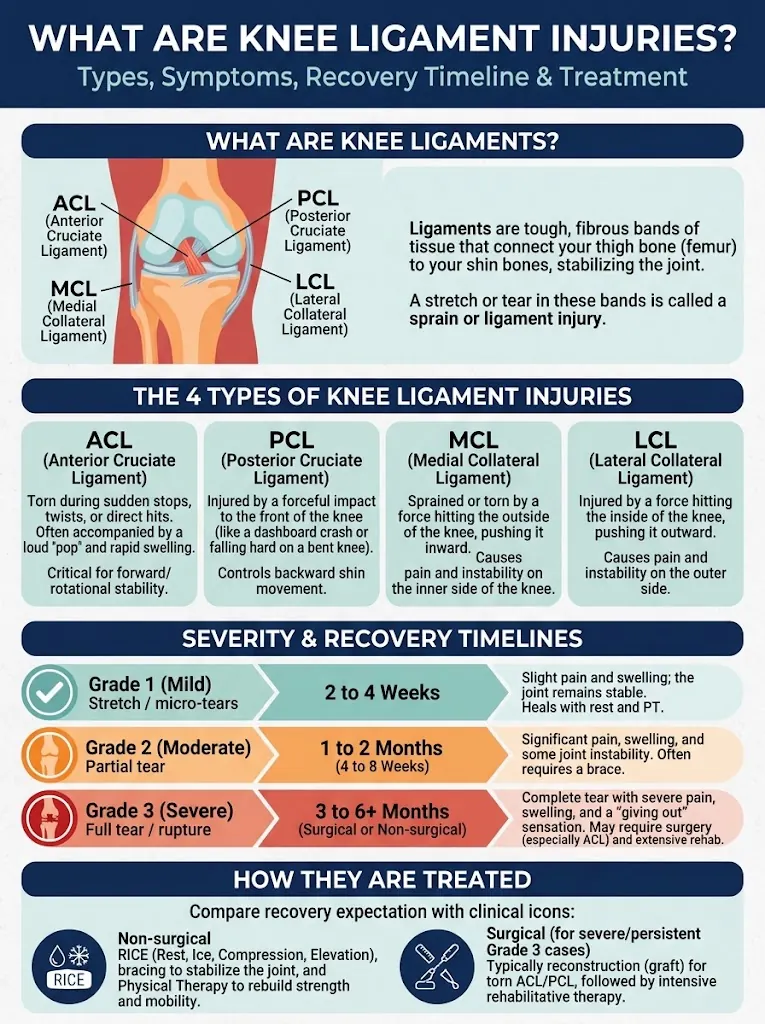
The four main knee ligaments are the anterior cruciate ligament (ACL), posterior cruciate ligament (PCL), medial collateral ligament (MCL), and lateral collateral ligament (LCL). Each helps control different types of movement, so the location and mechanism of an injury can offer clues about which ligament may be involved.
What Are the Main Types of Knee Ligament Injuries?
| Ligament | Main function | Common injury mechanism |
|---|---|---|
| ACL | Limits forward movement and rotation of the shinbone | Sudden pivot, awkward landing, abrupt stop |
| PCL | Limits backward movement of the shinbone | Direct impact to the front of a bent knee |
| MCL | Supports the inner side of the knee | Force pushing the knee inward |
| LCL | Supports the outer side of the knee | Force pushing the knee outward |
A ligament injury may be a sprain, partial tear, or complete tear. A sprain means the ligament has been stretched or damaged; it does not automatically mean the ligament is completely torn.
What Are the Symptoms of a Knee Ligament Injury?
Symptoms vary according to the ligament and severity. Common signs include:
- Pain around the injured side or center of the knee.
- Swelling that develops soon after an injury or over several hours.
- A popping sensation at the time of injury, particularly with some ACL tears.
- Difficulty bending or straightening the knee.
- A feeling that the knee is unstable, slipping, or giving way.
- Trouble bearing weight or returning to sports.
A pop alone cannot confirm a torn ligament. Meniscus injuries, kneecap problems, and other conditions can cause overlapping symptoms. Compare the patterns in ACL injury vs. meniscus tear symptoms and learn about sharp knee pain after an injury.
How Are Knee Ligament Injuries Diagnosed?
A clinician usually asks how the injury happened, where the pain is located, whether swelling developed, and whether the knee feels unstable. The physical examination may include checking tenderness, range of motion, and ligament stability.
| Test | What it helps assess | Important limitation |
|---|---|---|
| Physical examination | Stability, tenderness, movement, and swelling | Pain and swelling may limit accuracy |
| X-ray | Fractures or bone-related problems | Ligaments generally do not show clearly |
| MRI | Ligaments and other soft tissues, including menisci | Findings must be interpreted alongside symptoms and examination |
Not everyone needs an MRI. Imaging decisions depend on the examination, suspected injury, and whether a fracture or associated damage needs to be ruled out. A clinician may also consider whether knee pain has another cause.
What Is the Treatment for a Knee Ligament Injury?
Treatment depends on the ligament, tear severity, knee stability, associated injuries, and activity goals. Initial care often involves protecting the knee, reducing painful activity, and using ice wrapped in a cloth for short periods. Compression and elevation may help manage swelling if comfortable and appropriate.
A brace or crutches may be recommended temporarily. Avoid forcing the knee through painful movements, pivoting, running, or returning to sport before stability and function have recovered.
Physical therapy often helps restore movement, strength, balance, and coordination. Clinicians may recommend low-impact exercises for painful joints as recovery progresses. The appropriate exercises depend on the injury, so avoid starting a demanding routine without guidance.
| Injury severity | Typical management | General recovery considerations |
|---|---|---|
| Mild sprain | Activity modification and rehabilitation | Often improves over several weeks |
| Partial tear | Rehabilitation, sometimes bracing | May take several weeks to months |
| Complete tear | Structured rehabilitation; surgery for selected injuries | Recovery may take months, especially after reconstruction |
These are broad patterns, not guaranteed timelines. An isolated MCL injury may recover without surgery, while some ACL tears—especially in people returning to pivoting sports—may require reconstruction. Surgery decisions depend on instability, associated damage, and individual goals. Recovery after an operation includes a structured rehabilitation program; for ACL reconstruction, when you can walk after ACL surgery depends on the procedure and clinical instructions.
When Should You Seek Medical Care?
Seek urgent medical assessment after a significant injury if you cannot bear weight, the knee looks deformed, swelling is rapid or severe, or the knee becomes locked and cannot straighten. A cold, pale, numb, or unusually weak foot requires emergency evaluation.
Arrange a clinical assessment if pain, swelling, restricted movement, or instability persists or repeatedly returns. Do not assume you can safely walk on an injured ligament simply because you can put some weight on the leg; walking with a suspected torn ACL does not rule out a serious injury.
Frequently Asked Questions
1. Can a knee ligament heal without surgery?
Some sprains and partial tears can improve with rehabilitation. Complete tears may also be managed without surgery in selected cases, depending on stability and activity needs.
2. How long does a knee ligament injury take to heal?
Mild sprains may improve within weeks, while more severe injuries can take months. Surgical reconstruction generally requires a longer, supervised recovery.
3. Can you walk with a torn knee ligament?
Sometimes, yes. The ability to walk does not reliably indicate how severe the injury is.
4. Does a knee ligament tear always cause swelling?
No. Swelling varies by injury and may develop gradually or be minimal. Lack of swelling does not rule out a tear.
5. What does an ACL tear feel like?
Some people experience a pop, rapid swelling, pain, and instability after a pivot or landing. These symptoms can overlap with other knee injuries and require assessment.
6. Is a knee ligament injury the same as a meniscus tear?
No. Ligaments stabilize the knee, while the meniscus is cartilage that helps distribute load and cushion the joint. Both can be injured during the same event.
7. Should I use a knee brace?
A brace may support certain injuries, but the right type and duration depend on the ligament and severity. Ask a clinician before relying on a brace to return to sports.
8. When can I return to exercise?
Return when pain and swelling are controlled and strength, movement, balance, and stability are adequate. Follow a clinician’s or physical therapist’s progression rather than using time alone.
9. Can knee ligament injuries cause long-term problems?
Some injuries can lead to ongoing instability or increase the risk of further joint damage. Appropriate evaluation and rehabilitation can help guide risk reduction.
10. What should I avoid after a knee ligament injury?
Avoid painful twisting, sudden direction changes, jumping, and sports until cleared for those activities. Do not force movement or ignore repeated episodes of the knee giving way.
Conclusion
Knee ligament injuries range from mild sprains to complete tears, and treatment depends on the structures involved and the knee’s stability. Protect the knee after an injury, seek timely assessment for significant symptoms, and follow a gradual rehabilitation plan before returning to demanding activity.
Disclaimer: This article is provided for educational and informational purposes only.
This article is for education purpose only and is not a diagnosis or a substitute for medical advice.