
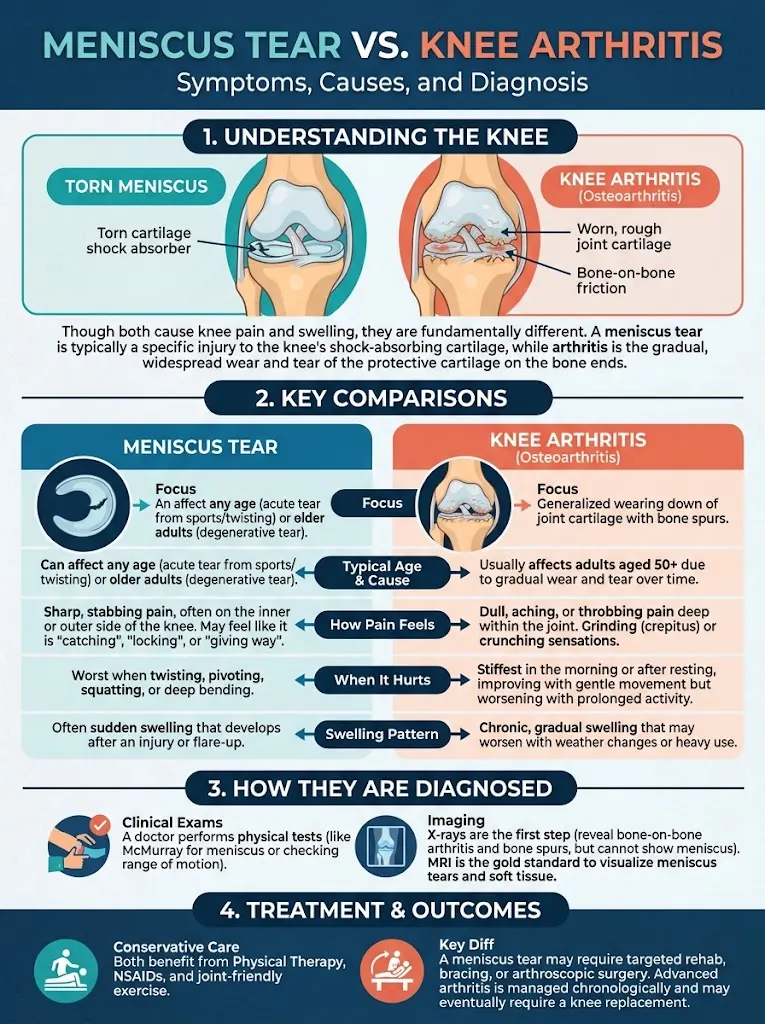
Knee pain can make everyday activities such as walking, climbing stairs, squatting, or getting up from a chair uncomfortable. If your knee clicks, swells, feels stiff, or catches when you bend it, you may wonder whether you have a meniscus tear or knee arthritis. Although both conditions can cause similar symptoms, they affect different structures inside the knee.
A meniscus tear often develops after a twisting injury or through gradual tissue degeneration. Knee arthritis, particularly osteoarthritis, involves changes to the joint cartilage and surrounding structures that can cause pain, stiffness, and reduced mobility. Importantly, these conditions can occur together, especially as people get older.
Understanding the differences between a meniscus tear and knee arthritis can help you recognize possible symptom patterns, understand which diagnostic tests may be useful, and decide when to seek medical care. Symptoms alone cannot confirm either condition, so a clinical assessment remains important.
What Is the Difference Between a Meniscus Tear and Knee Arthritis?
A meniscus tear is damage to one of the two crescent-shaped pieces of cartilage that cushion the thighbone and shinbone. Knee arthritis involves deterioration or inflammation affecting the joint, with osteoarthritis commonly associated with the gradual breakdown of articular cartilage.
Both can cause pain, swelling, stiffness, and difficulty moving the knee. The main differences involve how symptoms begin, where pain occurs, and whether mechanical symptoms or persistent stiffness are prominent.
Meniscus Tear vs. Knee Arthritis: Symptoms Compared
| Feature | Meniscus tear | Knee arthritis |
|---|---|---|
| Typical onset | Sudden after twisting or gradual with degeneration | Often gradual, although symptoms can flare |
| Pain location | Along the inner or outer joint line | May affect the joint line or a broader area of the knee |
| Swelling | May develop over hours after an injury | May fluctuate with activity and inflammation |
| Stiffness | Often associated with pain or swelling | Common after rest and in the morning |
| Clicking or catching | Can occur, particularly with certain tears | Can occur because of joint surface changes |
| Locking | A displaced tear can physically block movement | Less commonly causes true mechanical locking |
| Common risk factors | Twisting injuries, sports, and age-related tissue changes | Increasing age, previous knee injury, and other joint-related risk factors |
These are typical patterns, not diagnostic rules. Neither clicking nor swelling alone proves that a meniscus is torn or that arthritis is present.
What Does a Meniscus Tear Feel Like?
A meniscus tear may cause pain along the inner or outer edge of the knee, especially when twisting, pivoting, squatting, or bending deeply. Swelling may develop after an injury, and some people notice catching, clicking, or difficulty fully straightening the knee.
A traumatic tear can occur during sports or a sudden change of direction. Degenerative tears develop as the meniscus becomes more vulnerable to everyday loading over time.
For a more detailed explanation, review meniscus tear symptoms, treatment, and recovery.
Symptoms that deserve particular attention include:
-
Sudden pain following a twisting injury.
-
Swelling that develops after an injury.
-
Repeated catching or a feeling that movement is blocked.
-
Difficulty fully straightening the knee.
-
Pain when rotating the knee under load.
Pain during twisting can be associated with a meniscus injury, but ligament injuries and other knee conditions can produce similar symptoms. If your knee hurts after a sports injury, understanding the differences between an ACL injury and a meniscus tear may help you understand what a clinician will evaluate.
What Does Knee Arthritis Feel Like?
Knee osteoarthritis often causes pain during weight-bearing activities, stiffness after sitting, and reduced flexibility. Symptoms may worsen after prolonged activity and improve with rest, although advanced disease can cause pain at rest or during the night.
Some people experience swelling, grinding sensations, or difficulty bending and straightening the knee. Symptoms can vary considerably, and the amount of pain does not always correspond to the degree of cartilage changes seen on an X-ray.
Learn more about knee arthritis symptoms, causes, and treatment options.
How Can You Tell Whether It Is a Meniscus Tear or Arthritis?
The circumstances surrounding your pain can offer clues, but they cannot establish a diagnosis on their own.
| Symptom pattern | More suggestive of | Important limitation |
|---|---|---|
| Pain starts after a sudden twist | Meniscus tear or another acute injury | Ligament injuries can feel similar |
| Stiffness after sitting | Knee arthritis or another joint condition | Meniscus injuries can also cause stiffness |
| Pain when rotating the knee | Possible meniscus injury | Not specific to a tear |
| Gradually increasing discomfort over months | Osteoarthritis or a degenerative meniscus problem | Both may coexist |
| A knee that physically cannot straighten | Possible displaced meniscus tear or another mechanical obstruction | Needs prompt medical assessment |
If you experience knee pain when twisting, repeated locking, or a sudden loss of movement, arrange an evaluation. A knee that remains locked should be assessed urgently rather than repeatedly forced straight.
Research also highlights an important diagnostic limitation: meniscal abnormalities are frequently found on MRI in middle-aged and older adults who do not report knee symptoms. In a well-known community study, many MRI-detected tears were present without recent knee pain or stiffness. Therefore, an imaging finding must be interpreted alongside symptoms and examination results rather than automatically assumed to be the cause.
How Do Doctors Diagnose a Meniscus Tear vs. Knee Arthritis?
Diagnosis usually begins with your medical history and a physical examination. A clinician may ask whether symptoms began after an injury, where the pain is located, whether swelling developed, and whether the knee catches or locks.
The examination may include checking joint-line tenderness, range of motion, stability, and pain during specific movements. No single physical test reliably distinguishes every meniscus tear from arthritis.
When are X-rays or an MRI needed?
X-rays can show changes associated with osteoarthritis, including narrowing of the joint space and bone spurs. They generally do not show a meniscus tear directly.
MRI can show the meniscus, ligaments, and other soft tissues, making it useful when the examination suggests a tear and the result could change treatment. It is not necessary for every person with knee pain, and age-related abnormalities may not explain the symptoms.
A clinician may also investigate other explanations if you have sharp knee pain after an injury, persistent swelling, or difficulty bearing weight.
Can You Have a Meniscus Tear and Knee Arthritis at the Same Time?
Yes. Arthritis and a meniscus tear can coexist, particularly when the meniscus has developed age-related changes. A person may have joint stiffness from osteoarthritis and additional pain or catching associated with a meniscal injury.
This overlap is one reason diagnosis should not rely on symptoms or MRI findings alone. Your clinician will consider which findings best explain your limitations and whether treatment is likely to improve them.
What Treatment Helps Each Condition?
Treatment depends on symptom severity, functional limitations, the type of injury, and overall joint health. Many people initially benefit from nonsurgical treatment.
| Treatment | Meniscus tear | Knee arthritis |
|---|---|---|
| Activity modification | Reduces painful twisting and deep bending | Helps manage symptom flares |
| Physical therapy | Improves strength, mobility, and control | Supports strength, function, and joint movement |
| Pain medication | May provide short-term symptom relief | May reduce pain and inflammation when appropriate |
| Low-impact exercise | May maintain fitness during recovery | Often supports mobility and long-term function |
| Surgery | Considered for selected tears or persistent mechanical problems | Considered when severe symptoms remain despite appropriate nonsurgical care |
For either condition, a clinician may recommend physical therapy for a meniscus tear or an individualized exercise program. Suitable low-impact exercises for painful joints may include walking on a comfortable surface, stationary cycling, or water exercise, depending on your symptoms.
A meniscus tear does not automatically require surgery. Some tears improve with rehabilitation, while others may need specialist assessment, particularly if the knee is persistently locked or a repairable tear is suspected. Read about whether a meniscus tear can heal on its own and when meniscus surgery may be necessary.
When Should You Seek Medical Care?
Seek prompt evaluation after a significant injury, particularly if your knee becomes markedly swollen, unstable, or difficult to move. A knee that is hot and red with fever may indicate an infection and requires urgent medical attention.
Get emergency care if you cannot bear weight after a serious injury, the knee appears deformed, or you develop severe symptoms. Persistent swelling can have several causes, so understanding when a swollen knee may be dangerous is important.
If symptoms are mild, temporarily reduce painful activities and monitor progress. Avoid repeatedly twisting the knee to test it, and do not force a locked joint. If walking increases pain, learn whether walking on a torn meniscus can make it worse.
Frequently Asked Questions
1. Can a meniscus tear be mistaken for knee arthritis?
Yes. Both can cause pain, stiffness, swelling, and clicking. Examination and, when appropriate, imaging help determine which condition is contributing to symptoms.
2. Does knee arthritis hurt more than a meniscus tear?
Not necessarily. Pain severity varies with the condition, activity level, and individual circumstances. Neither diagnosis guarantees a particular level of pain.
3. Why does my knee hurt after sitting for a long time?
Stiffness after sitting is common with osteoarthritis, but other knee conditions can cause it too. See why knee pain develops after prolonged sitting.
4. Can a meniscus tear cause knee pain without swelling?
Yes. Some tears cause localized pain without noticeable swelling, so the absence of swelling does not rule out an injury. Learn about meniscus tears without swelling.
5. Why does my knee hurt on stairs?
Pain on stairs can occur with osteoarthritis, meniscus injuries, and other knee problems. Knee pain when walking up stairs may warrant evaluation if it persists or limits daily activities.
6. How long does a torn meniscus take to heal?
Recovery varies with tear location, severity, and treatment. Some people improve over several weeks, while others need months of rehabilitation or further treatment. See the meniscus tear recovery timeline.
7. Can a meniscus tear get worse?
Symptoms can worsen with repeated aggravating movements or further injury, although progression is not inevitable. Seek reassessment if pain, swelling, or locking increases. Review signs that a meniscus tear may be getting worse.
8. Why does my knee hurt at night?
Nighttime pain can occur with arthritis, an injury, or other conditions. Persistent, worsening, or unexplained nighttime pain should be discussed with a clinician. Read about common causes of knee pain at night.
9. Can fluid in the knee mean a meniscus tear or arthritis?
Yes. Both can contribute to joint fluid buildup, but injury, infection, and other conditions can also cause swelling. Learn when fluid on the knee may be dangerous.
10. When should I see a doctor for knee pain?
Arrange an assessment for persistent pain, recurring swelling, or difficulty with normal activities. Seek urgent care for a locked knee, significant injury, or a hot, red knee accompanied by fever.
Conclusion
A meniscus tear is an injury to the knee’s cushioning cartilage, whereas osteoarthritis involves changes to the joint and its cartilage. Their symptoms overlap, and both can occur together, so neither pain patterns nor MRI findings should be interpreted in isolation.
If knee pain persists, limits movement, or follows an injury, arrange a clinical assessment. The appropriate diagnosis can guide treatment, rehabilitation, and decisions about whether further testing or surgery is necessary.
Disclaimer: This article is provided for educational and informational purposes only.
This article is for education purpose only and is not a diagnosis or a substitute for medical advice.