
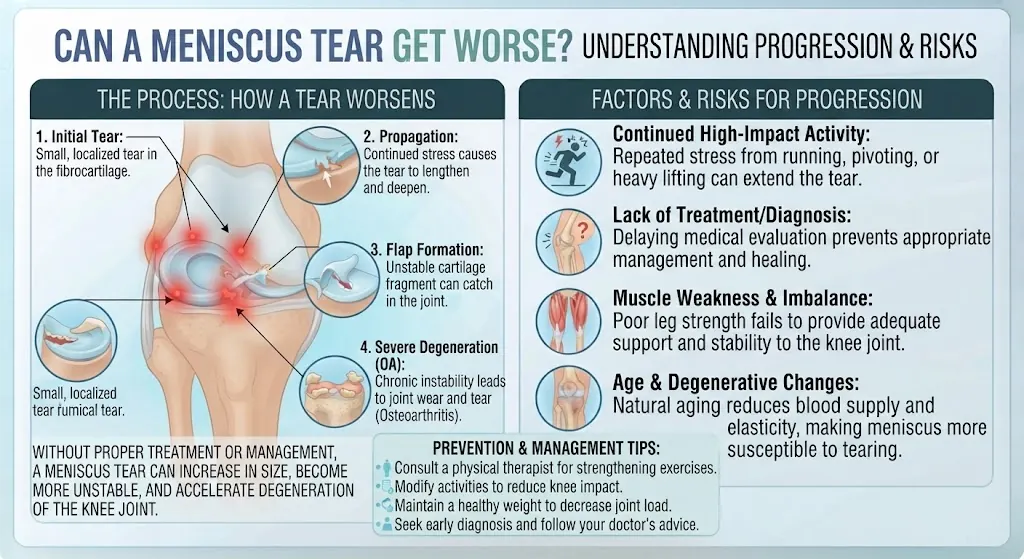
The risk depends on the tear’s location, shape, severity, how it happened, and whether other knee structures are injured. Some tears improve with appropriate nonsurgical treatment, while others may require specialist evaluation, especially if the knee locks or cannot fully straighten.
Understanding whether a meniscus tear can get worse, which activities may aggravate it, and what symptoms need medical attention can help you protect your knee without avoiding all movement unnecessarily.
What Can Make a Meniscus Tear Worse?
The meniscus is a C-shaped piece of cartilage that cushions the knee and helps distribute forces between the thighbone and shinbone. Each knee has two menisci. A tear may occur during a sudden twisting injury or develop gradually as the tissue changes with age.
Certain activities can increase discomfort or place additional stress on an injured meniscus:
-
Twisting on a planted foot: Quickly changing direction while your foot stays on the ground can stress the knee.
-
Deep squats and kneeling: Deep knee bending can aggravate some tears, particularly when combined with load.
-
High-impact exercise: Running, jumping, and contact sports may be unsuitable while the knee is painful or swollen.
-
Pushing through swelling or pain: Continuing an activity that consistently worsens symptoms may delay recovery and deserves reassessment.
-
Returning to sports too soon: Resuming pivoting or cutting movements before strength and control return can increase the risk of another injury.
Not every movement damages the tear further. The goal is to temporarily modify activities that provoke symptoms rather than keep the knee completely immobile.
For practical guidance, see whether walking on a torn meniscus can make it worse.
How Do You Know If a Meniscus Tear Is Getting Worse?
Increasing pain or swelling may indicate that the knee is being irritated, but symptoms alone cannot establish whether the tear has enlarged. A new injury, inflammation, or another knee problem can cause similar changes.
Common signs worth monitoring include:
-
Pain that becomes more frequent or intense.
-
Swelling that develops after activity or repeatedly returns.
-
Catching, clicking with pain, or a sensation that movement is blocked.
-
Reduced ability to bend or straighten the knee.
-
Difficulty walking, squatting, or bearing weight.
-
A feeling that the knee is giving way.
A painless click does not automatically mean the tear is worsening. However, new locking, loss of movement, or increasing difficulty walking warrants medical assessment. Read about why a meniscus tear may cause knee locking.
What Is the Difference Between a Flare-Up and a Worsening Tear?
A flare-up means symptoms have increased; it does not necessarily mean more cartilage has torn. A clinician may need to examine your knee and review how symptoms began to determine whether further investigation is needed.
| What you notice | What it may mean | Sensible next step |
|---|---|---|
| Mild soreness after activity that settles with rest | Temporary irritation or overload | Reduce aggravating activity and monitor |
| Repeated swelling after ordinary movement | Ongoing irritation or another knee problem | Arrange a medical evaluation |
| New sharp pain after twisting the knee | Possible new or aggravated injury | Stop the activity and seek assessment |
| Knee becomes stuck and will not straighten | Possible mechanical blockage | Seek prompt medical care |
| Severe pain, major swelling, or inability to bear weight after injury | Potentially significant injury | Seek urgent evaluation |
Learn about how to recognize signs of a worsening meniscus tear. If swelling is prominent, understanding when a swollen knee may be dangerous can help you judge the urgency of getting checked.
Can a Meniscus Tear Heal on Its Own?
Some meniscus tears improve without surgery, but healing depends partly on the tear’s location and blood supply. The outer portion receives more blood than the inner portion, so tears near the outer edge may have a better chance of healing than tears in areas with limited blood supply.
Even when the tissue does not fully heal, pain and function can improve with activity changes and rehabilitation. The appropriate approach depends on your symptoms, age, activity needs, and whether the knee locks or has other injuries.
Read more about whether a meniscus tear can heal without surgery and meniscus tear symptoms, treatment, and recovery.
What Should You Do If You Think Your Tear Is Getting Worse?
For mild symptoms without urgent warning signs, consider temporarily reducing activities that trigger pain. You can often maintain gentle movement, provided it does not increase symptoms.
-
Rest from pivoting sports, running, deep squats, and other painful movements.
-
Apply a cold pack wrapped in a towel for 15–20 minutes at a time to help manage discomfort.
-
Elevate the leg when resting if the knee is swollen.
-
Avoid forcing the knee to bend or straighten through pain.
-
Return to activity gradually as swelling, pain, and movement improve.
Gentle, suitable options may include low-impact exercises for painful joints. A physical therapist can tailor exercises to your symptoms and stage of recovery. Learn about whether physical therapy can help a meniscus tear.
Avoid using pain relief to push through an activity that your knee cannot tolerate. If symptoms are worsening despite reducing activity, arrange a clinical assessment.
How Long Does a Meniscus Tear Take to Recover?
Recovery varies from person to person. Symptoms may settle over several weeks with nonsurgical care, but more complex tears can take longer, and surgical recovery depends on the procedure performed.
| Factor | How it affects recovery |
|---|---|
| Tear location and pattern | Some tears have a better blood supply or are more stable than others |
| Associated injuries | Ligament or cartilage damage may complicate recovery |
| Activity demands | Pivoting sports generally require more rehabilitation than everyday walking |
| Treatment approach | Recovery after meniscus repair usually takes longer than recovery after some other procedures |
For a more detailed timeline, see how long a torn meniscus takes to heal. If pain started suddenly after an injury, the differences between an ACL injury and a meniscus tear may help explain why an examination is important.
When Should You Seek Medical Care?
Seek emergency or urgent care if you cannot bear weight after an injury, have severe pain or rapid swelling, or your knee is stuck and cannot straighten. A hot, red knee with fever also needs urgent assessment because infection is a concern.
Arrange a routine medical appointment if pain persists, swelling keeps returning, or the knee repeatedly catches or gives way. A clinician may examine your knee and decide whether X-rays or an MRI are appropriate. X-rays do not show the meniscus directly, but they can help assess bones and signs of arthritis.
For a broader overview of common knee pain causes and when to see a doctor, consider how the symptoms began and whether they are affecting normal activities.
Frequently Asked Questions
1. Can walking make a meniscus tear worse?
Walking on a stable knee may be reasonable if you can bear weight and symptoms remain mild. If walking increases pain, causes swelling, or makes you limp, reduce the distance and seek medical advice if symptoms persist.
2. Can a meniscus tear get worse without swelling?
Yes. Some tears cause pain, catching, or restricted movement without obvious swelling. The absence of swelling does not rule out an injury; see whether a meniscus tear can occur without swelling.
3. Why does a meniscus tear hurt when I twist my knee?
Twisting can load the meniscus, especially when your foot is planted and your knee rotates. Learn more about why knee twisting can trigger meniscus tear pain.
4. Can I exercise with a meniscus tear?
Often, modified exercise is possible, but the right activities depend on pain, swelling, stability, and the type of tear. Find guidance on which exercises may be appropriate with a meniscus tear.
5. Does a meniscus tear always need surgery?
No. Many people start with nonsurgical treatment, including activity modification and physical therapy. Surgery may be considered for certain tears, persistent symptoms, or mechanical problems; learn when surgery may be needed for a meniscus tear.
6. How can I tell a meniscus tear from knee arthritis?
Both can cause pain, stiffness, and difficulty bending the knee. A twisting injury and catching may suggest a meniscus problem, while gradual stiffness can occur with arthritis, but symptoms overlap. See meniscus tear versus knee arthritis.
7. What if my knee locks when I bend it?
A knee that becomes physically stuck or cannot fully straighten needs prompt medical assessment. Painful clicking alone is different from a true locked knee; review why a knee may lock when bending.
8. Can a meniscus tear cause the knee to give way?
It can contribute to a feeling of instability, although pain, muscle weakness, and ligament injuries can also cause the knee to buckle. If giving way is repeated or follows an injury, arrange an assessment.
9. Can a meniscus tear get worse if left untreated?
Some tears remain manageable, while others continue to cause pain or mechanical symptoms. The risk depends on the tear and any associated damage, so persistent symptoms deserve evaluation rather than assuming the injury will resolve.
10. What if my knee pain started suddenly after an injury?
Stop the activity and avoid twisting or forcing the knee. Significant swelling, severe pain, inability to bear weight, or loss of movement warrants urgent evaluation; sharp knee pain after an injury may involve a meniscus, ligament, or another structure.
Conclusion
A meniscus tear can become more symptomatic or sustain further injury, but increased pain does not automatically mean the tear has grown. Modify painful activities, use gentle movement that your knee tolerates, and seek medical assessment for persistent or worsening symptoms. A locked knee, inability to bear weight, severe swelling, or fever with a hot knee requires urgent care.
Disclaimer: This article is provided for educational and informational purposes only
This article is for education purpose only and is not a diagnosis or a substitute for medical advice.