
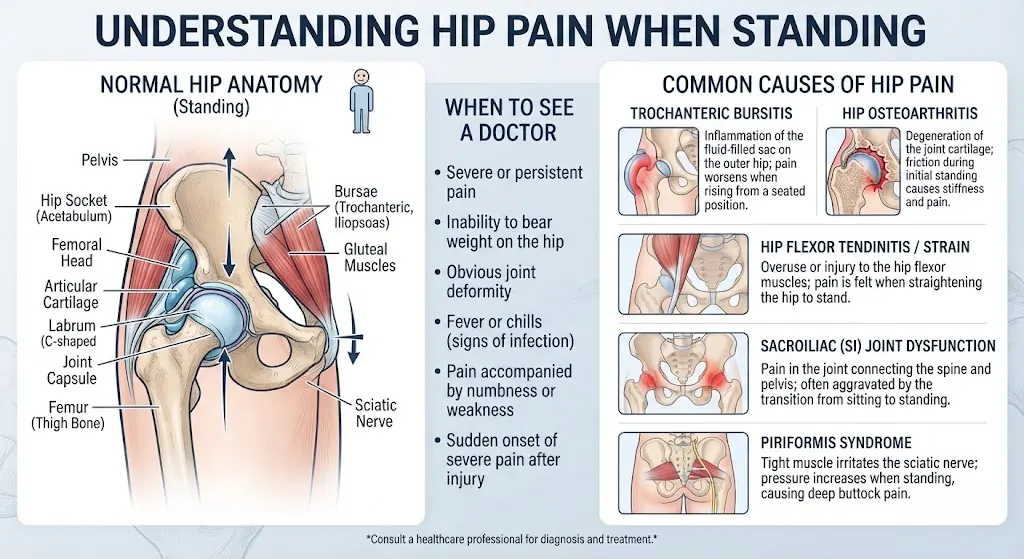
Hip pain when standing up can make everyday movements uncomfortable, whether you are rising from a chair, getting out of a car, or standing after sitting for a long time. The pain may feel like a deep ache in the groin, soreness on the outside of the hip, or stiffness that eases after a few steps.
Hip pain when standing up is not always a sign of serious damage, but persistent or worsening pain should not be ignored. It can arise from joint stiffness, arthritis, irritated tendons, or muscles that become uncomfortable after remaining in one position. Where you feel the pain, how long it lasts, and whether it affects walking can help guide the next steps.
Understanding why your hip hurts when you stand up can help you identify possible causes, adjust daily activities, and know when to seek medical care. This guide explains common reasons for hip pain after sitting, safe ways to manage mild symptoms, and warning signs that need prompt evaluation.
What Causes Hip Pain When Standing Up?
Hip pain when rising from a seated position can come from the hip joint, surrounding muscles and tendons, or structures in the lower back. The location and pattern of pain may provide clues, but symptoms alone cannot confirm a diagnosis.
| Possible cause | Common symptoms | Clues to notice |
|---|---|---|
| Hip osteoarthritis | Stiffness and deep groin pain | Often worse after rest or with weight-bearing |
| Tendon irritation | Pain on the outside of the hip | May worsen with stairs or lying on that side |
| Muscle strain or tightness | Localized soreness or pulling | May follow exercise, lifting, or an unusual movement |
| Hip labral injury | Groin pain, clicking, or catching | May worsen with twisting or deep bending |
| Referred lower-back pain | Hip or buttock discomfort, sometimes extending down the leg | May occur with back pain, tingling, or numbness |
1. Hip stiffness after sitting
Staying seated for a long time can make the hip feel stiff when you first stand. The sensation may improve after several comfortable steps as the joint and surrounding muscles begin moving. However, recurring stiffness that limits movement may warrant assessment, particularly if it is becoming more noticeable.
If pain starts specifically after prolonged sitting, see why your hip hurts after sitting for a long time.
2. Hip osteoarthritis
Osteoarthritis involves changes in the joint cartilage and surrounding structures. It can cause deep aching, stiffness after rest, and discomfort when standing, walking, or climbing stairs. Symptoms often develop gradually, although their severity varies.
An examination can help distinguish arthritis from other causes. If you have persistent groin pain or reduced hip movement, a clinician may recommend further assessment.
3. Tendon irritation around the hip
Tendons help connect muscles to bones and stabilize the hip during movement. Irritation of the tendons around the outer hip may cause tenderness when standing, walking, using stairs, or lying on the affected side. Pain on the outside of the hip can also involve nearby soft tissues, so it is not possible to identify the exact cause from location alone.
Learn about common causes of pain on the outside of the hip.
4. Hip labral problems
The labrum is a ring of cartilage that helps deepen and stabilize the hip socket. A labral tear may cause groin pain, clicking, catching, or discomfort with certain movements. These symptoms can overlap with other hip conditions, so an assessment is needed before concluding that the labrum is involved.
For more information, see hip labral tear symptoms, causes, and treatment.
5. Pain referred from the lower back
Not all pain felt around the hip begins in the hip joint. Problems involving the lower back or nearby nerves can cause pain in the buttock or hip region and may sometimes extend down the leg. Tingling, numbness, or back pain can provide additional clues.
If discomfort travels below the hip, review possible causes of hip pain that radiates down the leg.
Why Does Hip Pain Sometimes Improve After a Few Steps?
Pain that eases after moving may be related to stiffness after rest, but that pattern does not identify a single condition. Some people find that their hip feels tight when they stand and becomes more comfortable as they walk; others experience increasing pain with continued activity.
| Pattern | What it may suggest | Practical next step |
|---|---|---|
| Stiff at first, then improves | Stiffness after rest or a joint-related issue | Monitor how often it occurs |
| Pain continues or increases while walking | A condition aggravated by weight-bearing or movement | Reduce aggravating activity and seek advice if persistent |
| Pain mainly in the groin | Possible hip-joint involvement | Arrange an assessment if recurrent |
| Pain on the outer hip when standing or lying on that side | Possible tendon or nearby soft-tissue irritation | Avoid pressure and movements that trigger symptoms |
| Pain with tingling or numbness | Possible nerve involvement | Seek clinical evaluation, especially if symptoms worsen |
If walking itself triggers discomfort, read about common causes of hip pain when walking.
What Can You Do at Home?
For mild hip discomfort without a significant injury or warning signs, try reducing activities that repeatedly trigger pain while maintaining comfortable movement.
- Stand up gradually: Move toward the edge of the chair, place your feet firmly on the floor, and use your arms for support if needed.
- Break up long sitting periods: Stand and move gently at regular intervals rather than remaining in one position for hours.
- Avoid aggravating movements: Temporarily reduce deep squats, heavy lifting, and sudden twisting if they increase discomfort.
- Use a cold or warm pack: A wrapped cold pack may help after a recent strain, while gentle warmth may ease stiffness. Protect your skin and stop if either worsens symptoms.
- Choose comfortable activity: Gentle walking on level ground or other low-impact movement may help you stay active without excessive strain.
Explore low-impact exercises for people with joint pain for general activity ideas. Start gently and stop if exercise causes sharp pain, worsening symptoms, or difficulty bearing weight.
Over-the-counter pain medicines may help some people, but they are not appropriate for everyone. Ask a clinician or pharmacist which option is suitable if you have kidney disease, a history of stomach ulcers, cardiovascular conditions, take blood thinners, or are pregnant.
When Should You See a Doctor?
Arrange a medical appointment if hip pain keeps returning, lasts more than a short period, interferes with sleep or daily activities, or gradually reduces your ability to walk. A clinician may assess your range of motion, strength, walking pattern, and the location of tenderness. Imaging is not always necessary, but an X-ray or other test may be considered when the examination suggests a particular cause.
Seek urgent medical care if you develop sudden severe hip pain, cannot stand or put weight on the leg, or experience significant pain after a fall or other injury. A hot or swollen hip accompanied by fever or feeling seriously unwell also needs urgent assessment.
New leg weakness, numbness around the groin, or loss of bladder or bowel control alongside back or hip symptoms requires emergency evaluation.
Frequently Asked Questions
1. Why does my hip hurt when I stand up after sitting?
Prolonged sitting can contribute to stiffness in the hip joint and surrounding muscles. Recurrent pain may also be associated with arthritis, tendon irritation, or another condition, so persistent symptoms deserve assessment.
2. Why does my hip pain go away after walking a little?
Gentle movement may ease stiffness that develops during rest. However, improvement after a few steps does not rule out a joint or soft-tissue problem, especially if the pain keeps returning.
3. Can hip arthritis cause pain when standing up?
Yes. Hip osteoarthritis can cause stiffness after sitting and pain during weight-bearing movements. A clinician can assess whether arthritis or another condition better explains your symptoms.
4. Why does my hip hurt in the groin when I stand?
Groin pain can originate from the hip joint, including conditions such as osteoarthritis or a labral problem. Muscle strains and other causes can produce similar symptoms, so the location alone is not enough to diagnose the cause.
5. Can sitting too long cause hip pain?
Long periods in one position can contribute to stiffness and discomfort when you first stand. Taking movement breaks may help, but persistent or worsening pain should not automatically be attributed to sitting.
6. Should I keep walking if my hip hurts when I stand up?
Comfortable, gentle walking may be reasonable if you can bear weight normally and symptoms do not worsen. Stop activities that cause sharp or increasing pain, and seek evaluation if walking becomes difficult.
7. Could hip pain when standing come from my back?
Yes. Lower-back conditions can refer pain to the buttock or hip and sometimes cause tingling, numbness, or pain extending down the leg. A clinical assessment can help distinguish spinal causes from problems within the hip.
8. Why does the outside of my hip hurt when I stand?
Pain on the outer hip may involve irritated tendons or nearby soft tissues. It may also become more noticeable when climbing stairs or lying on the affected side, but an examination is needed to identify the cause.
9. When should hip pain when standing up be considered serious?
Sudden severe pain, inability to bear weight, or pain after a significant fall requires urgent assessment. Fever with a hot or swollen joint, or new neurological symptoms such as leg weakness or loss of bladder control, also needs urgent or emergency care.
10. How long does hip pain after standing up take to improve?
The recovery period depends on the cause. Mild stiffness may settle with movement and activity adjustments, while arthritis, tendon problems, or injuries may require longer-term management and professional guidance.
Conclusion
Hip pain when standing up can result from stiffness, arthritis, tendon irritation, a labral problem, or pain referred from the lower back. Notice where the pain occurs, whether it improves with movement, and whether it affects walking. Adjust activities that aggravate symptoms, keep movement comfortable, and seek medical advice if pain persists or limits daily life.
Disclaimer: This article is provided for educational and informational purposes only. It is not a substitute for professional medical advice, diagnosis, or treatment.
This article is for education purpose only and is not a diagnosis or a substitute for medical advice.