
A sudden knee injury can leave you wondering whether you damaged the ACL, tore a meniscus, or simply strained something around the joint. You may notice a pop, swelling, pain when walking, or a feeling that the knee is unstable. Because an ACL injury vs. meniscus tear can produce several overlapping symptoms, the difference is not always obvious from pain alone.
It is also easy to assume that a clicking knee means a meniscus tear or that a popping sound automatically means an ACL tear. Neither symptom is specific enough to confirm an injury by itself. The timing of swelling, the mechanism of injury, whether the knee gives way or locks, and the findings on a physical examination provide much more useful clues.
The ACL and meniscus perform different jobs inside the knee, so their injuries can behave differently. This guide explains the key differences between an ACL injury and a meniscus tear, what symptoms they commonly cause, how doctors evaluate them, when imaging may be needed, and what treatment can involve.
ACL Injury vs. Meniscus Tear: What Is the Difference?
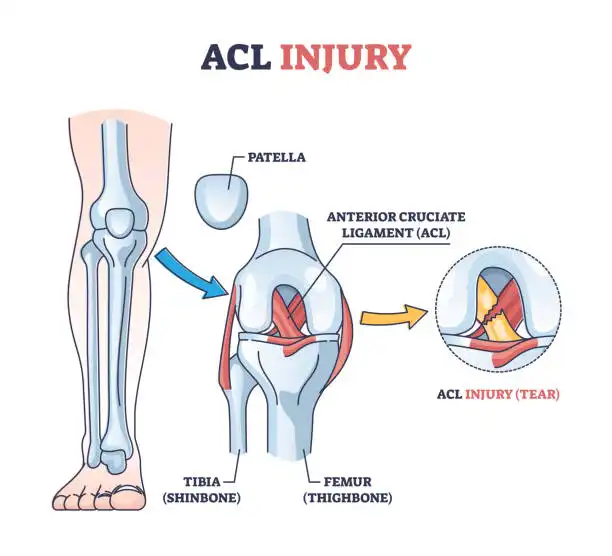
Theanterior cruciate ligament (ACL) is a strong ligament in the center of the knee that helps control forward movement and rotational stability between the thighbone and shinbone. An ACL injury commonly occurs during sudden stopping, cutting, pivoting, awkward landing, or contact sports. AAOS estimates that roughly 200,000 ACL injuries occur in the United States each year.
Themeniscus is a C-shaped piece of cartilage between the femur and tibia. Each knee has a medial and lateral meniscus. They help distribute load, absorb shock, and contribute to joint stability. Meniscus tears commonly occur after twisting or forceful loading of the knee, although degenerative tears can develop gradually.
| Feature | ACL injury | Meniscus tear |
| Structure injured | Ligament | Cartilage |
| Typical mechanism | Pivoting, cutting, sudden stopping, awkward landing, collision | Twisting, squatting, forceful rotation, or gradual degeneration |
| Common sensation | Pop, instability, knee giving way | Joint-line pain, catching, clicking, sometimes locking |
| Swelling | Often develops rapidly after an acute injury | May occur, sometimes more gradually |
| Instability | Common, particularly with pivoting | Less typical unless other structures are injured |
| Locking | Not the defining symptom | More characteristic, particularly with certain tears |
| MRI | Often useful to confirm ACL injury and associated damage | Often useful when a meniscus tear is suspected |
These patterns are useful clues rather than diagnostic rules. An ACL injury can occur together with a meniscus tear, and this combination is not unusual after significant knee trauma.
What Does an ACL Injury Feel Like?
An acute ACL injury often occurs during a movement that rapidly changes the direction or position of the knee. Some people report hearing or feeling a distinctpop at the moment of injury.
Other symptoms can include:
- Rapid knee swelling
- Difficulty bearing weight
- Reduced ability to fully bend or straighten the knee
- A sensation that the knee has shifted or buckled
- Pain after the initial injury
- Difficulty with pivoting or changing direction
A major clue isinstability. Someone with an ACL-deficient knee may feel that the knee gives way, particularly during twisting or sports that involve cutting.
However, not everyone with an ACL injury experiences every classic symptom. AAOS notes that the initial evaluation generally involves the injury history and physical examination, with MRI often used to confirm the injury and identify associated damage to the meniscus, cartilage, or other ligaments.
If you are specifically trying to understand symptoms after an injury, the distinction between general knee pain and a traumatic injury is also important. See the guide on knee pain after an injury for a broader symptom-based approach.
What Does a Meniscus Tear Feel Like?
Meniscus symptoms can vary considerably depending on the tear’s location, size, pattern, and whether the injury is acute or degenerative.
Common symptoms include:
- Pain along the inner or outer joint line
- Swelling or stiffness
- Clicking or catching
- Difficulty fully straightening or bending the knee
- Pain with twisting or squatting
- A sensation that something is caught inside the knee
- Locking in some cases
A meniscus tear doesnot necessarily cause severe pain immediately. Some people can walk after the injury, particularly when the tear is small or symptoms are initially mild.
If you’re wondering whether continuing to walk is safe after a suspected meniscus injury, see walking with a torn meniscus.
For a more comprehensive overview of symptoms, treatment choices, and recovery, see meniscus tear treatment and recovery.
ACL Injury vs. Meniscus Tear Symptoms: Which Clues Matter Most?
The most useful distinction is usuallyinstability versus mechanical symptoms, although there is considerable overlap.
A sudden pop and rapid swelling
A sudden pop followed by substantial swelling within a relatively short period is more suggestive of an acute ligament injury such as an ACL tear, particularly when it occurs during pivoting or landing.
It is not proof of an ACL injury. Other knee injuries can also produce swelling and popping.
Knee giving way
Repeated episodes of the knee buckling or shifting are more characteristic of ACL insufficiency. This can become particularly noticeable when turning, pivoting, or changing direction.
Meniscus injuries can cause discomfort and altered movement, but recurrent instability is less characteristic of an isolated meniscus tear.
Catching or locking
Catching, clicking, or a knee that becomes mechanically difficult to straighten can point toward meniscal involvement.
A knee that is genuinely locked and cannot be fully straightened deserves medical evaluation rather than repeated attempts to force it through the restricted motion.
Pain along the joint line
Pain that is localized along the inner or outer joint line can occur with a meniscus tear. Still, location alone cannot distinguish a meniscus injury from every other cause of knee pain.
For a broader discussion of possible causes, see what are the causes of knee pain.
Can You Have an ACL Tear and Meniscus Tear at the Same Time?
Yes. An ACL injury can occur with a meniscus tear, cartilage injury, or another ligament injury.
This matters because treating only one suspected structure may not address the full problem. MRI can help identify associated injuries when the clinical evaluation indicates that additional imaging is appropriate. AAOS specifically notes that MRI can help confirm an ACL injury and identify associated meniscal or cartilage damage.
This combination can also affect treatment decisions. An active person with substantial instability and an associated meniscus injury may have different treatment considerations from someone with an isolated, relatively stable meniscus tear.
How Doctors Diagnose an ACL Injury or Meniscus Tear
Diagnosis usually begins with thehistory and physical examination, not with an MRI alone.
A clinician may ask:
- How did the injury happen?
- Did you pivot, twist, land, or receive a direct blow?
- Did you hear or feel a pop?
- How quickly did swelling develop?
- Can you fully straighten the knee?
- Does the knee give way?
- Does it catch or lock?
- Where exactly is the pain?
The examination may include specific maneuvers designed to assess ligament stability and meniscal irritation. X-rays may be used to look for fractures or other bone abnormalities, while MRI can provide detailed information about ligaments, menisci, cartilage, and other soft tissues.
The goal is not simply to identify a tear on an image. The imaging findings need to be interpreted alongside symptoms and examination findings because structural abnormalities can sometimes exist without being the main source of pain.
What Should You Do Immediately After a Suspected ACL or Meniscus Injury?
After a significant knee injury, reduce activities that reproduce pain or instability rather than trying to “test” the knee repeatedly.
Depending on the severity of the injury, initial measures may include:
- Resting from pivoting, running, jumping, and other aggravating activities
- Elevating the leg if swelling is present
- Using cold therapy for short periods if it helps with pain or swelling
- Using crutches or other assistance if you cannot safely bear weight
- Arranging a clinical assessment when a significant ligament or meniscal injury is suspected
AAOS recommends medical assessment when an ACL injury is suspected and notes short-term protection of the injured leg may be appropriate.
Do not assume that being able to walk rules out a significant injury. Some ACL and meniscus injuries still allow weight bearing.
ACL vs. Meniscus Treatment: Is Surgery Always Necessary?
No. Treatment depends on the specific injury, knee stability, symptoms, activity requirements, age, associated injuries, and response to rehabilitation.
For some meniscus tears, especially when symptoms are manageable and the knee is not locking, nonoperative care may be appropriate. Physical therapy can be used to improve strength, movement, and function. Some tears may require surgical treatment when symptoms persist or mechanical problems are significant.
ACL treatment is more individualized. Some people with lower activity demands and a relatively stable knee may be managed without reconstruction. Active people who require substantial pivoting and cutting ability, particularly when instability persists, may be candidates for ACL reconstruction.
For rehabilitation decisions, physical therapy vs. chiropractic care explains how these approaches differ, although a confirmed ACL or meniscus injury warrants condition-specific medical guidance.
What About Returning to Sports After an ACL Injury?
Returning to sports should not be based solely on whether the knee “feels better.” Strength, range of motion, movement control, confidence, sport-specific demands, and the status of the injured structures all matter.
Research on ACL reconstruction shows that return-to-sport decisions are complex. A 2024 meta-analysis involving 1,410 people found that passing return-to-sport testing was associated with lower graft-rupture risk, although it was not clearly associated with every category of subsequent knee injury.
Another systematic review and meta-analysis found a pooled second-ACL-injury incidence of about16.9% after reconstruction, although the certainty of evidence regarding the relationship between return-to-sport timing and reinjury was very low.
These findings reinforce an important point:time alone should not determine readiness for unrestricted sport.
For people returning to activity after knee injury, the rehabilitation process may need to address strength, balance, movement mechanics, and gradual exposure to sport-specific demands.
Warning Signs: When Should You Get Medical Help?
Symptoms that can sometimes be monitored
Mild soreness or swelling that is steadily improving after a minor injury may sometimes be monitored while activity is reduced.
However, improvement should be accompanied by progressively better function rather than increasing instability or loss of movement.
Symptoms that need medical evaluation
Arrange an evaluation if you have:
- Significant swelling after an acute knee injury
- Persistent pain or difficulty walking
- Recurrent knee buckling or giving way
- Persistent clicking or catching
- Inability to fully straighten the knee
- Pain that does not improve with reasonable activity modification
- A sports injury involving a pop and immediate functional problems
A suspected ACL injury should be assessed because untreated instability can affect activity and may coexist with other knee injuries.
Symptoms requiring urgent assessment
Seek urgent medical attention if the knee is severely deformed, you cannot bear weight after significant trauma, the foot becomes cold or numb, or there is rapidly worsening swelling or severe pain.
These symptoms can indicate a more serious injury that requires prompt evaluation.
Frequently Asked Questions
1. Is an ACL tear worse than a meniscus tear?
Neither injury is automatically “worse.” An ACL tear can create significant instability, while a meniscus tear can cause substantial pain, mechanical symptoms, and loss of motion. Severity depends on the exact injury and whether other structures are damaged.
2. Which is more likely to cause a popping sound, ACL or meniscus?
A sudden pop during a pivot, landing, or abrupt change of direction is commonly associated with an ACL injury, but popping can occur with other knee injuries as well. The sound alone cannot establish the diagnosis.
3. Can you walk with an ACL tear?
Some people can walk after an ACL tear, particularly once the initial pain and swelling settle. Being able to walk does not rule out an ACL injury.
4. Can you walk with a meniscus tear?
Yes. Many people with meniscus tears can walk, although twisting, squatting, stairs, or prolonged activity may increase symptoms. A painful or locked knee should be medically assessed.
5. Does a meniscus tear always need surgery?
No. Some meniscus tears can be managed with activity modification, rehabilitation, and symptom management. Surgery may be considered when symptoms persist, the tear causes significant mechanical problems, or other factors make operative treatment appropriate.
6. Does an ACL tear always need surgery?
No. Treatment depends on knee stability, activity level, associated injuries, and individual goals. Some people can function well with structured nonoperative management, while active individuals with instability may benefit from reconstruction.
7. Which injury causes knee locking?
Mechanical locking or an inability to fully straighten the knee is more suggestive of certain meniscal injuries. ACL injuries more commonly cause instability, although combined injuries can produce both problems.
8. Can an ACL tear heal on its own?
The ACL has limited healing potential, and a complete tear does not reliably restore normal ligament stability without treatment. Some people nevertheless manage their symptoms successfully without reconstruction, depending on their knee stability and activity demands.
9. How is an ACL tear confirmed?
A clinician usually starts with the injury history and physical examination. MRI can then help confirm the injury and identify associated damage to the meniscus, cartilage, or other ligaments.
10. How can I tell whether my knee pain is from a meniscus tear or something else?
You cannot reliably determine the cause from pain location alone. The mechanism of injury, swelling pattern, instability, catching or locking, examination findings, and sometimes imaging need to be considered together. A clinician can help determine whether further testing is appropriate.
Conclusion
An ACL injury and a meniscus tear can look similar at first, but their typical patterns differ.ACL injuries more often involve instability, giving way, and rapid swelling after a twisting or pivoting event, while meniscus tears more often produce joint-line pain, catching, clicking, or locking. Neither pattern is definitive, and both injuries can occur together.
After a significant knee injury, avoid repeatedly testing the joint through painful or unstable movements. If you develop substantial swelling, instability, persistent pain, loss of motion, or mechanical locking, arrange an appropriate medical evaluation so the injury can be identified and treated according to your specific situation.
Disclaimer: This article is provided for educational and informational purposes only. It is not a substitute for professional medical advice
This article is for education purpose only and is not a diagnosis or a substitute for medical advice.