
Knee pain without swelling can be confusing. You may feel a sharp ache when bending your knee, discomfort when climbing stairs, or soreness after sitting for a long time, yet the joint looks completely normal. This can make everyday activities uncomfortable even when there is no obvious sign of injury.
Knee pain without swelling does not automatically mean something serious is wrong, but it does not rule out an injury. Some problems cause pain without visible inflammation, while others develop gradually and produce symptoms only during certain movements. The location of the pain, when it began, and which activities trigger it can provide useful clues.
Understanding why your knee hurts but does not swell can help you choose sensible self-care, recognize when you need an examination, and avoid aggravating the joint. Below, we explain common causes, what you can safely do at home, and which warning signs deserve medical attention.
What Causes Knee Pain Without Swelling?
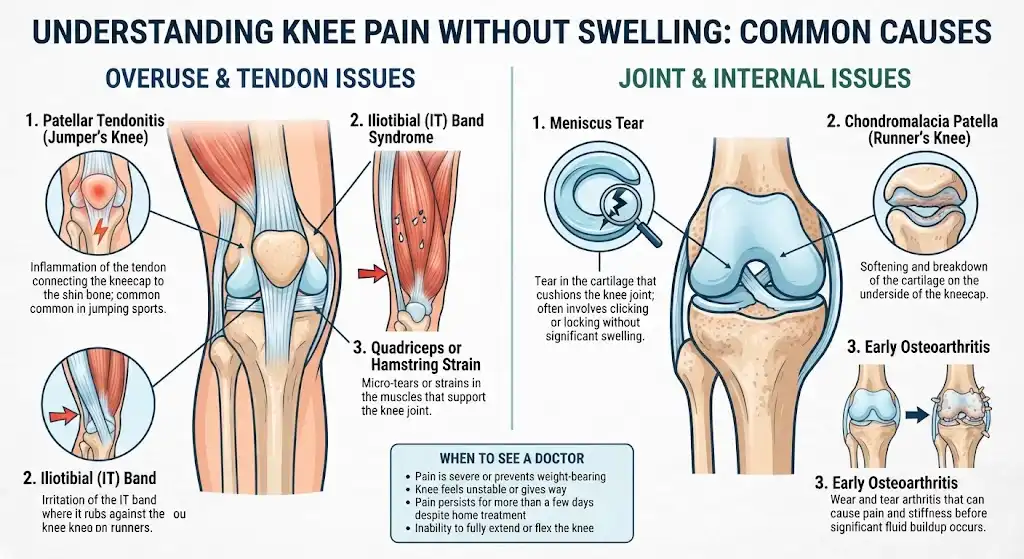
Knee pain without visible swelling can result from overuse, irritation around the kneecap, arthritis, or an injury involving cartilage or ligaments. The absence of swelling alone cannot identify the cause.
| Possible cause | Common clues | What to know |
|---|---|---|
| Patellofemoral pain | Aching around or behind the kneecap, especially on stairs | May worsen with squats or prolonged sitting |
| Meniscus injury | Pain along the inner or outer joint line, sometimes with catching | Some injuries occur without noticeable swelling |
| Knee osteoarthritis | Stiffness, aching with activity, or discomfort after rest | Symptoms can fluctuate over time |
| Tendon irritation | Localized pain during loading or repeated movement | May follow increased exercise or activity |
| Ligament injury | Pain after twisting, sometimes with instability | More significant injuries need assessment |
1. Kneecap-related pain
Pain around or behind the kneecap may worsen when climbing stairs, squatting, or getting up after sitting. This pattern can occur with patellofemoral pain, which may develop when activity levels increase or the knee is repeatedly loaded. Learn more about pain behind the kneecap and its possible causes.
2. Meniscus or ligament injury
A meniscus injury can cause pain during twisting, deep bending, or turning with your foot planted. Swelling is not always present, and symptoms vary according to the injury. Read about meniscus tear symptoms and treatment options and how to distinguish an ACL injury from a meniscus tear.
3. Arthritis or overuse
Knee osteoarthritis can cause aching, stiffness, and reduced comfort during movement without obvious swelling. Repetitive activity, a sudden increase in exercise, or prolonged pressure on the joint can also trigger pain. Explore knee arthritis symptoms and treatment options for more information.
What Can You Do at Home?
For mild pain without a major injury or warning signs, temporarily reduce activities that trigger symptoms. Avoid repeatedly testing the knee with deep squats, sudden turns, or forceful bending.
| Self-care approach | How to use it | Important limitation |
|---|---|---|
| Relative rest | Reduce painful activities for a short period | Avoid unnecessary prolonged inactivity |
| Cold pack | Apply through a towel for 15–20 minutes | Never place ice directly on skin |
| Gentle movement | Bend and straighten within a comfortable range | Stop if pain becomes sharp or worsens |
| Low-impact activity | Try easy walking or swimming if comfortable | Do not push through increasing pain |
Return to normal activity gradually as symptoms improve. Gentle movement may help maintain mobility, but strengthening exercises should match your symptoms and abilities. These low-impact exercises for people with joint pain may offer ideas, provided they do not aggravate your knee.
If you take medication for pain, check with a clinician or pharmacist about what is appropriate for you, especially if you have kidney disease, stomach ulcers, cardiovascular conditions, take blood thinners, or are pregnant.
When Should You See a Doctor?
Arrange a medical assessment if knee pain persists, keeps returning, interferes with walking or sleep, or limits how far you can bend or straighten your leg. An examination can help identify the likely cause. Imaging is not always necessary; a clinician may recommend an X-ray or MRI depending on your symptoms and examination.
Seek urgent medical care if you cannot bear weight, the knee becomes locked or visibly deformed, or severe pain follows a significant injury. A hot, red knee with fever also requires urgent evaluation, even if swelling was not present initially.
Do not assume that pain without swelling is harmless. If the discomfort began after a twist, causes the knee to give way, or is getting worse, seek assessment rather than continuing activities that provoke it.
Frequently Asked Questions
1. Can you have a meniscus tear without swelling?
Yes. Some meniscus injuries cause pain or catching without obvious swelling. A physical examination may be needed to determine whether a tear is likely.
2. Why does my knee hurt when I walk but not swell?
Walking can place pressure on the kneecap, cartilage, tendons, and other knee structures. The cause depends on where the pain occurs and whether it began suddenly or gradually.
3. Can knee arthritis cause pain without swelling?
Yes. Osteoarthritis may cause pain, stiffness, and reduced mobility without visible swelling. Symptoms can be more noticeable after activity or following a period of sitting.
4. Why does my knee hurt after sitting for a long time?
Stiffness or aching after sitting can occur with kneecap-related pain or arthritis. Gentle movement may help, but recurring or worsening symptoms should be evaluated.
5. Is knee pain without swelling serious?
Not necessarily, but the absence of swelling cannot rule out an injury. Severe pain, instability, restricted movement, or difficulty bearing weight warrants medical attention.
6. Should I keep walking if my knee hurts?
Gentle walking may be reasonable if the pain is mild and you can walk normally. Reduce activity if pain increases, you begin limping, or the knee feels unstable.
7. Can a knee ligament injury happen without swelling?
Yes. Symptoms vary by the ligament and severity of the injury. Pain after a twist, a popping sensation, or a feeling that the knee may give way should be assessed.
8. How long should knee pain without swelling last?
Mild irritation may improve over several days, but recovery depends on the cause. Seek medical advice if symptoms persist, worsen, or repeatedly return.
9. What exercises should I avoid when my knee hurts?
Temporarily avoid movements that cause sharp pain, including deep squats, forceful twisting, and high-impact exercise. Resume activities gradually as comfort and movement improve.
10. Can knee pain without swelling go away on its own?
Mild, activity-related pain may settle with relative rest and gradual return to movement. Persistent symptoms or warning signs should not be ignored, even if the knee looks normal.
Conclusion
Knee pain without swelling can result from several causes, including kneecap-related pain, overuse, arthritis, or a meniscus injury. Reduce aggravating activities, use gentle self-care when appropriate, and seek medical assessment if pain persists or affects normal movement. Severe pain, inability to bear weight, locking, or a hot knee with fever requires urgent attention.
Disclaimer: This article is provided for educational and informational purposes only.
This article is for education purpose only and is not a diagnosis or a substitute for medical advice.