
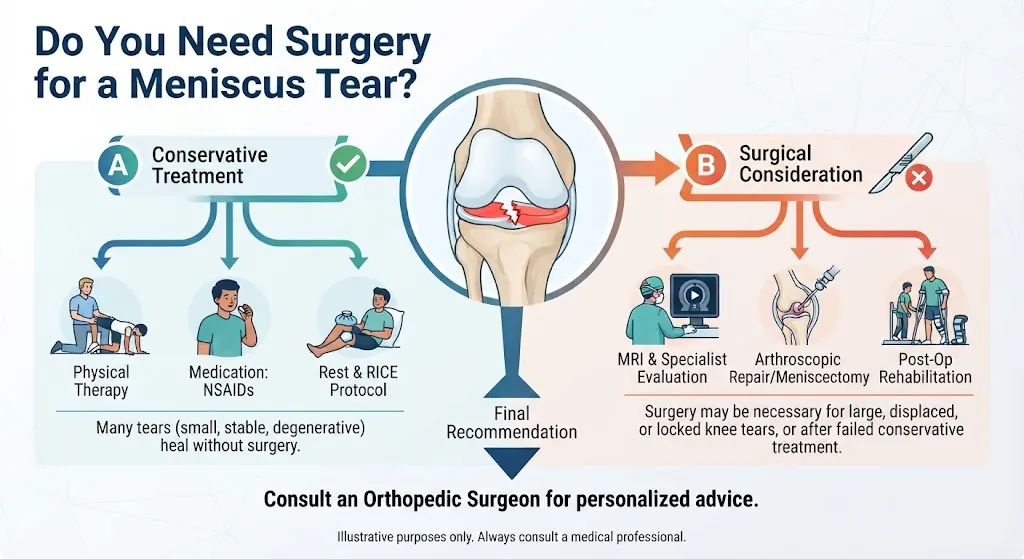
No, not every meniscus tear requires surgery. Many tears can be managed initially with activity adjustments, physical therapy, and appropriate pain relief. The best treatment depends on the tear’s location and pattern, your symptoms, your age and activity level, and whether the knee locks or becomes unstable.
This guide explains when meniscus surgery may be helpful, when nonsurgical treatment is reasonable, how doctors make the decision, and which symptoms need prompt medical attention.
When Do You Need Surgery for a Meniscus Tear?
Surgery may be considered when a tear causes persistent symptoms despite appropriate nonsurgical care, or when the injury interferes with normal knee movement. Certain tears may benefit from earlier orthopedic assessment, especially if a displaced piece of cartilage prevents the knee from straightening.
The decision is not based on MRI findings alone. Meniscus abnormalities can also appear in people who have little or no knee pain, particularly as they get older. Doctors compare imaging results with your symptoms, physical examination, injury history, and daily functional limitations.
Signs Surgery May Be Worth Considering
An orthopedic specialist may discuss surgery if you have:
-
A locked knee: You cannot fully straighten or bend the knee because something appears to block movement.
-
Persistent pain or swelling: Symptoms continue to limit daily activities despite a suitable course of conservative treatment.
-
A repairable tear: The tear’s pattern and location may allow the surgeon to stitch the damaged tissue together.
-
A traumatic injury: A sudden twisting injury causes significant symptoms, particularly when accompanied by other knee damage.
-
Ongoing mechanical symptoms: Catching or restricted movement repeatedly interferes with walking or normal knee function.
Not every click or pop means the knee is mechanically blocked. If you suddenly cannot straighten your knee, arrange prompt medical assessment rather than trying to force it into position.
When Can You Avoid Meniscus Surgery?
Nonsurgical treatment is often a reasonable first step when the tear does not block knee movement and symptoms can be managed safely. Treatment may include temporary activity changes, guided rehabilitation, and monitoring how the knee responds.
A clinician may recommend conservative care for a degenerative tear associated with age-related joint changes, especially when there is no true locking. Read about meniscus tear symptoms, treatment, and recovery to understand the range of options.
What Nonsurgical Treatment Involves
-
Activity modification: Temporarily reduce pivoting, deep squats, running, and movements that trigger pain.
-
Ice and compression: A wrapped cold pack and a comfortable compression wrap may help swelling. Avoid compression that causes numbness, color changes, or increased pain.
-
Physical therapy: Exercises can improve knee motion, strength, balance, and control. A therapist can adjust the program as symptoms change.
-
Pain relief: Medication may help, but suitability depends on your medical history and other medicines.
Some tears can improve without surgery, although the meniscus may not fully heal structurally. Learn whether a meniscus tear can heal on its own and how physical therapy may help a meniscus tear.
What Does Research Say About Surgery?
Evidence does not support operating on every tear seen on an MRI. For many degenerative meniscus tears, structured exercise-based treatment can be a reasonable alternative to arthroscopic surgery. However, evidence about degenerative tears should not automatically be applied to every sudden traumatic injury.
A 2024 clinical practice guideline on acute, isolated meniscus injuries states that selected patients who do not improve with conservative treatment may benefit from surgery; a displaced tear restricting knee movement may warrant earlier assessment. It also emphasizes preserving as much functional meniscus tissue as possible when surgery is indicated.
Meniscus Repair vs. Partial Meniscectomy
If surgery is appropriate, the surgeon may repair the tear or remove only the damaged portion that cannot be preserved. The choice depends on tear pattern, location, tissue quality, blood supply, and whether the tissue is likely to heal.
| Treatment | What happens | Main consideration |
|---|---|---|
| Meniscus repair | The torn tissue is stitched together | Preserves tissue but usually requires a longer, more restricted recovery |
| Partial meniscectomy | The unstable damaged portion is trimmed | Often allows faster early recovery but removes some cushioning tissue |
| Nonsurgical care | Rehabilitation and symptom management without an operation | May work well when the knee is not mechanically blocked |
Because the meniscus helps distribute force across the knee, preserving healthy tissue is an important goal whenever feasible. Surgery also has risks, including infection, blood clots, stiffness, and persistent symptoms.
What Symptoms Should You Watch For?
Do not assume every click means the tear is worsening. Symptoms such as pain with twisting, swelling, catching, or a knee that gives way should be interpreted alongside your ability to move and bear weight.
-
If walking on a torn meniscus makes symptoms worse, reduce the activity and seek guidance.
-
If you notice signs a meniscus tear may be getting worse, such as increasing swelling or reduced movement, arrange a clinical review.
-
Pain that appears when twisting may need assessment; see why a meniscus tear hurts when you twist your knee.
-
A knee that physically will not straighten may be different from ordinary stiffness; understand why a meniscus tear can cause knee locking.
How Long Does Recovery Take?
Recovery varies by the type of treatment and the tear itself. Symptoms may improve with conservative care over several weeks, while recovery after meniscus repair commonly takes several months because the tissue needs time to heal and activity must be increased gradually.
The expected timeline also depends on whether other structures, such as the ACL, are injured. These key differences between an ACL injury and a meniscus tear can affect both treatment planning and rehabilitation.
| Situation | General expectation |
|---|---|
| Nonsurgical treatment | Improvement may occur over several weeks, depending on symptoms and rehabilitation |
| Partial meniscectomy | Return to routine activities may take weeks, depending on recovery and work demands |
| Meniscus repair | Recovery often takes several months, with restrictions set by the surgeon |
These are general ranges, not personal predictions. Follow your clinician’s instructions about weight-bearing, driving, work, and returning to sport.
When Should You Seek Medical Care?
Get urgent assessment if your knee becomes locked, you cannot bear weight after an injury, or swelling and pain are severe or rapidly increasing. A hot, red knee with fever also needs urgent evaluation because infection is one possible cause.
Arrange a routine appointment for persistent pain, repeated swelling, catching, or instability. Symptoms can overlap with other conditions, including meniscus tears and knee arthritis, so an examination is more useful than relying on symptoms alone.
| Symptom | Suggested action |
|---|---|
| Mild pain that is improving | Modify activity and monitor symptoms |
| Ongoing pain, swelling, or catching | Arrange a medical assessment |
| A knee that cannot fully straighten | Seek prompt assessment |
| Severe injury, inability to bear weight, or a hot swollen knee with fever | Seek urgent medical care |
Frequently Asked Questions
1. Can a meniscus tear heal without surgery?
Some tears improve with nonsurgical treatment, but healing depends on the tear’s location, pattern, and blood supply. Pain improvement does not necessarily mean the cartilage has fully healed.
2. Can you have a meniscus tear without swelling?
Yes. Swelling is common but not required, and some tears cause mainly pain or catching. Persistent symptoms still deserve assessment; see whether a meniscus tear can occur without swelling.
3. Can you have a meniscus tear without pain?
Yes. Some meniscus changes, particularly age-related ones, are found on imaging in people without symptoms. A scan finding alone does not mean surgery is necessary.
4. Does every meniscus tear need an MRI?
No. A clinician may start with your injury history and physical examination, then order imaging when needed. MRI can help define an acute tear and assess other knee structures.
5. What movements should you avoid with a meniscus tear?
Temporarily avoid movements that increase pain or swelling, particularly deep squats, forceful twisting, and pivoting. The right limits depend on the injury, so ask your clinician about exercising with a meniscus tear.
6. Why does my knee hurt when I bend it?
Bending can put pressure on irritated knee structures, including a torn meniscus. Other causes are possible, so pain with bending alone cannot confirm a tear. See common causes of knee pain when bending.
7. Why does my knee hurt when I straighten it?
A tear, swelling, or another knee problem may make straightening painful. If the knee is physically blocked from straightening rather than simply sore, seek prompt assessment.
8. How long does a torn meniscus take to heal?
There is no single timeline. Symptoms may improve within weeks with nonsurgical care, while a repaired meniscus usually requires months of rehabilitation; more details are available in this meniscus tear recovery timeline.
9. Does knee instability mean I need surgery?
Not always. A knee that gives way can reflect pain, weakness, or an associated ligament injury, so assessment is important. Learn about why a knee may feel like it is giving out.
10. What if my knee still hurts after treatment?
Persistent symptoms may mean the rehabilitation plan needs adjustment or that another condition is contributing. Follow up with your clinician rather than assuming surgery is the only remaining option; broader knee pain causes and treatment options may help explain why evaluation matters.
The Bottom Line
You do not automatically need surgery for a meniscus tear. Many people can begin with activity modification and physical therapy, while displaced tears, a truly locked knee, or persistent symptoms may require orthopedic evaluation. The goal is to choose treatment based on your symptoms and injury while preserving as much healthy meniscus tissue as possible.
Disclaimer: This article is provided for educational and informational purposes only.
This article is for education purpose only and is not a diagnosis or a substitute for medical advice.