
Quick answer
Yes. A meniscus tear can occur without visible swelling. Pain, catching, stiffness or limited motion may still occur, and some tears cause few symptoms. Symptoms alone cannot confirm a tear; seek assessment for locking, inability to bear weight, major trauma or worsening symptoms.
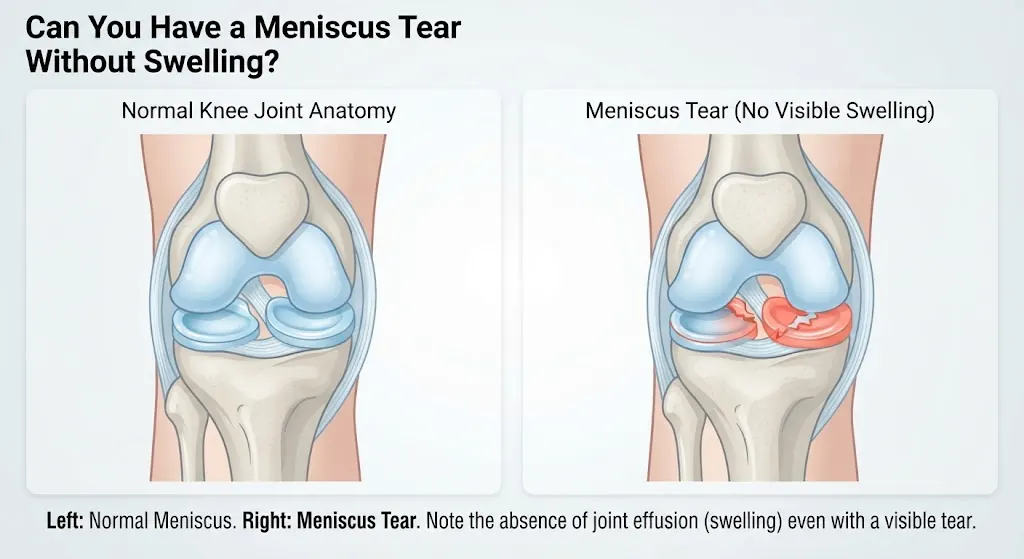
This can make a meniscus injury difficult to recognize. You might be able to walk, bend your knee, or continue daily activities while still experiencing discomfort when twisting, squatting, or using stairs. Being able to walk does not rule out a tear.
Understanding the symptoms of a meniscus tear without swelling can help you decide what to monitor, which activities to modify, and when to seek medical evaluation. However, no single symptom can confirm a tear without an examination.
Why Can a Meniscus Tear Occur Without Swelling?
The menisci are two crescent-shaped pieces of cartilage inside the knee that help distribute weight, absorb impact, and support joint stability. A tear can occur during a twisting injury, sports activity, or gradual age-related tissue changes.
Swelling depends partly on the injury’s severity and the body’s response. Some knee injuries cause substantial fluid buildup, while others produce localized pain with little visible inflammation. Smaller or degenerative tears may not cause obvious swelling, although the amount of swelling alone cannot establish how serious an injury is.
What Are the Signs of a Meniscus Tear Without Swelling?
Common symptoms can include:
-
Pain along the joint line: Discomfort on the inner or outer side of the knee, especially when twisting or bending.
-
Pain during squats: Deep knee bending may increase pressure on the injured area.
-
Clicking or catching: The knee may feel as though something briefly catches during movement.
-
Stiffness: Bending or straightening the knee may feel uncomfortable, particularly after sitting.
-
A feeling of instability: The knee may feel unreliable or give way, although this can have other causes.
-
Reduced movement: Straightening or bending the knee fully may become difficult.
Not everyone experiences these symptoms. To understand how symptoms vary, see this guide to meniscus tear symptoms, treatment, and recovery.
Meniscus Tear With Swelling vs. Without Swelling
| Feature | With visible swelling | Without visible swelling |
|---|---|---|
| Knee appearance | May look enlarged or feel tight | May look normal |
| Pain | Can range from mild to severe | Can also range from mild to severe |
| Movement | Swelling may restrict bending | Pain or catching may still limit movement |
| Walking | May be uncomfortable or difficult | May remain possible |
| Does it confirm a tear? | No | No |
Important: Swelling is only one clue. Neither its presence nor its absence can confirm or exclude a meniscus tear.
What Else Can Cause Knee Pain Without Swelling?
Meniscus tears are not the only explanation for knee pain when the joint looks normal.
| Possible cause | Symptoms that may occur |
|---|---|
| Meniscus tear | Joint-line pain, catching, discomfort with twisting |
| Knee osteoarthritis | Stiffness after rest, aching with activity, reduced flexibility |
| Patellofemoral pain | Pain around or behind the kneecap, often with stairs or squats |
| Tendon irritation | Localized pain during jumping, running, or resisted movement |
| Ligament injury | Pain or instability, often following a specific injury |
For a closer comparison, read about meniscus tears versus knee arthritis. If your knee hurts when bending but does not visibly swell, the movement that triggers the pain and the location of discomfort can help guide an evaluation.
What Should You Do If You Suspect a Meniscus Tear?
If symptoms are mild and you can walk comfortably, initial care can focus on protecting the knee while monitoring changes.
-
Reduce aggravating activities: Temporarily avoid pivoting, deep squats, running, and movements that trigger sharp pain.
-
Apply ice: Use a cold pack wrapped in a towel for about 15–20 minutes at a time.
-
Keep movement comfortable: Gentle bending and straightening may help prevent stiffness, but do not force the knee through pain.
-
Adjust weight-bearing: If walking causes significant pain or limping, reduce how much weight you place on the leg and seek medical advice.
-
Avoid repeatedly testing the knee: Twisting or squatting to check whether it still hurts may aggravate symptoms.
For more guidance, see whether walking on a torn meniscus can make it worse.
How Is a Meniscus Tear Diagnosed Without Swelling?
A clinician typically asks how the pain started, where it occurs, and whether the knee catches, locks, or gives way. They may examine tenderness, range of motion, and specific knee movements.
An X-ray can help assess bones and signs of arthritis, but it generally does not show the meniscus itself. An MRI may be considered when the history and examination suggest a tear and the result would help guide treatment. Imaging findings must be interpreted alongside symptoms because meniscus changes can sometimes appear even when they are not the source of pain.
Treatment depends on the tear’s pattern, location, symptoms, activity needs, and other knee conditions. Some tears improve with activity modification and physical therapy; others may require specialist assessment. Surgery is not automatically necessary.
When Should You Seek Medical Care?
Arrange a medical appointment if knee pain persists, repeatedly returns, interferes with daily activities, or comes with catching or instability.
Seek urgent evaluation if you cannot bear weight, develop severe pain after an injury, or have a knee that becomes hot and swollen with fever. A knee that is physically locked and cannot fully straighten also needs prompt assessment.
Do not wait for swelling to appear if your symptoms are worsening or your knee function is significantly limited.
Frequently Asked Questions
1. Can a small meniscus tear cause no swelling?
Yes. Some tears cause localized pain or catching without noticeable swelling. Symptoms alone cannot determine the size or severity of the tear.
2. Can you walk with a meniscus tear and have no swelling?
Yes, walking may remain possible. However, being able to walk does not rule out an injury, especially if twisting or bending causes pain.
3. Does a meniscus tear always hurt?
No. Some meniscus tears, particularly age-related changes, may cause few or no symptoms. Others cause pain, stiffness, catching, or restricted movement.
4. Can a meniscus tear cause pain only when bending?
Yes. Deep bending can aggravate symptoms in some people with a meniscus tear, but cartilage irritation, arthritis, and other knee conditions can cause similar pain.
5. Can a meniscus tear heal without surgery?
Some tears can improve with nonsurgical treatment, depending on their location, pattern, and symptoms. The meniscus has a limited blood supply in many areas, so healing potential varies.
6. How long can a meniscus tear hurt without swelling?
The duration varies from days to months, depending on the cause and severity. Persistent or recurring pain should be evaluated rather than judged by the absence of swelling.
7. Can an MRI detect a meniscus tear if there is no swelling?
Yes. An MRI can show meniscus abnormalities even when the knee looks normal externally. A clinician must determine whether the imaging finding matches your symptoms and examination.
8. Should I exercise with a suspected meniscus tear?
Avoid activities that cause sharp pain, twisting, or catching until you have a clearer understanding of the injury. A clinician or physical therapist can help determine which movements are appropriate.
9. Does clicking without swelling mean a meniscus tear?
Not necessarily. Knee clicking can occur for several reasons, including normal joint movement. Painful clicking or catching deserves evaluation if it persists or limits function.
10. When does a meniscus tear need surgery?
Surgery may be considered for selected tears that cause persistent symptoms, mechanical problems, or functional limitations despite appropriate treatment. The decision depends on the tear and individual circumstances, not simply on whether swelling is present.
Conclusion
A meniscus tear can occur without visible swelling, so a normal-looking knee does not rule out an injury. Pay attention to joint-line pain, catching, stiffness, and difficulty bending or straightening the knee. Modify painful activities and seek medical evaluation if symptoms persist, worsen, or limit movement.
Disclaimer: This article is provided for educational and informational purposes only.
This article is for education purpose only and is not a diagnosis or a substitute for medical advice.