
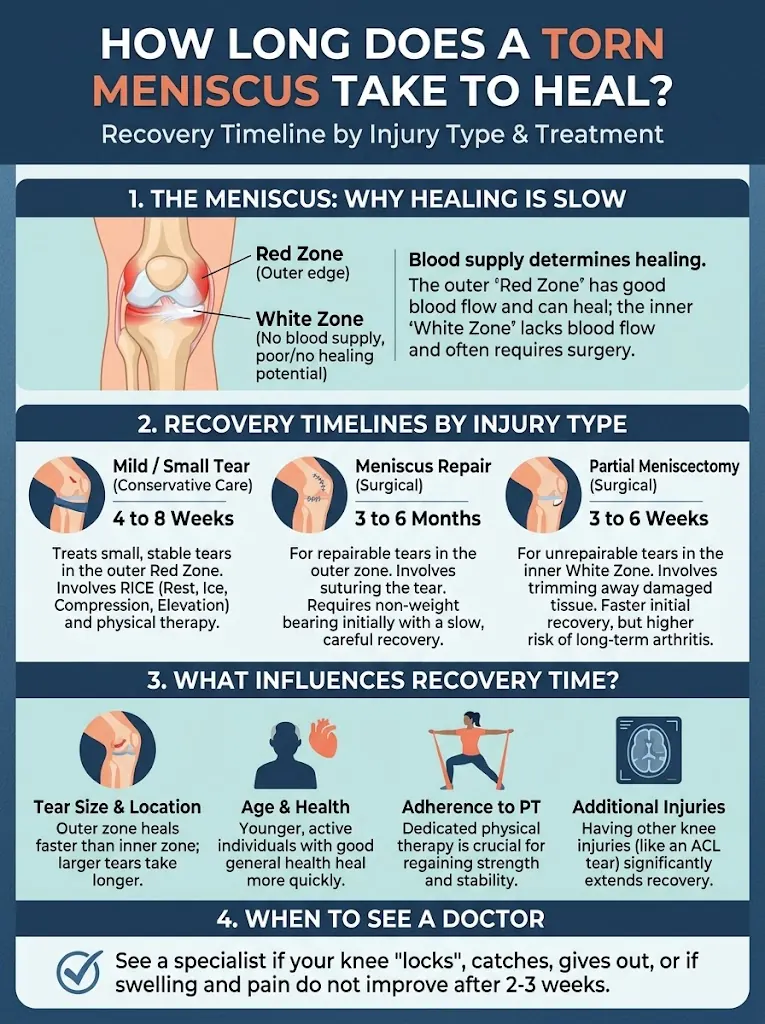
A torn meniscus can cause knee pain, swelling, stiffness, clicking, or difficulty bending and straightening the leg. Everyday activities such as walking, climbing stairs, squatting, and getting out of a chair may become uncomfortable. Recovery time varies, so understanding what influences healing can help you set realistic expectations and avoid returning to activity too soon.
Not every meniscus tear requires surgery, and not every tear heals at the same rate. Some smaller tears improve with activity modification and physical therapy, while certain tears may have limited healing potential because of their location, size, or pattern. Persistent swelling, locking, or difficulty bearing weight should not be ignored.
So, how long does a torn meniscus take to heal? This guide explains typical recovery timelines by injury type and treatment, what can affect healing, how to manage symptoms safely, and when to seek medical evaluation.
How Long Does a Torn Meniscus Take to Heal?
A meniscus tear may improve within several weeks, but full recovery can take several months or longer, depending on the injury and treatment. Symptom improvement does not necessarily mean the torn tissue has completely healed.
| Injury or treatment | General recovery expectation | Important consideration |
|---|---|---|
| Small, stable tear treated without surgery | Several weeks to a few months for symptom improvement | Some tears remain structurally present despite reduced pain |
| Tear with persistent swelling or mechanical symptoms | Several weeks or longer, depending on severity | Locking or repeated catching needs evaluation |
| Meniscus repair surgery | Often several months; commonly around 3–6 months or longer for full activity | The repaired tissue needs time to heal |
| Partial meniscectomy (removal of damaged tissue) | Often several weeks to return to many daily activities | Recovery depends on swelling, strength, and activity demands |
These are broad estimates, not guarantees. Your clinician may recommend a different timeline based on the tear pattern, other knee injuries, and your recovery progress.
What Affects Meniscus Tear Recovery Time?
The meniscus is a C-shaped piece of cartilage-like tissue that cushions the knee and helps distribute load between the thighbone and shinbone. Each knee has a medial meniscus on the inner side and a lateral meniscus on the outer side.
Several factors influence how quickly symptoms improve:
- Tear location: The outer edge has a better blood supply than the inner portion. Tears in the outer, vascular region generally have greater healing potential than tears in areas with limited blood flow.
- Tear pattern and size: Small, stable tears may be easier to manage than large, displaced, or complex tears.
- Age and tissue condition: Degenerative tears can develop gradually as the meniscus changes with age. They may coexist with knee osteoarthritis.
- Associated injuries: An ACL injury or damage to other knee structures can complicate rehabilitation.
- Activity demands: Repeated twisting, deep squatting, pivoting, or heavy loading may aggravate symptoms during recovery.
- Treatment approach: Conservative treatment, meniscus repair, and partial meniscectomy involve different rehabilitation goals and timelines.
For a broader overview of meniscus tear symptoms, treatment, and recovery, consider how your symptoms and activity limitations fit into the overall recovery process.
Do Different Types of Meniscus Tears Heal at Different Rates?
Yes. The tear’s location and shape can affect its healing potential, although imaging findings alone do not determine the treatment plan.
| Tear type | General healing potential | What it may mean for recovery |
|---|---|---|
| Peripheral tear near the outer edge | Often better because blood supply is stronger | Some suitable tears may heal or be repaired |
| Inner-zone tear | More limited because blood supply is poor | Symptoms may improve without the tear fully healing |
| Horizontal or degenerative tear | Variable | Treatment often depends on symptoms and coexisting arthritis |
| Displaced tear | May interfere with knee movement | Prompt assessment is important if the knee locks or cannot straighten |
| Tear with an ACL injury | Depends on both injuries | Rehabilitation may need to address knee stability as well as the meniscus |
A meniscus tear versus ACL injury comparison can help explain why these injuries may produce overlapping symptoms but require different assessments.
How Long Does a Torn Meniscus Take to Heal Without Surgery?
When surgery is not needed, pain and swelling may improve over several weeks, with continued progress over the following months. However, some tears do not heal completely because the damaged area receives little blood supply.
A clinician may recommend temporarily reducing activities that trigger pain, using ice for short periods, and beginning an individualized physical therapy program. Treatment may focus on restoring comfortable knee movement, strengthening the quadriceps and hip muscles, and improving balance.
Whether a meniscus tear can heal on its own depends on its characteristics. Conservative care can improve function even when the tissue does not return to its original structure.
Walking is not automatically harmful, but limping, worsening swelling, or increasing pain suggests the knee may not tolerate the current activity level. Learn whether walking on a torn meniscus can make it worse before pushing through symptoms.
How Long Does Recovery Take After Meniscus Surgery?
Recovery depends on which procedure is performed.
Meniscus repair
During repair, a surgeon stitches suitable torn tissue together. Because the tissue needs to heal, weight-bearing, knee bending, and exercise may be restricted initially. Returning to running and sports often takes several months and depends on meeting rehabilitation milestones.
Partial meniscectomy
During a partial meniscectomy, the surgeon removes the damaged portion of the meniscus that cannot be preserved. Many people resume routine activities sooner than after repair, but swelling, stiffness, weakness, and activity-related discomfort may continue during rehabilitation.
| Recovery milestone | After repair | After partial meniscectomy |
|---|---|---|
| Early movement | May be restricted by the repair protocol | Usually encouraged as tolerated under instructions |
| Crutches or weight-bearing limits | May be needed for several weeks | Often needed for a shorter period |
| Strength and balance training | Progresses according to tissue healing | Progresses as pain and swelling allow |
| Return to sports | Often several months or longer | May occur sooner, depending on strength and function |
These are general patterns, not personalized clearance dates. Follow your surgeon’s instructions, especially if the procedure included treatment for another injury.
What Can You Do to Support Recovery?
The safest approach is to protect the knee from movements that aggravate symptoms while maintaining appropriate movement and strength.
- Modify painful activities. Temporarily limit deep squats, twisting, pivoting, and sudden changes in direction.
- Manage swelling. Apply a cold pack wrapped in a towel for about 15–20 minutes at a time.
- Keep moving within your limits. Gentle movement may help prevent stiffness, but stop activities that cause sharp pain or worsening swelling.
- Follow a rehabilitation plan. A physical therapist can guide progressive strengthening and balance exercises.
- Increase activity gradually. Do not use reduced pain alone as proof that the knee is ready for running or sports.
Ask your clinician which exercises are appropriate for a meniscus tear. The right program depends on symptoms, tear type, and whether surgery has been performed.
When Should You Seek Medical Care?
Arrange a medical assessment if knee pain or swelling persists, symptoms repeatedly return, or the knee catches during movement. An examination can help determine whether imaging or specialist treatment is appropriate.
Seek urgent medical attention if you cannot bear weight after an injury, the knee becomes locked and cannot straighten, or severe swelling develops rapidly. A hot, red knee accompanied by fever also requires prompt evaluation because infection must be considered.
Frequently Asked Questions
1. Can a torn meniscus heal in two weeks?
Some people notice improvement within two weeks, particularly when symptoms are mild. However, symptom relief does not necessarily mean the tear has healed.
2. Can you walk normally with a torn meniscus?
Yes, some people can walk with a meniscus tear, while others develop pain, swelling, or a limp. Avoid forcing normal walking if symptoms worsen or the knee feels unstable.
3. Does every meniscus tear require surgery?
No. Many tears, particularly some degenerative tears, can initially be managed with activity modification and physical therapy. Surgery may be considered for selected tears or persistent mechanical symptoms.
4. Which meniscus tears are most likely to heal?
Tears near the outer edge generally have better healing potential because that area has a stronger blood supply. The pattern, size, stability, and overall knee condition also matter.
5. How do you know if a meniscus tear is healing?
Improved walking, less swelling, better knee movement, and increased tolerance for daily activities may indicate progress. Only a clinical assessment can determine whether further evaluation is needed.
6. Can a meniscus tear get worse over time?
It can, especially if the knee is repeatedly exposed to aggravating movements or if symptoms reflect an unstable tear. Worsening pain, swelling, catching, or locking deserves medical review.
7. Is heat or ice better for a torn meniscus?
Ice may help relieve pain and swelling, particularly after activity or an acute injury. Heat may feel soothing for stiffness in some situations, but avoid applying heat to a newly swollen knee without appropriate guidance.
8. When can you return to running after a meniscus tear?
Return to running depends on pain, swelling, strength, knee control, and treatment type. After surgery, follow your rehabilitation team’s criteria rather than relying on a fixed number of weeks.
9. Can physical therapy help a meniscus tear?
Physical therapy can improve strength, movement, balance, and function, and it may reduce symptoms in appropriate cases. It cannot guarantee that every tear will structurally heal.
10. What happens if a meniscus tear is left untreated?
Some tears remain manageable, but others may cause ongoing pain, swelling, or mechanical symptoms. If symptoms persist or the knee locks, seek an assessment rather than assuming the injury will resolve on its own.
Conclusion
A torn meniscus may improve over several weeks, but complete recovery can take months, particularly after meniscus repair surgery. Tear location, injury pattern, treatment, and rehabilitation all influence the timeline. Reduce activities that aggravate symptoms, follow an appropriate recovery plan, and seek medical care for persistent pain, worsening swelling, or knee locking.
Disclaimer: This article is provided for educational and informational purposes only.
This article is for education purpose only and is not a diagnosis or a substitute for medical advice.