
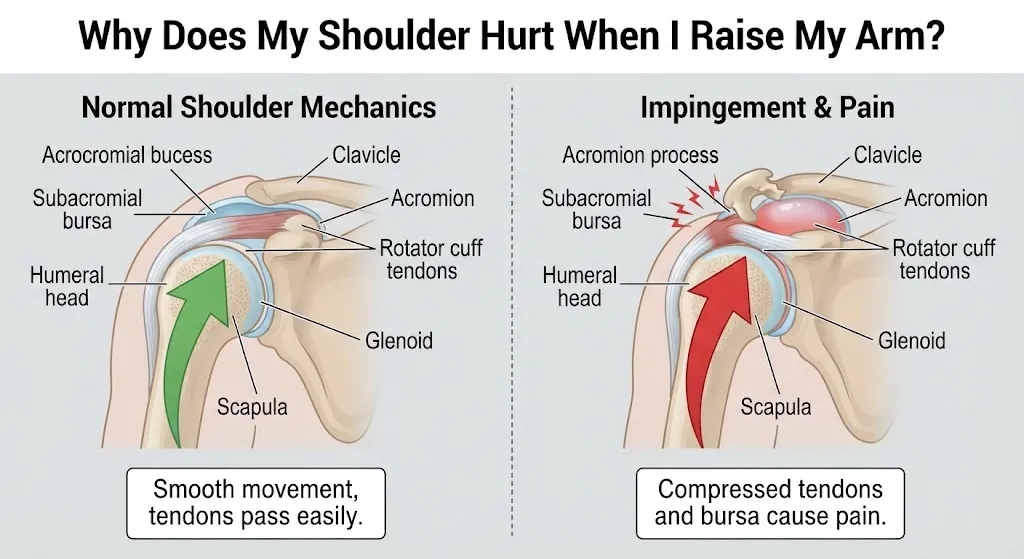
Pain during arm elevation does not automatically mean you have a torn tendon or a serious injury. Several conditions can cause similar symptoms, and the level of pain alone cannot identify the cause. However, sudden weakness, a major injury, or shoulder pain accompanied by chest discomfort or breathing difficulty needs prompt attention.
Understanding why your shoulder hurts when you raise your arm can help you recognize common patterns, choose safer ways to manage discomfort, and decide when to seek medical care. The location of the pain, how it began, and whether you can move your arm normally are all useful clues.
What causes shoulder pain when raising your arm?
The most common causes involve the rotator cuff tendons, the bursa that cushions shoulder structures, or the tissues surrounding the joint. Neck problems, arthritis, and injuries can also contribute. A clinician may need to examine your shoulder to distinguish between these possibilities.
Common causes and how they differ
| Possible cause | Symptoms that may occur | Typical movement difficulty |
|---|---|---|
| Rotator cuff tendinopathy or tear | Aching, pain with lifting, possible weakness | Reaching overhead or lifting objects |
| Shoulder impingement-related pain | Pinching or aching during elevation | Raising the arm through certain angles |
| Shoulder bursitis | Pain with movement, sometimes at night | Lifting or lying on the affected side |
| Frozen shoulder | Gradually increasing pain and stiffness | Reaching overhead or behind the back |
| AC joint injury or arthritis | Pain near the top of the shoulder | Reaching across the chest or lifting |
| Neck-related nerve irritation | Pain traveling from the neck into the shoulder or arm, sometimes tingling | Movement may vary with neck position |
These patterns overlap, so they are clues rather than a diagnosis. For a broader overview, see the common types of shoulder pain and what causes them.
Rotator cuff problems
The rotator cuff is a group of muscles and tendons that helps stabilize and move the shoulder. Irritation, degeneration, or a tear can cause pain when lifting your arm, weakness, or discomfort at night. Learn about the signs of a rotator cuff tear.
Shoulder impingement and bursitis
Shoulder impingement is a term commonly used for pain associated with raising the arm as tissues around the joint become irritated or compressed during movement. Bursitis involves inflammation of a small fluid-filled sac that reduces friction. Both may cause pain with overhead activity, but symptoms alone cannot reliably separate them. Read about shoulder impingement symptoms and treatment and shoulder bursitis symptoms and possible relief.
Other possible causes
-
Tendon irritation: Shoulder tendonitis can cause tenderness and pain during repeated lifting. See shoulder tendonitis symptoms and treatment options.
-
Frozen shoulder: Increasing stiffness may make several directions of movement difficult, not just lifting. Compare frozen shoulder and shoulder impingement.
-
AC joint problems: Pain at the top of the shoulder, especially after a fall or direct impact, may involve the acromioclavicular joint. Learn about AC joint injury symptoms and recovery.
-
Labral injury: A tear in the cartilage rim around the shoulder socket may cause deep pain, catching, or a feeling of instability. Explore early signs of a shoulder labral tear.
Why does the pain happen at certain arm angles?
Pain that appears during part of the lifting motion can occur when irritated tissues are loaded or moved. Pain near the top or outer side of the shoulder may occur with rotator cuff-related problems, while stiffness in several directions may suggest a different issue. These patterns are not specific enough to confirm a condition without an assessment.
| Symptom pattern | What it may suggest | What to consider |
|---|---|---|
| Pain mainly overhead | Rotator cuff irritation or impingement-related pain | Reduce repeated overhead lifting temporarily |
| Pain with weakness after an injury | Possible significant tendon or other injury | Arrange prompt medical assessment |
| Pain and stiffness in several directions | Frozen shoulder or joint disease | Seek evaluation if movement remains limited |
| Pain extending from the neck down the arm | Possible nerve irritation | Mention numbness, tingling, or neck pain to a clinician |
If you notice pain when lifting everyday objects, this related guide covers why shoulder pain can occur when lifting something. If you have discomfort even without a clear injury, see possible causes of shoulder pain without an injury.
What can you do at home?
For mild pain without warning signs, temporarily modify activities that trigger symptoms rather than forcing your arm through painful movements. Complete rest for a prolonged period can increase stiffness, so gentle, comfortable movement is usually preferable.
-
Modify painful tasks: Reduce heavy lifting and repeated overhead reaching for now.
-
Try a cold pack: Wrap it in a towel and apply for 15–20 minutes at a time. Avoid direct ice-to-skin contact.
-
Keep movement comfortable: Move the shoulder gently within a tolerable range. Stop if an exercise causes sharp pain or worsening symptoms.
-
Review posture and activity: Avoid staying in one position for long periods. Posture correction exercises for shoulder and neck pain may be useful when posture contributes to discomfort.
-
Consider suitable pain relief: Ask a pharmacist or clinician which option is safe for you, especially if you have kidney disease, stomach ulcers, heart disease, take blood thinners, or are pregnant.
For additional guidance, review shoulder pain relief at home. Avoid starting strengthening exercises until you can perform them without significant pain; a clinician or physical therapist can help select appropriate movements. You can also discuss exercises for shoulder pain relief and how to prevent shoulder injuries during workouts.
When should you seek medical care?
Arrange an appointment if the pain persists, keeps returning, disrupts sleep, limits daily activities, or is accompanied by reduced strength or movement. A clinician may assess your range of motion, strength, neck, and shoulder, then decide whether imaging is needed. X-rays and MRI scans show different structures, so the right test depends on the suspected cause; see X-ray versus MRI for shoulder pain.
| Level of concern | Signs | Recommended action |
|---|---|---|
| Usually reasonable to monitor briefly | Mild pain after activity that is improving, with normal arm function | Modify activities and monitor symptoms |
| Medical assessment needed | Persistent pain, worsening stiffness, recurring symptoms, or weakness | Arrange a clinical appointment |
| Urgent assessment | Sudden severe pain, major injury, inability to move the arm, deformity, or a hot, red shoulder with fever | Seek urgent medical care |
| Emergency | Shoulder or arm pain with chest pressure, shortness of breath, sweating, faintness, or nausea | Call 911 in the United States |
Pain spreading down the arm can sometimes involve nerves in the neck; review causes of shoulder pain that radiates down the arm and neck pain that radiates to the shoulder. Do not assume that unexplained shoulder pain is only a muscle problem: shoulder pain and possible heart-related warning signs deserve particular attention when other emergency symptoms occur.
Frequently Asked Questions
1. Why does my shoulder hurt only when I raise my arm?
Pain during lifting can result from irritation of the rotator cuff tendons, bursa, or other shoulder structures. The movement that triggers pain helps guide an examination but does not establish the cause.
2. Does shoulder pain when lifting my arm mean I have a rotator cuff tear?
No. Tendon irritation, bursitis, and other conditions can produce similar symptoms. Sudden weakness after an injury warrants prompt assessment.
3. Why does my shoulder hurt more when I lift my arm overhead?
Overhead movement places different demands on the shoulder and may aggravate irritated tissues. Temporarily reducing painful overhead activity can help while you monitor symptoms.
4. Can shoulder pain improve without treatment?
Mild activity-related pain may improve with activity modification and gradual return to comfortable movement. Persistent, worsening, or function-limiting symptoms should be evaluated.
5. Should I stretch a painful shoulder?
Gentle movement may help maintain mobility, but forceful stretching can aggravate some injuries. Stop movements that cause sharp pain or worsening symptoms.
6. Why does my shoulder hurt at night?
Night pain can occur with rotator cuff problems, bursitis, and other conditions, particularly when lying on the affected side. Persistent sleep-disrupting pain is a reason to seek an assessment.
7. Can neck problems cause shoulder pain when raising my arm?
Yes. Nerve irritation or other neck conditions can cause pain that spreads into the shoulder or arm. Tingling, numbness, or symptoms that change with neck movement are useful details to report.
8. Do I need an MRI for shoulder pain?
Not always. Many evaluations begin with your medical history and physical examination; imaging is considered when findings suggest it would change care.
9. How long does shoulder pain from lifting last?
Recovery depends on the underlying cause, severity, and how the shoulder is used during recovery. Seek medical advice if symptoms are not improving, recur frequently, or limit normal activities.
10. When is shoulder pain an emergency?
Seek emergency help if shoulder pain occurs with chest pressure, difficulty breathing, sweating, faintness, or nausea. Major injuries, visible deformity, or inability to move the arm also require urgent assessment.
Conclusion
Shoulder pain when raising your arm can arise from several conditions, including rotator cuff irritation, bursitis, impingement-related pain, and joint stiffness. Temporarily modify painful activities, keep movement gentle, and seek assessment if symptoms persist or worsen. Sudden severe symptoms or signs of a possible heart problem require urgent attention.
Disclaimer: This article is provided for educational and informational purposes only.
This article is for education purpose only and is not a diagnosis or a substitute for medical advice.