
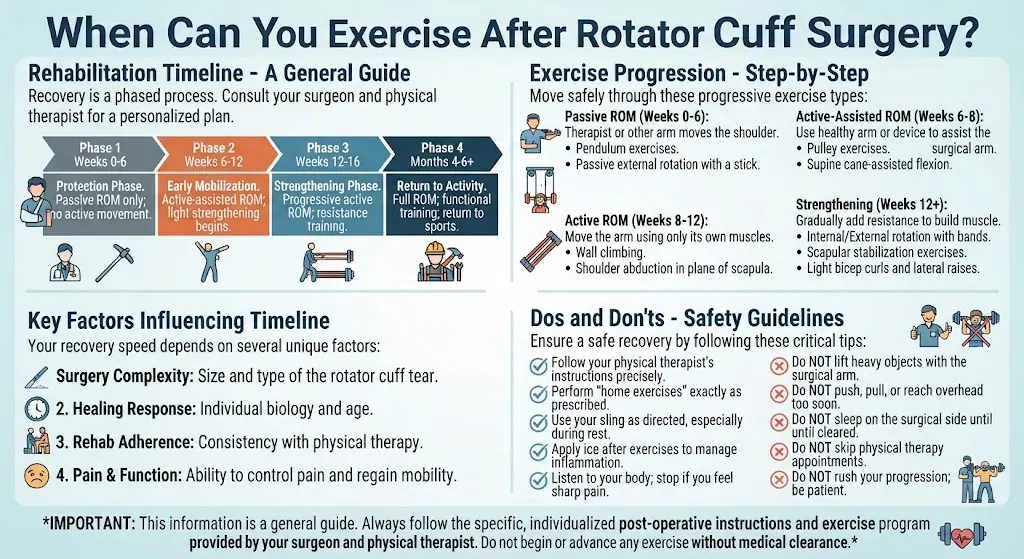
It is normal to feel eager to regain strength, especially if shoulder pain prevented you from exercising before surgery. However, less pain does not necessarily mean the repaired tendon is ready for resistance or strenuous movement. Recovery depends on the size of the tear, the type of repair, and your surgeon’s rehabilitation protocol.
This guide explains when you can exercise after rotator cuff surgery, which activities are generally introduced at different stages, what to avoid, and how to recognize signs that you may be progressing too quickly. Your surgical team’s instructions should always take priority over general timelines.
When Can You Start Exercising After Rotator Cuff Surgery?
You can often begin a structured rehabilitation program soon after surgery, but the type of exercise matters more than the date alone. Early rehabilitation may focus on protecting the repair and maintaining movement in areas that are safe to move. Active shoulder movement and strengthening exercises are introduced later, according to your surgeon’s instructions.
A typical recovery may involve several stages, but these are planning estimates rather than fixed deadlines.
Typical Exercise Timeline After Rotator Cuff Repair
| Recovery stage | Exercises or activities that may be introduced | Main goal |
|---|---|---|
| Weeks 0–2 | Prescribed hand, wrist, and elbow movements; shoulder protection | Protect the repair |
| Weeks 2–6 | Therapist-guided passive shoulder movement, if permitted | Maintain safe mobility |
| Weeks 6–12 | Gradual active shoulder movement when cleared | Regain movement control |
| Around weeks 12–16 | Progressive resistance exercises, if approved | Rebuild strength |
| Around 4–6 months or later | Gradual return to demanding workouts and sports | Restore functional capacity |
These stages are examples, not universal instructions. Some patients need slower progression, particularly after larger tears or complex repairs. Your rehabilitation protocol may differ substantially from this table.
What Exercises Can You Do in the Early Weeks?
During early recovery, the priority is protecting the tendon rather than strengthening the shoulder. Your surgeon may prescribe gentle movements for your hand, wrist, and elbow, along with specific shoulder exercises performed by a physical therapist.
Passive Range-of-Motion Exercises
Passive movement means your operated shoulder is moved with assistance rather than powered by your own shoulder muscles. A therapist or an approved technique may help move the arm within prescribed limits.
Do not assume that pendulum exercises, wall walks, or assisted arm raises are appropriate immediately after surgery. Even exercises described as gentle can place unwanted stress on a repair if performed incorrectly or too early.
Follow your instructions for rotator cuff rehabilitation and recovery and wearing a sling after rotator cuff surgery.
Can You Walk After Rotator Cuff Surgery?
Walking is often possible soon after surgery if you are steady on your feet, your medical team has not restricted it, and your arm remains protected as instructed. Start with short, comfortable walks and increase gradually as your energy returns.
Avoid uneven terrain, activities that risk falling, and carrying weights with the operated arm. If you also want to maintain general fitness, low-impact exercise options for joint pain may provide ideas for later stages, but your immediate postoperative restrictions come first.
When Can You Start Shoulder Strengthening?
Strengthening often begins around 8–12 weeks or later, depending on healing and the surgical protocol. Some rehabilitation plans delay resistance work until approximately week 12. Your therapist may first focus on controlled active movement before introducing bands, light weights, or other resistance.
The 2016 rehabilitation consensus statement for arthroscopic rotator cuff repair recommends gradual loading, with protected passive movement followed by active movement and progressive strengthening. The 2025 clinical practice guideline from the American Academy of Orthopaedic Surgeons also reports that, for selected small-to-medium full-thickness tears, earlier versus delayed mobilization can produce similar outcomes. These findings do not mean every repair can safely follow the same schedule.
How to Progress From Movement to Strength
| Exercise category | Typical place in rehabilitation | Key precaution |
|---|---|---|
| Passive movement | Early, when prescribed | Do not actively lift the arm unless cleared |
| Active range of motion | After initial protection | Avoid shrugging or forcing movement |
| Isometric exercises | When specifically approved | Use only the instructed effort and position |
| Resistance bands or light weights | Often around 8–12 weeks or later | Start only after clearance |
| Push-ups, heavy presses, and overhead lifts | Later-stage rehabilitation | Require adequate strength and specific approval |
A structured shoulder exercise program for general shoulder pain is not automatically suitable after tendon repair. Postoperative exercises must match the procedure and healing stage.
When Can You Return to the Gym, Swimming, or Sports?
Returning to exercise outside physical therapy depends on the activity’s demands. Lower-body workouts may be possible earlier than upper-body training, while swimming, racket sports, weightlifting, and overhead sports generally require more recovery and specific clearance.
-
Gym workouts: Lower-body machines or stationary cycling may be options if you can maintain balance, protect the operated arm, and follow your surgeon’s restrictions.
-
Swimming: Wait until your incision has healed, shoulder movement is adequate, and your surgeon approves swimming and the required arm movements.
-
Weightlifting: Avoid pressing, pulling, and lifting with the operated arm until resistance training is authorized.
-
Sports: Throwing, tennis, golf, and similar activities need a gradual return that accounts for strength, control, and sport-specific demands.
If you are an athlete, shoulder injury prevention during workouts becomes particularly important when you eventually resume training. Use an appropriate warm-up before exercise once your clinician clears you for more activity.
What Exercises Should You Avoid After Surgery?
Until your surgical team permits them, avoid:
-
Lifting weights with the operated arm.
-
Push-ups, pull-ups, bench presses, and overhead presses.
-
Forceful shoulder stretches or sudden reaching.
-
Resistance-band exercises that activate the repaired tendon.
-
Throwing, swimming strokes, or sports movements that load the shoulder.
-
Any movement that violates your prescribed range-of-motion or lifting limits.
These restrictions protect the repair while it heals. If you are also recovering from a labral injury, the recommendations in exercises to avoid with a shoulder labral tear may be relevant, but a labral repair and a rotator cuff repair are different procedures.
How Do You Know If You Are Exercising Too Much?
Mild, temporary discomfort can occur during rehabilitation, but sharp pain, increasing pain, or a sudden loss of function should not be ignored. Do not push through pain to meet a repetition target or progress to the next exercise.
Contact your surgical team if you notice new weakness, worsening swelling, persistent numbness, or pain that continues to increase after exercise. Fever with worsening redness or drainage from the incision also requires prompt medical assessment. Seek emergency care for chest pain or sudden shortness of breath.
A useful rule is to progress only when your current exercises are tolerated within the limits set by your therapist. Do not increase resistance, repetitions, and range of motion all at once without guidance.
For additional context, signs of a rotator cuff tear explain common symptoms of the original injury, while shoulder pain relief at home covers general comfort measures. Neither replaces postoperative advice if symptoms change after surgery.
Frequently Asked Questions
1. Can I exercise one week after rotator cuff surgery?
You may be allowed to perform specific hand, wrist, and elbow movements, but shoulder exercises depend on your surgeon’s protocol. Do not start independent shoulder exercises during the first week unless they have been prescribed.
2. When can I lift weights after rotator cuff surgery?
Resistance training often begins around 8–12 weeks or later, depending on the repair and your progress. Heavy lifting and overhead weights generally require additional rehabilitation and explicit clearance.
3. Can I do leg day after rotator cuff surgery?
Possibly, if you can exercise without putting weight through the operated arm or risking a fall. Avoid exercises that require gripping heavy weights, supporting your body with your arms, or making sudden shoulder movements.
4. When can I do push-ups after rotator cuff surgery?
Push-ups place substantial demands on the shoulder and should be avoided until your surgeon or physical therapist approves them. The timing depends on strength, movement control, and tendon healing.
5. When can I swim after rotator cuff surgery?
Swimming may need to wait several months, depending on healing and the movements involved. Your incision must heal, and your surgeon must approve both swimming and active shoulder use.
6. Can I use resistance bands during recovery?
Resistance bands are generally introduced during a later strengthening stage, not automatically during early recovery. Your therapist should determine the appropriate resistance, movement, and starting point.
7. Is it normal to have shoulder pain during physical therapy?
Some discomfort may occur, but sharp or increasing pain should not be ignored. Tell your therapist if symptoms worsen during exercise or remain significantly aggravated afterward.
8. How often should I do my rehabilitation exercises?
Follow the frequency and repetitions prescribed by your therapist. More exercise is not necessarily better; adequate recovery between sessions and correct technique matter.
9. When can I return to my normal workout routine?
Many people need several months to return to demanding workouts, and some need longer. Use your rotator cuff recovery timeline as general context, not as clearance for unrestricted training.
10. What if I accidentally move my arm too much?
One unexpected movement does not automatically mean the repair has failed. Stop the activity and contact your surgical team if you experience sudden severe pain, new weakness, or a noticeable loss of function.
Conclusion
Exercise after rotator cuff surgery should progress from protecting the repair to restoring movement, rebuilding strength, and eventually returning to sports or demanding workouts. Timelines vary, so follow your surgeon’s protocol instead of relying on a calendar or pain level alone. At your next follow-up, ask which exercises are safe now and what milestones you must meet before progressing.
Disclaimer: This article is provided for educational and informational purposes only.
This article is for education purpose only and is not a diagnosis or a substitute for medical advice.