
Quick answer
A shoulder labral tear affects the fibrocartilage rim around the socket (glenoid), while a rotator cuff tear affects one or more tendons that help move and stabilize the shoulder. Symptoms can overlap, so pain location alone cannot reliably distinguish them; examination and sometimes imaging are used.
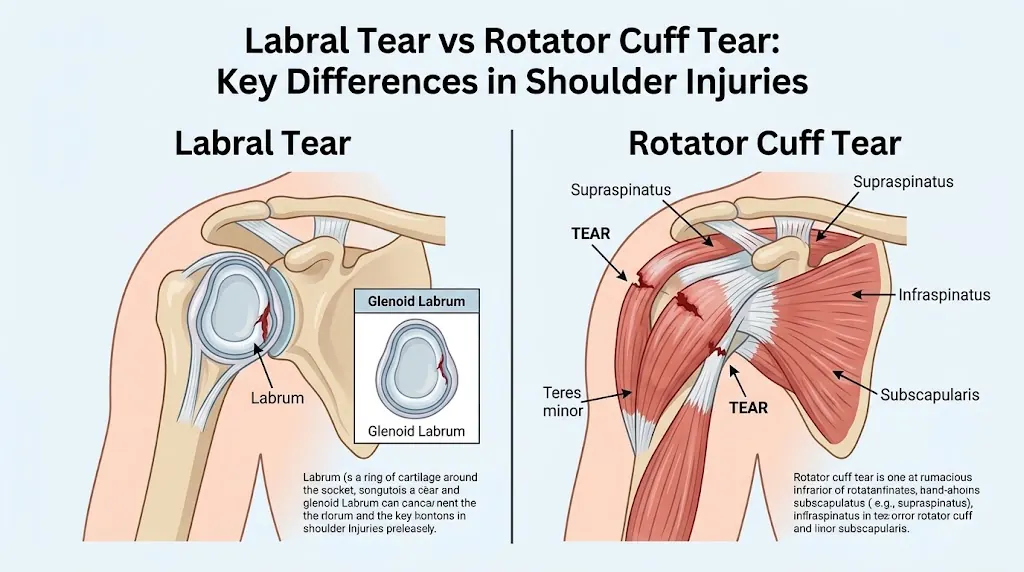
A labral tear vs rotator cuff tear can be difficult to distinguish because both may cause shoulder pain, weakness, clicking, and difficulty with overhead movements. For example, pain when reaching into a cabinet or lifting a bag could come from either structure, even though the underlying injury is different. Understanding shoulder labral tear symptoms can help put these symptoms into context.
The biggest difference is what tissue is injured. A labral tear affects the cartilage-like rim around the shoulder socket, while a rotator cuff tear affects one or more tendons that connect the shoulder muscles to the upper arm bone. Symptoms can overlap considerably, so pain location alone usually cannot establish which injury is present.
This guide compares labral and rotator cuff tears by symptoms, causes, movement patterns, examination, MRI findings, and treatment considerations. It also explains why having an abnormal MRI does not automatically mean that surgery is necessary.
Labral Tear vs Rotator Cuff Tear: What Is the Difference?
The shoulder labrum helps deepen the socket and contributes to joint stability. The rotator cuff consists of four muscles and their tendons that help stabilize the shoulder and control lifting and rotation.
| Feature | Labral tear | Rotator cuff tear |
|---|---|---|
| Injured structure | Glenoid labrum | One or more rotator cuff tendons |
| Main role of tissue | Shoulder stability and socket support | Shoulder movement and dynamic stability |
| Common symptoms | Clicking, catching, instability, deep shoulder pain | Pain, weakness, difficulty lifting or rotating the arm |
| Typical triggers | Dislocation, repetitive overhead activity, forceful shoulder movement | Acute injury, repetitive use, age-related tendon degeneration |
| Imaging | MRI or MR arthrogram may show labral abnormality | MRI or ultrasound can show tendon damage |
| Common concern | Shoulder feels unstable or catches | Shoulder feels painful or weak during lifting |
Rotator cuff tears may result from either an injury or gradual tendon degeneration. They become more common with age, although younger people can also develop traumatic tears.
For a broader overview, see what is a labral tear and its symptoms and rotator cuff tear signs and treatment.
Labral Tear Symptoms vs Rotator Cuff Tear Symptoms
A labral injury often produces deep shoulder pain, clicking, catching, or a sensation that the shoulder is slipping or unstable. Some people notice symptoms during overhead activity or certain throwing movements.
A rotator cuff tear more commonly produces pain with lifting the arm and measurable weakness. Night pain can also occur, particularly when lying on the affected side.
| Symptom | More suggestive of labral tear | More suggestive of rotator cuff tear |
|---|---|---|
| Deep shoulder pain | Common | Possible |
| Clicking or catching | More characteristic | Possible |
| Feeling of instability | More characteristic | Less typical |
| Pain lifting the arm | Possible | Common |
| Weakness | Possible | Often prominent |
| Pain at night | Possible | Common |
| History of dislocation | Important clue | Possible but less specific |
| Sudden loss of strength after injury | Possible | Important warning for acute tear |
These are patterns rather than diagnostic rules. A person can have both a labral injury and rotator cuff pathology at the same time.
Where Does Each Injury Usually Hurt?
Pain location can provide clues but cannot reliably identify the damaged structure.
Labral pain is often described as deep inside the shoulder. Clicking, catching, or instability may be more informative than whether the pain is in the front, side, or back of the shoulder.
Rotator cuff pain commonly occurs around the outer or front portion of the shoulder and may become worse when lifting the arm. For symptoms triggered specifically by elevation, see why your shoulder hurts when you raise your arm.
Other movement-related patterns can provide additional clues, including shoulder pain when reaching behind your back and shoulder pain when lifting something.
What Causes a Labral Tear vs a Rotator Cuff Tear?
Labral tears can occur after shoulder dislocation, a fall, forceful pulling, repetitive overhead activity, or sports involving throwing. Different regions of the labrum can be injured, including superior, anterior, and posterior portions.
Rotator cuff tears may occur suddenly after a fall or forceful movement, but many develop gradually because of tendon degeneration. Repetitive overhead work and sports can increase mechanical stress on the tendons.
This distinction matters because types of shoulder labral tears have different mechanisms and treatment considerations, while rotator cuff injuries range from partial-thickness to full-thickness tears.
How Are Labral and Rotator Cuff Tears Diagnosed?
Diagnosis begins with the medical history and physical examination. A clinician may assess range of motion, strength, instability, pain during specific movements, and provocative tests designed to stress different shoulder structures.
Imaging is then selected according to the suspected problem.
| Test | Labral tear | Rotator cuff tear |
|---|---|---|
| X-ray | Usually does not directly show the labrum | Does not directly show a tendon tear |
| MRI | Can identify many labral abnormalities | Commonly used to evaluate cuff tendons |
| MR arthrogram | Can improve visualization of some labral lesions | Can also evaluate certain cuff abnormalities |
| Ultrasound | Limited for many labral questions | Useful for evaluating rotator cuff tendons |
| Arthroscopy | Directly visualizes the labrum | Directly visualizes the joint and cuff-related pathology |
MRI and ultrasound are established tools for evaluating rotator cuff tears, while MRI and MR arthrography can help assess labral pathology.
For imaging questions, shoulder labral tear MRI explains what radiologists may look for.
Can an MRI Tell Which Tear You Have?
Often, yes, but imaging findings must be interpreted alongside symptoms and examination findings.
A recent meta-analysis of 53 studies involving 5,487 patients found that MR arthrography performed particularly well for anterior labral tears and full-thickness rotator cuff tears, while performance was less consistent for posterior or superior labral lesions and partial-thickness cuff tears.
This is important because an MRI can identify abnormalities that are not necessarily responsible for someone’s pain. For example, some labral changes can occur without symptoms.
If a scan identifies a labral abnormality, comparing it with labral tear vs shoulder impingement or labral tear vs frozen shoulder can help explain why symptoms may not always point to one condition.
What If Both a Labral Tear and Rotator Cuff Tear Are Present?
Both injuries can occur in the same shoulder, particularly after significant trauma. A clinician may therefore evaluate the labrum, rotator cuff, biceps tendon, cartilage, and shoulder stability rather than looking for only one abnormality.
The presence of multiple findings does not automatically mean that every abnormality needs treatment. The most relevant finding is generally the one that best matches the symptoms, examination, injury history, and functional limitations.
Labral Tear vs Rotator Cuff Tear: Which One Needs Surgery?
Neither diagnosis automatically requires surgery.
For labral injuries, treatment may involve activity modification, physical therapy, and progressive rehabilitation before surgery is considered in appropriate patients. See labral tear treatment: physical therapy vs surgery.
Rotator cuff treatment also depends on factors such as tear size, symptoms, injury mechanism, age, activity requirements, and response to nonsurgical treatment. AAOS guidance notes that not all rotator cuff tears require immediate surgery.
For patients considering rehabilitation, best exercises for labral tear recovery and shoulder strengthening exercises for athletes address different stages and goals.
What Should You Do While Waiting for a Diagnosis?
Avoid movements that consistently produce sharp pain, instability, catching, or significant weakness. Do not repeatedly test the shoulder with heavy lifting to determine whether an injury is improving.
If exercise is aggravating symptoms, exercises to avoid with a shoulder labral tear can help identify movements that may need temporary modification. General shoulder pain relief at home may also help with symptom management while awaiting evaluation.
Warning Signs That Need Medical Attention
Usually monitor and arrange routine evaluation
- Persistent shoulder pain that interferes with normal activities
- Recurrent clicking or catching
- Gradually increasing weakness
- Pain that continues despite activity modification
Seek prompt medical evaluation
- Significant weakness after an injury
- Recurrent shoulder instability
- A shoulder that repeatedly feels as though it will slip out
- Loss of normal shoulder movement after trauma
Seek urgent care
- Visible shoulder deformity
- Suspected dislocation
- New numbness or major weakness in the arm or hand
- Severe pain following significant trauma
Frequently Asked Questions
Is a labral tear worse than a rotator cuff tear?
Neither is automatically more serious. The impact depends on the location and severity of the injury, symptoms, instability, weakness, activity requirements, and associated damage.
How can I tell if I tore my labrum or rotator cuff?
Clicking, catching, and instability can point toward labral involvement, while pain and weakness with lifting are common with rotator cuff problems. However, these symptoms overlap, so examination and imaging may be necessary.
Does a labral tear cause weakness?
It can, particularly when pain or instability limits shoulder function. Significant weakness is also common with rotator cuff tears, so weakness alone cannot distinguish the two.
Does a rotator cuff tear cause clicking?
It can, although clicking and catching may have several causes. Persistent clicking combined with deep pain or instability warrants clinical assessment.
Can you have a labral tear and rotator cuff tear together?
Yes. A traumatic shoulder injury can damage more than one structure, which is why imaging and physical examination often assess the entire shoulder.
Is an MRI always needed?
Not necessarily. A clinician may initially diagnose or manage some shoulder conditions based on history and examination, while MRI or ultrasound may be added when the diagnosis remains uncertain or the results would affect treatment.
Is an MR arthrogram better for a labral tear?
It can provide additional detail for certain labral lesions because contrast outlines structures within the joint. The appropriate imaging test depends on the suspected injury and clinical circumstances.
Can a rotator cuff tear heal without surgery?
Some tears can be managed without surgery, particularly when symptoms and functional limitations improve with nonsurgical care. Treatment decisions depend on the individual tear and patient factors.
Can a labral tear heal without surgery?
Some people improve substantially without surgery, although symptom improvement does not necessarily mean that the labral tissue has completely restored its original structure. Rehabilitation and activity modification may be part of nonsurgical management.
When should shoulder pain be evaluated?
Persistent pain, weakness, instability, catching, or loss of function deserves medical evaluation. Sudden major weakness, deformity, suspected dislocation, or new neurological symptoms warrant more urgent assessment.
Conclusion
The key difference between a labral tear and a rotator cuff tear is the injured tissue: the labrum helps stabilize the shoulder socket, while the rotator cuff tendons help move and stabilize the joint. Clicking and instability can provide clues toward labral involvement, while pain and weakness with lifting are common with rotator cuff tears, but symptoms overlap too much for a reliable diagnosis based on symptoms alone.
A physical examination combined with appropriate imaging can clarify the diagnosis. The MRI finding should then be interpreted in the context of symptoms, injury history, age, activity level, and shoulder function rather than treated as an isolated diagnosis.
Disclaimer: This article is provided for educational and informational purposes only. It is not a substitute for professional medical advice, diagnosis, or treatment.
This article is for education purpose only and is not a diagnosis or a substitute for medical advice.