
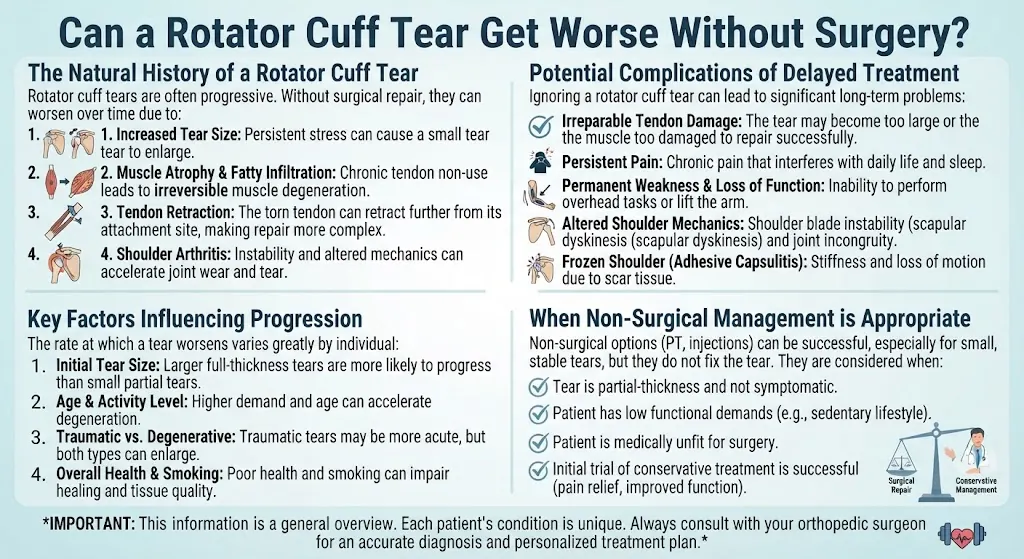
Yes, a rotator cuff tear can get larger or cause increasing weakness without surgery, but this does not happen to everyone. Some tears remain stable for years, and many people manage symptoms with physical therapy and activity changes. The risk of progression depends on factors such as tear size, cause, age, tendon quality, and how much you use the affected shoulder.
Understanding what makes a tear more likely to worsen can help you protect your shoulder and decide when to seek medical care. This guide explains the warning signs, treatment options, and situations in which surgery may be worth discussing with an orthopedic specialist.
Can a Rotator Cuff Tear Get Worse Without Surgery?
Yes. A rotator cuff tear may gradually extend, involve more tendon tissue, or lead to greater muscle weakness over time. However, the outcome varies, and a tear does not automatically require surgery simply because it is present.
The rotator cuff consists of four muscles and their tendons, which help stabilize the shoulder and control arm movement. A tear may develop suddenly after an injury or gradually through tendon wear and degeneration.
| Tear type | How it may change without surgery | Factors to consider |
|---|---|---|
| Small partial-thickness tear | May remain stable or progress deeper into the tendon | Repeated overhead activity, tendon health |
| Large partial-thickness tear | May cause persistent pain and weakness or extend further | Tear depth and functional demands |
| Full-thickness tear | May enlarge or develop muscle changes over time | Initial size, injury mechanism, age |
| Acute tear after trauma | May cause sudden weakness and loss of function | Prompt assessment is important, especially after a fall or heavy lift |
These are general patterns, not predictions for an individual. Research on the natural history of rotator cuff tears indicates that some tears progress structurally over time, while others remain unchanged. Symptoms alone cannot reliably tell you whether the tear has grown.
For more background, see rotator cuff tear symptoms, treatment, and recovery.
What Makes a Rotator Cuff Tear More Likely to Worsen?
Several factors may increase the likelihood of progression.
-
Larger tears: A tear involving more tendon tissue may affect shoulder strength and function more substantially.
-
Repeated overhead activity: Frequent lifting, throwing, or overhead work can aggravate symptoms, particularly if the shoulder has insufficient recovery time.
-
A new injury: Falling onto the arm, suddenly lifting a heavy object, or experiencing a forceful pull may worsen an existing tear.
-
Age-related tendon changes: Tendons can become less resilient with age, making degenerative tears more common.
-
Muscle changes: Long-standing tears can be associated with muscle atrophy or fatty infiltration, which may affect function and future repair options.
A tear can also cause pain that limits activity without actually becoming larger. Likewise, a tear may progress on imaging even when symptoms change very little.
If shoulder pain occurs mainly when lifting your arm, compare possible causes in this guide to why your shoulder hurts when you raise your arm.
What Are the Signs That a Rotator Cuff Tear Is Getting Worse?
Increasing pain, reduced strength, and declining shoulder function deserve attention, particularly when these changes persist or develop after a new injury.
| Change you notice | What it may indicate | What to do |
|---|---|---|
| Increasing difficulty raising your arm | Worsening pain, weakness, or tendon dysfunction | Arrange a clinical assessment if persistent |
| New or increasing weakness | Possible progression or another shoulder problem | Contact a healthcare professional |
| More frequent night pain | Ongoing irritation or another shoulder condition | Seek evaluation if sleep is repeatedly disrupted |
| Sudden pain and weakness after an injury | Possible acute tear extension or another injury | Seek prompt medical assessment |
| Shoulder deformity or inability to move the arm after trauma | Possible serious injury, including dislocation or fracture | Seek urgent medical care |
Night pain alone does not prove that a tear is growing. Similarly, clicking or popping without pain or weakness does not necessarily indicate damage progression.
When to seek urgent care
Seek urgent assessment after a significant injury if you suddenly cannot lift your arm, develop marked weakness, or experience severe pain. A visibly deformed shoulder, a cold or pale hand, or new substantial numbness warrants emergency evaluation. Chest pressure, shortness of breath, sweating, or shoulder pain associated with these symptoms may signal a heart problem and requires emergency care.
Can a Rotator Cuff Tear Heal Without Surgery?
Some rotator cuff tears can be managed successfully without surgery, particularly when pain and functional limitations improve with conservative treatment. However, symptom improvement does not necessarily mean the tendon has fully reattached or healed structurally.
Non-surgical treatment may include:
-
Activity modification: Temporarily reduce painful overhead lifting, heavy pressing, and repetitive shoulder movements.
-
Physical therapy: A clinician or physical therapist can prescribe exercises to improve shoulder movement, strength, and control without excessively loading the tendon.
-
Pain management: A healthcare professional can help you choose appropriate medication or other strategies based on your health history.
-
Gradual return to activity: Increase lifting and exercise demands according to symptoms, strength, and professional guidance.
Avoid completely immobilizing your shoulder for prolonged periods unless instructed, because excessive restriction can contribute to stiffness. At the same time, pushing through sharp pain or repeatedly testing your maximum strength may aggravate symptoms.
Learn more about whether a rotator cuff tear can heal without surgery and shoulder pain treatment options: nonsurgical care versus surgery.
When Is Surgery Worth Considering?
Surgery may be considered when pain and weakness continue despite appropriate conservative treatment, when the tear substantially limits daily activities, or when a significant acute tear occurs in someone who needs strong shoulder function.
The decision depends on the tear’s size and location, tendon quality, muscle condition, general health, activity goals, and expected benefits and risks. A person with a small degenerative tear and manageable symptoms may choose physical therapy, while someone with sudden major weakness after an injury may need earlier specialist evaluation.
| Consideration | Nonsurgical treatment may be reasonable when… | Surgery may be discussed when… |
|---|---|---|
| Symptoms | Pain is manageable and function is improving | Pain or weakness remains limiting |
| Tear circumstances | The tear is degenerative and symptoms respond to treatment | A traumatic tear causes substantial weakness |
| Daily needs | Routine activities remain possible | Work, sports, or daily tasks are seriously affected |
| Examination and imaging | Findings support continued conservative care | The tear and clinical findings suggest repair may help |
Imaging findings should be interpreted alongside symptoms and physical examination. An MRI can help assess tear size, tendon retraction, and muscle changes when imaging is clinically appropriate. A normal X-ray does not rule out a rotator cuff tear; see how X-rays and MRI differ for shoulder pain.
How Can You Reduce the Risk of Making It Worse?
Protecting the shoulder means adjusting activity rather than avoiding all movement indefinitely.
-
Reduce or modify movements that reliably trigger pain, especially heavy overhead lifting.
-
Follow an individualized physical therapy program instead of starting intense shoulder exercises on your own.
-
Keep your clinician informed about increasing weakness, worsening pain, or declining function.
-
Return to demanding workouts gradually, with attention to technique and recovery time.
-
Avoid assuming that pain relief means the tendon has healed completely.
For practical guidance, review exercises to avoid with a shoulder labral tear for related shoulder-loading considerations, along with how to prevent shoulder injuries during workouts. Because a labral tear and a rotator cuff tear affect different structures, exercise restrictions for one condition should not automatically be applied to the other.
Frequently Asked Questions
1. How quickly can a rotator cuff tear get worse?
There is no single timeline. Some tears remain stable for years, while others enlarge over months or longer; progression depends on the tear and individual circumstances.
2. Can a small rotator cuff tear become a large tear?
Yes, some small tears enlarge over time, but others do not. Follow-up depends on symptoms, examination findings, and the clinician’s assessment of risk.
3. Does shoulder pain always mean the tear is getting bigger?
No. Pain can fluctuate because of irritation, activity changes, stiffness, or other shoulder conditions. Imaging and clinical assessment may be needed to evaluate structural progression.
4. Can I exercise with a rotator cuff tear?
Often, yes, but exercises should match your symptoms and the tear’s characteristics. A physical therapist can help select movements that maintain function without placing excessive stress on the shoulder.
5. Should I avoid lifting anything with a torn rotator cuff?
Not necessarily. You may need to reduce heavy, overhead, or painful lifting, but complete avoidance of all lifting is not always necessary. Ask your clinician what loads and movements are appropriate for you.
6. Can physical therapy prevent a tear from worsening?
Physical therapy can improve strength, movement, and function, but it cannot guarantee that the tear will remain the same size. Progress should be monitored based on symptoms and clinical findings.
7. Is a rotator cuff tear more serious if I am older?
Age can be associated with tendon degeneration and muscle changes, but age alone does not determine severity or treatment. Functional needs, tear characteristics, health, and treatment goals also matter.
8. Will an untreated rotator cuff tear eventually need surgery?
No. Some people manage symptoms without surgery, while others develop persistent pain, weakness, or structural progression. Treatment decisions should be based on the individual situation rather than an assumption that surgery is inevitable.
9. When should I get an MRI for a rotator cuff tear?
An MRI may be appropriate when examination findings suggest a tear and the results could change treatment decisions. A clinician can decide whether MRI, ultrasound, or another assessment is most useful.
10. What should I do if my shoulder suddenly becomes much weaker?
Arrange prompt medical evaluation, particularly if the change follows a fall, heavy lift, or other injury. Sudden major weakness should not be treated as ordinary soreness or managed solely with home exercises.
Conclusion
A rotator cuff tear can worsen without surgery, but progression is not inevitable. The most useful next step is to understand the tear’s characteristics, modify activities that aggravate symptoms, and follow a suitable rehabilitation plan. If weakness increases, daily function declines, or symptoms begin after a significant injury, seek medical assessment to discuss the safest treatment options.
Disclaimer: This article is provided for educational and informational purposes only.
This article is for education purpose only and is not a diagnosis or a substitute for medical advice.