
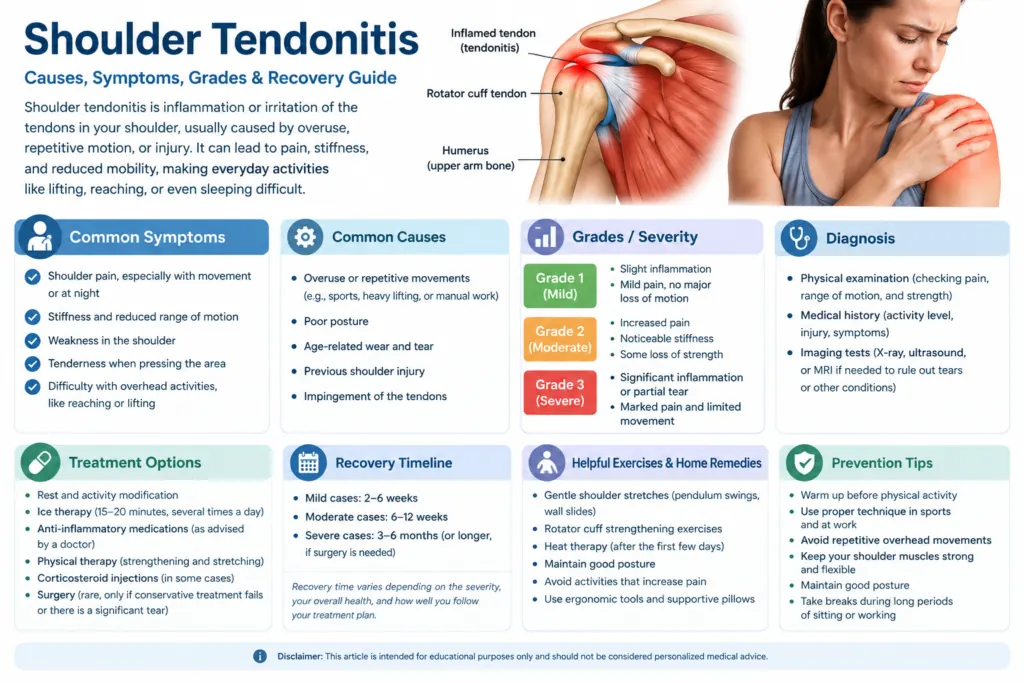
Shoulder pain can make everyday activities surprisingly difficult. Reaching overhead, lifting an object, putting on a shirt, sleeping on your side, or even brushing your hair may cause aching or sharp discomfort. When the pain develops gradually, many people wonder whether they have simply overworked their shoulder or whether something more serious is happening.
Shoulder tendonitis is a common cause of shoulder pain, especially in people who perform repetitive movements at work, during sports, or in the gym. The condition can cause pain, tenderness, weakness, and difficulty moving the arm. Fortunately, many cases improve with appropriate activity modification, rehabilitation, and gradual strengthening.
Shoulder tendonitis occurs when a shoulder tendon becomes irritated and painful, often involving the rotator cuff tendons. Understanding the symptoms, causes, treatment options, exercises, recovery, and prevention strategies can help you recognize the problem and know when professional evaluation may be necessary.
Disclaimer: This article is intended for educational purposes only and should not be considered personalized medical advice.
What Is Shoulder Tendonitis?
Shoulder tendonitis refers to irritation or inflammation involving one or more tendons around the shoulder.
The shoulder contains several tendons that connect muscles to bones and help control movement. Therotator cuff is particularly important because it helps stabilize the shoulder joint and allows the arm to rotate and lift.
Repeated stress can irritate these tendons, leading to pain and reduced function.
Shoulder tendonitis is sometimes discussed alongside rotator cuff tendinopathy or tendinosis. These terms can describe different stages or patterns of tendon problems, so an accurate diagnosis is important when symptoms persist.
What Causes Shoulder Tendonitis?
Shoulder tendonitis commonly develops when a tendon is repeatedly exposed to loads that exceed its ability to recover.
Common causes and risk factors include:
- Repetitive overhead activities.
- Swimming, tennis, baseball, or other throwing sports.
- Repetitive lifting at work.
- Weightlifting with poor technique or excessive load.
- Sudden increases in exercise volume.
- Poor shoulder movement mechanics.
- Age-related tendon changes.
- Previous shoulder injuries.
The problem does not always come from one specific injury. In many cases, symptoms gradually develop after repeated activity.
People with other shoulder conditions may also experience similar symptoms. For example, shoulder impingement syndrome can produce pain during overhead movements and may overlap with rotator cuff tendon problems.
Shoulder Tendonitis Symptoms
Shoulder tendonitis symptoms can range from mild discomfort to significant pain that interferes with daily activities.
Common symptoms include:
- Aching pain around the front or side of the shoulder.
- Pain when lifting the arm.
- Discomfort during overhead movements.
- Tenderness around the affected area.
- Weakness during lifting or rotation.
- Pain that becomes worse with repetitive activity.
- Difficulty sleeping on the affected shoulder.
- Reduced ability to perform certain activities.
Some people notice pain during a particular part of the arm’s movement, while others experience a more constant ache after activity.
If shoulder pain has a burning or unusual sensation, other causes may need to be considered. Our guide to burning pain in the shoulder discusses several possible causes.
Where Does Shoulder Tendonitis Hurt?
The location of shoulder tendonitis pain depends on which tendon or surrounding structure is involved.
Rotator cuff-related pain is commonly felt around the front, side, or upper part of the shoulder. Pain may sometimes extend down the upper arm.
Pain can become more noticeable when raising the arm, reaching overhead, carrying objects, or performing repetitive movements.
Because several shoulder conditions can produce similar pain patterns, the exact location of pain alone cannot confirm tendonitis.
What Makes Shoulder Tendonitis Worse?
Certain activities can increase irritation and make symptoms more noticeable.
Common aggravating activities include:
- Repeated overhead reaching.
- Heavy lifting.
- Throwing.
- Repetitive pushing or pulling.
- Exercises that cause sharp shoulder pain.
- Sleeping directly on the affected side.
- Suddenly increasing training intensity.
You do not necessarily need to stop all physical activity. Instead, temporarily reducing painful movements while maintaining appropriate movement can often be more helpful than complete inactivity.
How Is Shoulder Tendonitis Diagnosed?
Diagnosis usually begins with a medical history and physical examination.
A healthcare professional may ask when your symptoms started, what activities make them worse, whether there was an injury, and how the pain affects your daily activities.
They may also evaluate:
- Shoulder range of motion.
- Muscle strength.
- Pain during specific movements.
- Shoulder stability.
- Neck and upper-back movement.
- Tenderness around the shoulder.
Imaging is not always required, but an X-ray, ultrasound, or MRI may be considered when another condition or a more significant tendon injury is suspected.
Shoulder Tendonitis Treatment
Treatment depends on the severity of symptoms and the underlying cause.
Many cases can improve with conservative treatment rather than surgery.
Common approaches include:
- Modifying painful activities.
- Temporary reduction in shoulder loading.
- Appropriate pain-management strategies.
- Physical therapy.
- Mobility exercises.
- Progressive strengthening.
- Gradual return to normal activities.
For a broader look at non-surgical and surgical approaches to shoulder problems, see our guide to shoulder pain treatment options.
The goal is not simply to eliminate pain temporarily. Long-term recovery usually involves improving the shoulder’s ability to tolerate normal and progressively demanding activities.
Can Shoulder Tendonitis Heal on Its Own?
Mild shoulder tendon problems may improve with appropriate rest from aggravating activities and gradual rehabilitation.
However, complete inactivity is not always the best approach. Tendons generally need an appropriate amount of progressive loading to regain strength and tolerance.
If symptoms continue despite modifying activities, or if pain is getting worse, a healthcare professional can help determine whether tendonitis is actually the cause.
Persistent shoulder pain may also be related to a rotator cuff tear, bursitis, arthritis, instability, or another condition.
Exercises for Shoulder Tendonitis
Exercise is often an important part of shoulder tendonitis rehabilitation.
The specific exercises depend on the affected tendon, symptoms, strength, and stage of recovery.
A rehabilitation program may include:
- Gentle shoulder mobility exercises.
- Shoulder blade control exercises.
- Isometric strengthening.
- Resistance-band exercises.
- Rotator cuff strengthening.
- Progressive resistance training.
- Activity-specific strengthening.
Our guide to shoulder strengthening exercises for athletes provides additional information about strengthening the muscles that support shoulder movement.
Exercises should be progressed gradually. A movement that produces mild muscular effort may be appropriate, while sharp or worsening pain may indicate that the exercise needs modification.
What Exercises Should You Avoid With Shoulder Tendonitis?
There is no universal list of exercises that everyone with shoulder tendonitis must avoid.
However, movements that consistently produce significant pain should generally be modified while the shoulder recovers.
Depending on your symptoms, these may include:
- Heavy overhead pressing.
- Repeated lateral raises with excessive weight.
- High-volume throwing.
- Deep or painful pressing movements.
- Exercises performed with poor shoulder control.
- Sudden increases in training volume.
The goal is usuallyload management, not permanent avoidance of exercise.
If you have a different shoulder injury, such as a labral tear, exercise restrictions may be different. Our guide on exercises to avoid with a shoulder labral tear explains why certain movements may need to be limited with that condition.
How Long Does Shoulder Tendonitis Take to Heal?
Shoulder tendonitis recovery time varies depending on the severity of symptoms, how long the problem has been present, and how well the shoulder responds to treatment.
Mild symptoms may improve over several weeks with appropriate activity modification and rehabilitation. More persistent tendon problems may require a longer period of progressive strengthening.
Recovery is not always completely linear. Symptoms may improve and then temporarily increase after an activity that places too much stress on the tendon.
A gradual progression is generally more sustainable than trying to return to full activity immediately.
Can You Prevent Shoulder Tendonitis?
You may be able to reduce your risk of shoulder tendon problems by managing training loads and maintaining good shoulder strength.
Helpful strategies include:
- Warm up before demanding activities.
- Increase exercise intensity gradually.
- Avoid sudden increases in training volume.
- Strengthen the rotator cuff and shoulder stabilizers.
- Use appropriate lifting and sports techniques.
- Take recovery breaks during repetitive work.
- Address persistent shoulder discomfort early.
If you regularly exercise, maintaining appropriate shoulder strength can support joint function. You can also learn about everyday choices that influence joint health.
Shoulder Tendonitis vs. Frozen Shoulder
Shoulder tendonitis and frozen shoulder can both cause pain and difficulty moving the arm, but they are different conditions.
Tendonitis generally causes pain associated with loading or movement of an affected tendon. Frozen shoulder is characterized by significant stiffness and progressive loss of shoulder movement.
If your main problem is that the shoulder is becoming increasingly stiff in multiple directions, you may want to learn more about the early signs and stages of frozen shoulder.
A proper examination is important because these conditions can sometimes produce overlapping symptoms.
Shoulder Tendonitis vs. Rotator Cuff Tear
Shoulder tendonitis can cause pain and weakness, but a rotator cuff tear involves a structural disruption of the tendon.
A tear may occur suddenly after an injury or develop gradually. Significant weakness, especially after a traumatic event, may require further evaluation.
Not every person with shoulder tendonitis has a rotator cuff tear, and not every rotator cuff problem produces severe symptoms.
If pain or weakness persists despite appropriate treatment, further assessment may help identify the underlying problem.
When Should You See a Doctor?
Mild shoulder pain may improve with appropriate activity modification, but persistent or severe symptoms should be evaluated.
Consider seeking professional advice if:
- Shoulder pain lasts for several weeks.
- Pain is getting progressively worse.
- You have significant weakness.
- You cannot raise your arm normally.
- Pain began after a fall or accident.
- You experience repeated shoulder instability.
- Pain consistently interferes with sleep.
- Home treatment does not improve your symptoms.
Sudden severe pain accompanied by major weakness or inability to move the arm should be assessed promptly.
Frequently Asked Questions
1. What is the fastest way to treat shoulder tendonitis?
There is no single instant treatment. Reducing aggravating activities, managing symptoms, and following a progressive rehabilitation program can support recovery.
2. Can shoulder tendonitis heal without surgery?
Yes. Many cases improve with activity modification, physical therapy, and progressive strengthening. Surgery is generally considered only for specific underlying problems.
3. Should I massage shoulder tendonitis?
Gentle soft-tissue work may provide temporary comfort for some people, but it does not replace appropriate rehabilitation and load management.
4. Can I exercise with shoulder tendonitis?
Often, yes. Exercises may need to be modified to reduce painful loading while maintaining appropriate movement and gradually rebuilding strength.
5. Is heat or ice better for shoulder tendonitis?
Both may provide symptom relief for some people. The choice often depends on what feels more comfortable and when the symptoms occur.
6. How long does shoulder tendonitis usually last?
Mild cases may improve within several weeks, while persistent tendon problems can take longer. Recovery depends on the underlying cause and rehabilitation.
7. Does shoulder tendonitis cause weakness?
It can. Pain may inhibit muscle function, making the shoulder feel weak. Significant or persistent weakness should be evaluated.
8. Can sleeping on your shoulder cause tendonitis?
Sleeping directly on a painful shoulder may aggravate symptoms, but shoulder tendon problems usually involve multiple contributing factors rather than one sleeping position.
9. What exercises are best for shoulder tendonitis?
The best exercises depend on the specific tendon involved and your stage of recovery. Mobility, isometric exercises, and progressive rotator cuff strengthening are commonly used.
10. When should shoulder tendonitis be checked by a doctor?
Seek professional evaluation when pain is severe, persistent, worsening, associated with significant weakness, or follows a traumatic injury.
Conclusion
Shoulder tendonitis can cause aching, tenderness, weakness, and pain during everyday movements or exercise. It commonly develops when shoulder tendons are exposed to repetitive or excessive loading without enough recovery.
Treatment often focuses on modifying aggravating activities, managing symptoms, restoring movement, and progressively strengthening the shoulder. Most people do not automatically need surgery, but persistent symptoms should be assessed to rule out other causes such as rotator cuff tears, instability, arthritis, or other shoulder conditions
A gradual return to activity is important. By managing training loads, improving shoulder strength, and addressing symptoms early, you can support healthier shoulder function and reduce the risk of recurring problems.
Disclaimer: This article is intended for educational purposes only and should not be considered personalized medical advice.
This article is for education purpose only and is not a diagnosis or a substitute for medical advice.