
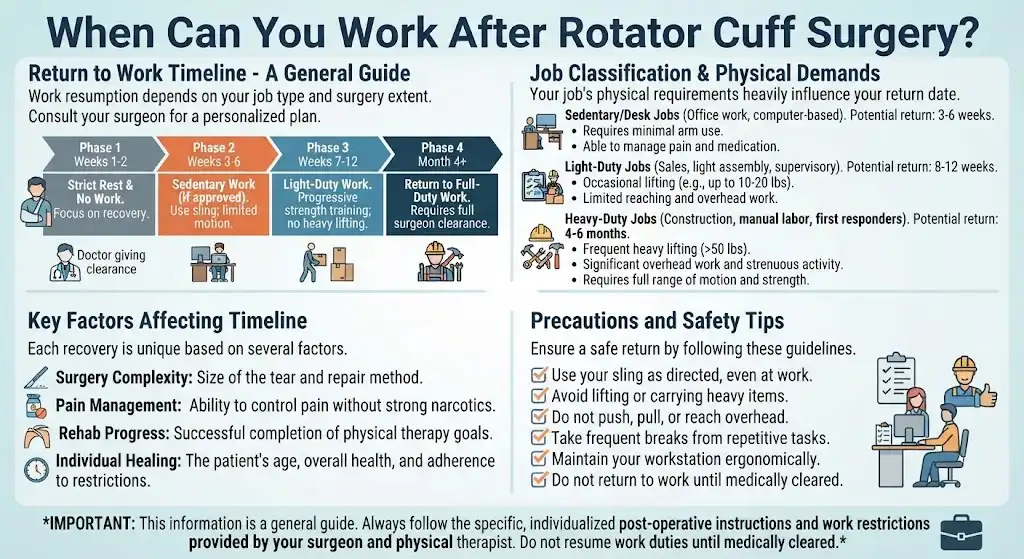
It is common to wonder whether you can type, drive to work, carry equipment, or perform your usual responsibilities while wearing a sling. Going back too early can place stress on the repair, but remaining away from work longer than necessary may not be needed for every job. Your recovery plan should balance protection of the shoulder with safe, gradual movement.
This guide explains when you can work after rotator cuff surgery, how timelines differ by occupation, what affects recovery, and how to plan a safe return. It also covers modified duties, warning signs, and questions to discuss with your surgeon or physical therapist.
How Soon Can You Return to Work After Rotator Cuff Surgery?
Many people return to some form of work within 2–6 weeks after surgery, particularly if their jobs are sedentary and their employers can accommodate restrictions. Physically demanding work often requires 3–6 months or longer, depending on tendon healing, strength, and the demands of the position. These are general estimates, not guaranteed milestones.
A rotator cuff surgery recovery timeline can help you understand the difference between early postoperative recovery and a full return to physical activity. Your surgeon should determine when you can safely resume specific tasks.
Typical Return-to-Work Timelines by Job Type
| Type of work | General planning estimate | Important considerations |
|---|---|---|
| Desk work or remote work | 1–3 weeks, sometimes longer | Pain control, typing comfort, and ability to keep the arm supported |
| Light administrative or customer service work | 2–6 weeks | Limited lifting and reaching; possible need for shorter shifts |
| Driving for work | Several weeks or longer | Sling restrictions, reaction time, medications, and safe steering |
| Light physical work | 6–12 weeks or longer | Repetitive movement and lifting restrictions |
| Heavy manual labor or overhead work | 3–6 months or longer | Tendon healing, strength, endurance, and surgeon clearance |
These ranges are approximate and overlap because surgical repairs and job requirements differ. A small repair may recover differently from a large or massive tear, and complications can extend the timeline.
What Affects Your Return-to-Work Date?
Several factors determine whether you can resume work early or need a longer recovery period.
-
Tear size and repair complexity: Larger tears and more extensive repairs may require longer protection and rehabilitation.
-
Dominant arm involvement: Surgery on your dominant shoulder can make writing, typing, dressing, and handling tools more difficult.
-
Job demands: Heavy lifting, repetitive reaching, pushing, pulling, and overhead work place greater demands on the healing shoulder.
-
Pain and mobility: Pain, sleep disruption, stiffness, and limited arm movement may affect concentration and productivity.
-
Healing and rehabilitation: Your progress with prescribed exercises and follow-up assessments helps guide activity restrictions.
-
Other health factors: Smoking, certain medical conditions, and complications can affect healing and recovery.
A rotator cuff tear and its symptoms can vary considerably, so the original injury and the repair performed both matter when planning time off.
What Does Research Say About Returning to Work?
Research supports a consistent finding: people with less physically demanding jobs generally return to work sooner than those whose jobs require heavy manual labor.
A 2021 systematic review and meta-analysis of 13 retrospective studies involving 1,224 patients found that 62.3% returned to their previous level of work, with an average return time of approximately 8.2 months. A separate review published in 2025, covering 21 studies and 5,445 patients, reported an overall return-to-work rate of about 80.7%, with an average return time of approximately 6.2 months. Differences in patient groups, study methods, and definitions of returning to work help explain the variation.
These findings do not mean everyone must wait six to eight months before working. They highlight the difference between returning to some duties and returning to the same workload without restrictions.
Can You Work While Wearing a Sling?
Sometimes. People with desk jobs may be able to work while wearing a sling if their surgeon permits it, pain is manageable, and the work setup supports the recovering arm. Physical jobs that require both hands, lifting, or reaching are usually incompatible with early sling restrictions.
The sling protects the repair while the tendon heals. Your surgeon will explain how long to wear it and when you can begin using the arm more actively. Do not remove it or start using the operated arm for work tasks simply because discomfort has decreased.
For practical planning, review how long you need to wear a sling after rotator cuff surgery and how to sleep after rotator cuff surgery, since sleep quality can influence your comfort and ability to concentrate during the day.
How to Make Desk Work More Comfortable
If you receive clearance for office or remote work, consider these adjustments:
-
Keep your keyboard, mouse, and frequently used items within comfortable reach.
-
Support your operated arm as instructed rather than letting it hang unsupported.
-
Take short breaks to change position and avoid prolonged discomfort.
-
Ask about reduced hours or flexible scheduling if fatigue or pain interferes with concentration.
-
Avoid carrying a laptop bag, heavy files, or other loads with the operated arm.
Typing may be possible before you regain full shoulder strength, but repetitive movements can still become uncomfortable. Follow your individual restrictions rather than assuming that computer work is automatically safe.
How Can You Return to Work Safely?
A gradual return is often more practical than immediately resuming every responsibility. Before your first day back, ask your surgeon whether you need written work restrictions and discuss what your employer can accommodate.
| Recovery phase | Possible work arrangement | What to prioritize |
|---|---|---|
| Early recovery | Leave from work or limited remote duties, if approved | Protect the repair and manage pain |
| Initial return | Shorter shifts or seated tasks | Comfortable positioning and avoiding prohibited arm use |
| Intermediate recovery | Gradual increase in approved duties | Follow rehabilitation and movement restrictions |
| Later recovery | Progressive lifting or physical tasks after clearance | Restore strength, endurance, and task-specific function |
These phases are illustrative rather than a fixed rehabilitation protocol. Your surgeon may recommend a slower or faster progression based on the repair and your examination.
What Work Restrictions Should You Discuss With Your Employer?
Ask your care team to specify restrictions in practical terms, including:
-
Maximum permitted lifting weight, if any.
-
Whether you can reach above shoulder height.
-
Whether pushing, pulling, repetitive arm movements, or two-handed tasks are permitted.
-
Whether you can operate machinery or perform safety-sensitive duties.
-
Whether modified hours, additional breaks, or temporary alternative duties are appropriate.
A written plan helps prevent misunderstandings. If your employer cannot provide suitable modified duties, you may need to remain off work longer.
For additional preparation, see what to know before shoulder surgery and shoulder surgery treatment options.
When Can You Return to Heavy or Overhead Work?
Heavy work usually takes longer because the shoulder must tolerate substantial force, repeated movement, and sometimes sudden loads. Construction, warehouse work, nursing tasks involving patient transfers, painting, plumbing, and overhead installation may require a longer period of restricted duties than office-based jobs.
Do not test your shoulder by lifting heavy objects to see whether it is ready. Pain improvement does not prove that the tendon has healed enough for strenuous activity.
Your surgeon or physical therapist may assess your range of motion, strength, endurance, and ability to perform job-specific movements before recommending unrestricted work. If your job requires repetitive overhead activity, a shoulder-strengthening program for athletes is not a substitute for your prescribed postoperative rehabilitation plan.
Work Tasks That May Need to Wait
| Task | Why caution is important | Safer approach |
|---|---|---|
| Lifting boxes or equipment | Heavy loads stress the healing repair | Wait for explicit lifting clearance |
| Reaching overhead | Requires shoulder strength and control | Resume gradually when approved |
| Pushing or pulling heavy objects | Can load the repaired tendon unexpectedly | Use alternative duties initially |
| Repetitive tool use | Repeated movement can cause fatigue and discomfort | Follow task-specific restrictions |
| Patient transfers or emergency responses | May involve sudden, unpredictable forces | Obtain clearance for full physical duties |
For work-related shoulder discomfort before surgery or during later recovery, the causes may differ. For example, shoulder tendonitis symptoms and treatment and shoulder impingement symptoms describe other conditions that can cause pain with lifting. They should not be used to determine whether a repaired tendon is ready for work.
Should You Return to Work If Your Shoulder Still Hurts?
Not necessarily, and pain alone should not determine the decision. Some discomfort can persist during recovery, but increasing pain, new weakness, or a sudden change in function warrants discussion with your care team.
Consider whether you can complete your approved duties without repeatedly aggravating the shoulder, compromising your sling or movement restrictions, or taking medication that makes work unsafe.
A guide to managing shoulder pain at home may offer general comfort measures, but postoperative instructions take priority. Do not start new exercises, use forceful stretches, or apply treatments around the incision without checking whether they are appropriate for your stage of healing.
Warning Signs: When to Contact Your Surgeon
Symptoms that may be monitored: Mild, gradually improving soreness or stiffness may occur during recovery. Follow your postoperative instructions and report symptoms that persist or interfere with rehabilitation.
Symptoms needing prompt medical evaluation: Contact your surgical team if you develop increasing pain, new or worsening weakness, worsening swelling, persistent numbness, or a sudden decline in shoulder function.
Symptoms requiring urgent or emergency care: Seek urgent assessment for fever with worsening wound redness or drainage, significant wound opening, or rapidly increasing swelling. Call 911 for chest pain, sudden shortness of breath, fainting, or other symptoms that could indicate a life-threatening problem.
If you experience new pain spreading down your arm, a pinched nerve in the neck is one possible explanation, but symptoms after surgery need appropriate assessment rather than self-diagnosis.
How Can You Prepare for Your Return-to-Work Appointment?
Before your follow-up visit, write down the tasks your job requires, including lifting weights, overhead reaching, driving, repetitive movements, and any safety-sensitive responsibilities. This helps your clinician provide restrictions that fit your actual work.
Ask these questions:
-
When can I return to my current duties, and when can I resume full duties?
-
Which movements and lifting tasks remain restricted?
-
Can I work while wearing my sling?
-
Do I need physical therapy or a functional assessment before resuming heavy work?
-
What symptoms should prompt me to stop working and contact the surgical team?
-
Can you provide written restrictions and an estimated date for reassessment?
If returning to your previous job remains difficult, discuss temporary modifications or vocational support. Persistent limitations do not automatically mean the surgery has failed, but they deserve assessment and a practical plan.
Frequently Asked Questions
1. Can I return to work two weeks after rotator cuff surgery?
Possibly, if your job is sedentary, your surgeon approves, and you can work comfortably within your restrictions. Two weeks is generally too early for unrestricted lifting or overhead work.
2. Can I work from home after rotator cuff surgery?
Remote work may be possible within the first few weeks, depending on pain, fatigue, sling use, and your surgeon’s instructions. An adjustable workstation and flexible hours can make early work more manageable.
3. Can I drive myself to work after rotator cuff surgery?
Do not drive while wearing a sling unless your surgeon has specifically cleared you and local requirements permit it. You must be able to control the vehicle safely, react quickly, and avoid impairing medications. See when you can drive after rotator cuff surgery for more details.
4. When can I return to work after surgery on my dominant shoulder?
You may need additional help with writing, typing, handling tools, or other tasks if your dominant arm was operated on. Your return date depends on job demands and functional recovery rather than handedness alone.
5. Can I return to work before physical therapy is finished?
Sometimes. You may be able to perform approved duties while continuing rehabilitation, but returning to work does not mean the tendon has fully healed. Follow your surgeon’s restrictions throughout the rehabilitation process.
6. How long should I take off work after a large rotator cuff tear repair?
A large tear may require several months before you can resume physically demanding duties, and some people need longer. The repair’s complexity, healing progress, and work requirements determine the appropriate timeline.
7. What happens if I return to work too early?
Returning before your shoulder is ready may increase pain and expose the repair to excessive loading. Avoid prohibited lifting, reaching, and sudden movements, and contact your surgical team if symptoms worsen.
8. Can I do light exercises before returning to work?
Only perform exercises prescribed for your current recovery stage. Some early rehabilitation movements are designed to protect the repair, while active movement or resistance may be restricted. Review exercises to avoid with a shoulder labral tear only if you also have a diagnosed labral injury; labral and rotator cuff repairs can require different protocols.
9. What if my job requires lifting but my shoulder is not strong enough?
Ask your surgeon for written restrictions and discuss temporary light duty, reduced hours, or additional leave with your employer. You may also benefit from a supervised functional assessment before resuming demanding tasks.
10. How do I know when I am ready for full-duty work?
Readiness generally involves adequate healing, improving strength and mobility, and the ability to perform essential job tasks safely. Your surgeon or rehabilitation team should confirm that your progress supports unrestricted duties rather than relying on pain levels alone.
Conclusion
You may be able to return to desk work within a few weeks after rotator cuff surgery, but physically demanding jobs often require several months of recovery. The safest approach is to follow your surgeon’s restrictions, arrange modified duties when possible, and progress toward full work only when your healing and function support it. Before setting a return date, discuss your actual job responsibilities with your surgical team.
Disclaimer: This article is provided for educational and informational purposes only.
This article is for education purpose only and is not a diagnosis or a substitute for medical advice.