
Twisting knee pain does not automatically mean you have a torn meniscus. Ligament injuries, arthritis, and irritation around the kneecap can cause similar symptoms. However, pain that begins after a sudden twist, especially with swelling or difficulty bending the knee, deserves attention.
Understanding why a meniscus tear hurts when you twist your knee can help you recognize aggravating movements, protect the joint, and decide when to seek medical care. The following guide explains the mechanics of twisting pain, common symptoms, safe activity modifications, recovery expectations, and treatment options.
Why Does a Meniscus Tear Hurt When You Twist Your Knee?
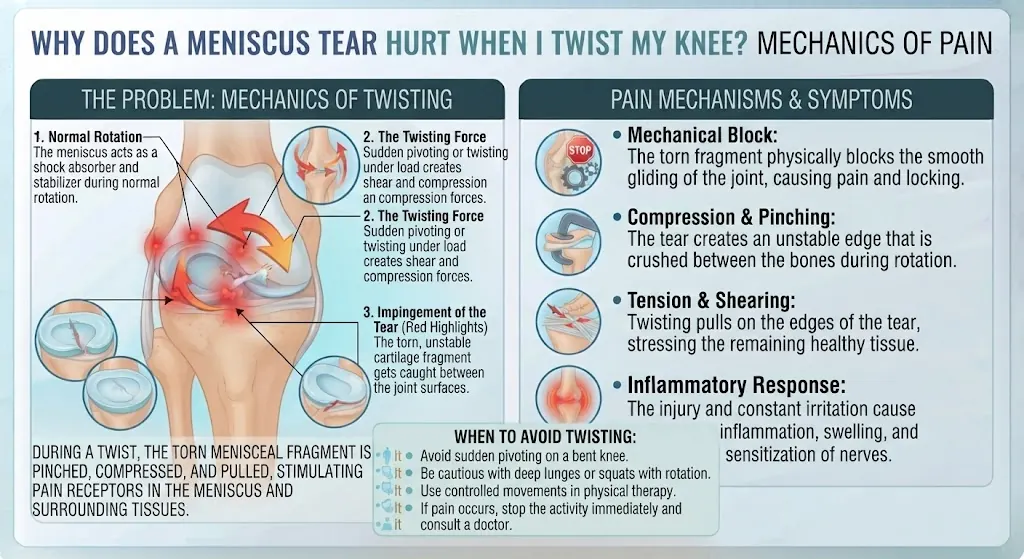
A meniscus tear hurts during twisting because rotation can place pressure and shear forces on the injured cartilage while the knee is bearing weight. The menisci are two crescent-shaped pieces of fibrocartilage that sit between the thighbone (femur) and shinbone (tibia). They help distribute load, absorb shock, and support knee stability.
When your foot remains planted and your body turns, the femur rotates relative to the tibia. This movement can compress or displace a torn portion of the meniscus, irritating pain-sensitive tissues around the knee joint. Deep bending combined with rotation may increase the stress on the injured area.
Pain can feel sharp, pinching, or deep inside the joint. It may settle when you straighten your leg and stop rotating, then return when you repeat the same movement. The severity depends on the tear’s location, shape, and size, as well as whether other knee structures are injured.
What Does Meniscus Tear Pain During Twisting Feel Like?
Twisting pain often occurs alongside other symptoms, although not everyone experiences the same pattern.
-
Pain along the joint line: Discomfort may occur on the inner or outer side of the knee.
-
Pain with pivoting: Turning quickly, changing direction, or rotating on a planted foot may trigger symptoms.
-
Swelling or stiffness: The knee may become swollen over several hours or feel difficult to bend fully.
-
Clicking or catching: Movement may produce a click or a sensation that something is catching inside the joint.
-
Limited movement: Straightening or bending the knee may become uncomfortable.
-
Giving way: The knee may feel unreliable, although this can also occur with ligament injuries or pain-related muscle inhibition.
These symptoms can suggest a meniscus injury but cannot confirm one. For a broader overview, see meniscus tear symptoms, treatment, and recovery.
Which Movements Make a Meniscus Tear Hurt More?
Twisting is a common trigger, but other movements can also compress the knee joint or place stress on the meniscus. The following comparisons can help you identify patterns worth discussing with a healthcare professional.
| Movement | Why it may trigger pain | Safer modification |
|---|---|---|
| Pivoting on a planted foot | Rotates the thighbone relative to the shinbone | Turn your whole body with small steps rather than twisting the knee |
| Deep squatting | Increases compression inside the knee | Avoid deep bends that reproduce pain |
| Kneeling | Places pressure on the knee and often requires deep flexion | Use a different position until symptoms improve |
| Turning while carrying something | Combines rotation with added load | Set the load down before changing direction |
| Rapid direction changes during sports | Combines rotation, bending, and force | Pause cutting, pivoting, and contact sports during recovery |
Do not repeatedly perform painful twists to test whether the meniscus is injured. Provoking symptoms cannot reliably establish the diagnosis and may aggravate an existing injury.
Is Twisting Pain Always a Sign of a Meniscus Tear?
No. Twisting pain can occur with several knee conditions, and more than one structure may be injured during the same incident.
| Possible condition | Common clues | How it differs from a meniscus injury |
|---|---|---|
| Meniscus tear | Pain along the inner or outer joint line, catching, swelling | Pain may be particularly noticeable with loaded rotation |
| ACL injury | A pop during injury, rapid swelling, instability | Often follows a sudden pivot or landing; meniscus injuries can occur at the same time |
| Knee ligament sprain | Pain around the joint, sometimes instability | Tenderness may be concentrated along the injured ligament |
| Knee osteoarthritis | Stiffness, aching, discomfort with weight-bearing | Symptoms may develop gradually, although an arthritic knee can also have a meniscus tear |
| Kneecap-related pain | Pain at the front of the knee during stairs or squats | Usually centered around or behind the kneecap rather than the joint line |
For a closer comparison, see how an ACL injury differs from a meniscus tear and how to distinguish a meniscus tear from knee arthritis.
What does the evidence say?
Meniscus tears are common, but the presence of a tear does not automatically mean it is the source of knee pain. The American Academy of Orthopaedic Surgeons’ 2024 clinical guideline supports combining a physical examination with appropriate imaging when evaluating an acute meniscus injury. It also emphasizes preserving functional meniscus tissue when surgery is indicated.
A further consideration is that meniscus tissue has different blood supplies in different regions. Tears near the outer edge may have better healing potential than tears in the inner region, which receives less blood. This is one reason the tear’s location and pattern matter when clinicians discuss treatment.
What Should You Do If Twisting Your Knee Hurts?
If you suspect a meniscus injury, the initial goal is to reduce irritation without unnecessarily immobilizing the knee.
-
Stop painful twisting and pivoting. Temporarily avoid sports, deep squats, kneeling, and movements that cause sharp pain or catching.
-
Apply a cold pack. Wrap it in a towel and use it for about 15–20 minutes at a time to help manage pain and swelling.
-
Elevate the leg. When resting, support the leg comfortably on pillows if swelling is present.
-
Use compression cautiously. A comfortable elastic wrap may help with swelling, but loosen or remove it if you develop numbness, tingling, color changes, or increased pain.
-
Keep movement gentle. If the knee is not locked and movement is comfortable, gentle bending and straightening may help prevent unnecessary stiffness. Do not force the joint.
-
Arrange an assessment when needed. Significant pain, recurring symptoms, swelling, or difficulty bearing weight may require a clinical examination.
For more detail, review whether walking on a torn meniscus can make it worse. If swelling is prominent, it is also useful to understand when fluid on the knee may be dangerous.
Avoid starting an intensive rehabilitation routine before the injury has been assessed if the knee is significantly swollen, unstable, or difficult to move.
How Is a Meniscus Tear Diagnosed?
A clinician will ask how the injury happened, where the pain occurs, whether swelling developed, and which movements are difficult. They may examine joint-line tenderness, knee motion, and stability, using specific maneuvers to assess whether a meniscus or ligament injury is likely.
Imaging may be needed to clarify the diagnosis:
-
X-rays help assess bones and may reveal arthritis or a fracture, but they do not directly show a meniscus tear.
-
MRI provides detailed images of the meniscus and other soft tissues. It is often the preferred imaging test when an acute meniscus tear needs confirmation.
-
Further evaluation may be necessary when the knee locks, symptoms persist, or the examination suggests another injury.
An MRI finding must be interpreted alongside symptoms and examination results because some tears, particularly degenerative tears, may not be responsible for the pain.
If your knee hurts when bending or straightening, these movement-specific guides may help you describe the problem: knee pain when bending and knee pain when straightening the leg.
How Long Does a Meniscus Tear Hurt When Twisting?
There is no single recovery timeline. A mild injury may improve over days or weeks, while a more significant tear can cause symptoms for longer. Recovery depends on the tear’s location, pattern, severity, other injuries, and the treatment used.
| Treatment or injury pattern | General recovery considerations |
|---|---|
| Mild symptoms managed without surgery | Improvement may occur over several weeks, but symptoms and function should guide activity |
| Structured physical therapy | Progression depends on pain, swelling, range of motion, and strength |
| Meniscus repair surgery | Often requires several months of rehabilitation because the tissue needs time to heal |
| Partial meniscectomy (trimming damaged tissue) | Recovery is often shorter than after repair, but still depends on individual circumstances |
These are broad expectations rather than guarantees. For additional context, see how long a torn meniscus takes to heal and whether a meniscus tear can heal on its own.
A clinician may recommend nonsurgical treatment first when the knee is not locked and symptoms can be managed safely. Surgery may be considered for certain repairable tears, persistent symptoms, or a displaced tear that restricts movement. The decision should reflect the type of injury and the person’s needs, not pain during twisting alone.
When Should You Seek Medical Care?
Seek urgent medical assessment if you cannot bear weight, cannot fully bend or straighten the knee, have severe pain after an injury, or develop substantial swelling with heat and fever. A knee that becomes visibly deformed or a leg that develops new numbness or loss of sensation needs emergency evaluation.
Arrange a routine appointment if twisting pain keeps returning, swelling persists, the knee catches, or symptoms interfere with work, sleep, or everyday activities. A knee that physically locks in one position should be assessed promptly rather than forced straight.
If the knee repeatedly gives way, do not assume this is simply a meniscus problem. Knee ligament injuries can cause instability, and an injury can affect both the meniscus and ligaments.
You can also review warning signs of a dangerously swollen knee and what worsening meniscus tear symptoms may look like.
Frequently Asked Questions
1. Why does my knee hurt only when I twist it?
Twisting pain may occur when rotation compresses or irritates an injured meniscus. Ligament injuries and other joint conditions can cause similar symptoms, so the movement that triggers pain cannot confirm a tear by itself.
2. Can you have a meniscus tear without swelling?
Yes. Some meniscus tears cause pain without obvious swelling, while others produce swelling several hours or days after the injury. The absence of swelling does not rule out a tear.
3. Why does my knee click when I twist it?
Clicking can occur when joint structures move, but it is not proof of a meniscus tear. Painful clicking, catching, or restricted movement is more concerning than painless clicking alone.
4. Can a meniscus tear get worse if I keep twisting my knee?
Repeated painful twisting and pivoting may aggravate symptoms or worsen certain injuries. Avoid movements that reproduce pain until you have recovered or received appropriate guidance; see how a meniscus tear can worsen.
5. Should I exercise with a meniscus tear?
Some people can exercise safely with a meniscus tear, but the appropriate activities depend on the injury and symptoms. A physical therapist can help select movements that build strength without aggravating the knee; learn more about exercising safely with a meniscus tear.
6. Can physical therapy help a meniscus tear heal?
Physical therapy can improve knee strength, mobility, and function, and some people improve without surgery. Whether therapy alone is appropriate depends on the tear’s characteristics, symptoms, and whether the knee is mechanically blocked; see physical therapy for a meniscus tear.
7. Does every painful meniscus tear need surgery?
No. Many tears can initially be managed without surgery, particularly when symptoms are manageable and the knee is not locked. Surgery may be appropriate for selected tears or persistent symptoms, and the decision should be individualized.
8. Why does my knee feel stuck when I bend it?
A catching sensation may have several causes, including a meniscus tear. If your knee becomes physically locked and you cannot straighten or bend it normally, seek prompt medical assessment rather than forcing the movement; read more about why a knee may lock when bending.
9. How can I tell an ACL injury from a meniscus tear?
An ACL injury may cause a pop, rapid swelling, and instability after a sudden pivot or landing. A meniscus tear may cause joint-line pain and catching, but the symptoms overlap, and both injuries can occur together. Learn about sharp knee pain after an injury and the differences between ACL and meniscus tears.
10. When should I see a doctor for twisting knee pain?
Seek assessment if pain persists, swelling develops, the knee repeatedly catches or gives way, or normal activities become difficult. Severe pain, inability to bear weight, fever with a hot swollen knee, or a locked joint requires urgent evaluation; a broader guide to knee pain causes and when to seek medical care can help you understand other warning signs.
The Bottom Line
A meniscus tear can hurt when you twist your knee because rotation under load places stress on the injured cartilage. Avoid painful pivoting, do not repeatedly test the knee, and use gentle activity only when it is comfortable and appropriate. Persistent pain, swelling, catching, or restricted movement warrants medical evaluation so you can determine the cause and choose a suitable recovery plan.
Disclaimer: This article is provided for educational and informational purposes only.
This article is for education purpose only and is not a diagnosis or a substitute for medical advice.