
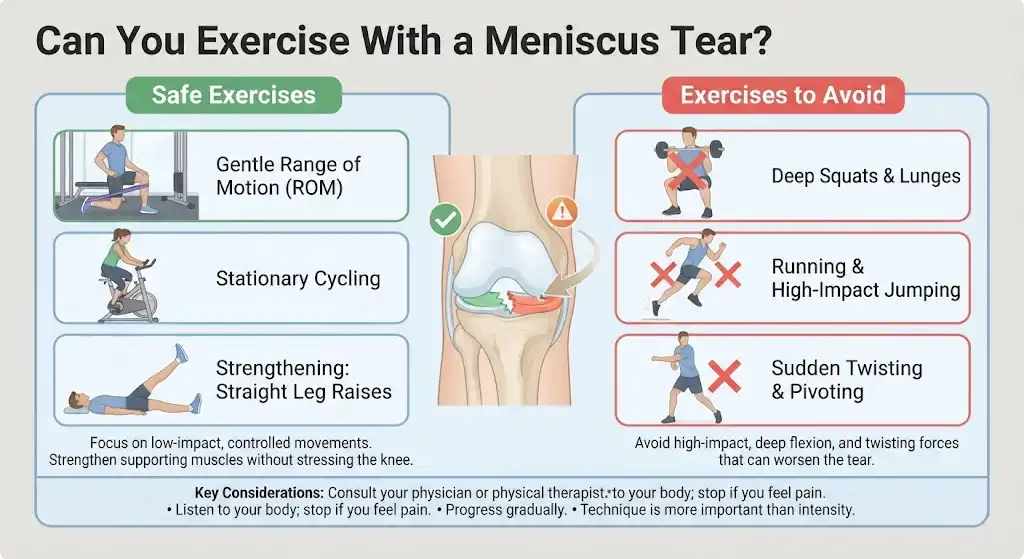
A meniscus tear does not automatically mean you must stop all exercise. Some people can continue gentle, low-impact activity while recovering, but the right choice depends on the tear, pain, swelling, knee movement, and advice from a healthcare professional. Avoid pushing through sharp pain, a locked knee, or worsening swelling.
Quick answer: Short, comfortable walks, gentle quadriceps contractions, straight-leg raises, or low-resistance stationary cycling may be suitable for some people when these movements do not worsen symptoms. Deep squats, loaded twisting, pivoting sports, jumping, and running may need to be paused until symptoms improve and a clinician or physical therapist advises that they are appropriate.
This guide explains how to choose activity more safely, which symptoms mean you should stop, and when to seek medical care. It is educational information, not a personal diagnosis or rehabilitation plan.
Is It Safe to Exercise With a Meniscus Tear?
Often, modified exercise is possible, but it is not safe for every tear or every stage of recovery. The meniscus is a crescent-shaped piece of cartilage that helps distribute load and absorb shock in the knee. A tear can occur after a twisting injury or develop gradually as the tissue changes with age.
Symptoms can include pain along the joint line, swelling, catching, stiffness, or difficulty fully bending or straightening the knee. Some people have relatively mild symptoms, so pain intensity alone cannot establish how serious a tear is.
A clinician can assess your knee, consider other possible causes of pain, and advise whether you need imaging or a supervised rehabilitation plan. If your knee is significantly swollen, unstable, or difficult to move, do not start a new exercise routine without assessment.
Which Exercises May Be Suitable?
Choose activity that keeps symptoms stable rather than trying to work through pain. The options below may be appropriate for some people, but they are not suitable for every tear. Start gently and follow any restrictions provided by your clinician.
| Activity | When it may be appropriate | Safety point |
|---|---|---|
| Short, level walks | When you can walk without a marked limp or worsening pain | Shorten the walk or stop if pain or swelling increases |
| Stationary cycling | When you can bend the knee comfortably through the pedal cycle | Use low resistance; do not force the knee around |
| Quadriceps sets | When the knee can be comfortably straightened | Gently tighten the front thigh muscles without forcing the joint |
| Straight-leg raises | When you can keep the knee straight without increased symptoms | Stop if pain develops or you cannot control the movement |
| Physical-therapy strengthening | When exercises have been selected for your injury and recovery stage | Increase resistance and range gradually under guidance |
There is no universal number of repetitions or schedule that is safe for every meniscus tear. A physical therapist can adapt the range of motion, load, and progression to your symptoms, strength, and treatment plan. See our guide to low-impact exercises for people with joint pain for broader activity ideas.
Which Exercises Should You Avoid or Modify?
When the knee is painful or swollen, activities that combine weight-bearing with twisting or deep knee bending may aggravate symptoms. Temporarily modify or avoid the following unless your treating clinician has cleared you to do them.
| Activity | Why it may be a problem | Possible modification |
|---|---|---|
| Deep squats or deep lunges | Increase knee flexion and loading | Avoid deep ranges; only reintroduce a shallower range if advised and comfortable |
| Pivoting and cutting sports | Combine rotation with weight-bearing | Pause until symptoms, control, and rehabilitation progress support a return |
| Jumping and hard landings | Add impact and rapid loading | Wait until a clinician or rehabilitation plan supports impact activity |
| Heavy leg presses | High resistance or deep bending may increase symptoms | Do not load through pain; ask a physical therapist about range and resistance |
| Running | Repeated impact may aggravate a painful or swollen knee | Return gradually only when symptoms and function allow |
| Kneeling with the knee deeply bent | May provoke pain or pressure in a sensitive knee | Avoid it if uncomfortable and use a less painful position |
These are not necessarily permanent restrictions. What you can safely do depends on the tear pattern, symptoms, treatment, and recovery. Do not use pain medication simply to mask symptoms so you can complete a workout.
If walking is uncomfortable, read whether walking on a torn meniscus can make it worse.
How Do You Know if Exercise Is Making Symptoms Worse?
Notice how your knee feels during activity and later that day or the following morning. An increase in pain, swelling, limping, or mechanical symptoms can mean the activity was too demanding. Stop the aggravating movement and reduce the load rather than repeatedly testing the knee.
| What you notice | What to do |
|---|---|
| Mild discomfort that settles and does not affect walking | Keep the activity gentle and do not increase intensity yet |
| Pain that rises during exercise or swelling afterward | Stop or reduce the activity and seek advice if it persists or recurs |
| Repeated catching, giving way, or reduced movement | Arrange a clinical assessment |
| Knee locks and you cannot fully straighten it | Seek prompt medical evaluation |
| Severe pain or inability to bear weight after an injury | Seek urgent medical care |
Sudden or substantial swelling deserves attention. Read more about when a swollen knee may need medical attention.
How Long Should You Rest Before Exercising Again?
There is no single rest period for every meniscus tear. Recovery varies with the location and pattern of the tear, other knee injuries, symptoms, age-related tissue changes, and whether treatment is nonsurgical or surgical. Some people need only a period of activity modification; others need a longer, supervised rehabilitation plan.
Unless your clinician advises otherwise, recovery does not always mean complete inactivity. The aim is to protect the knee from aggravating loads while maintaining comfortable movement and gradually rebuilding strength and function. Increase activity in small steps, and back off if pain, swelling, or limping increases.
For more context, read our meniscus tear recovery timeline and learn whether a meniscus tear can heal on its own.
When Should You See a Doctor?
Arrange a medical assessment if pain or swelling persists, your knee repeatedly catches or gives way, movement is limited, or symptoms interfere with normal walking. A clinician may examine the knee and decide whether imaging, including MRI, is appropriate.
Seek urgent care if your knee becomes locked and cannot straighten, you cannot bear weight after an injury, or the joint is hot and swollen with fever. These symptoms may indicate a problem that needs prompt evaluation.
For related guidance, see how to recognize a worsening meniscus tear and when surgery may be considered for a meniscus tear.
Frequently Asked Questions
Can I go to the gym with a meniscus tear?
Possibly, if your symptoms are stable and you choose movements that do not provoke pain or swelling. Avoid heavy loads, deep bending, and twisting until a clinician or physical therapist advises what is appropriate for your injury.
Is walking good for a meniscus tear?
Short, level walks may be tolerated if you can walk without significant pain or a pronounced limp. Reduce the distance or stop if symptoms increase. If you cannot bear weight comfortably, seek medical advice.
Can stationary cycling damage a torn meniscus?
Some people tolerate stationary cycling with low resistance when knee bending is comfortable. Do not force the pedal cycle or continue if pain or swelling increases.
Can exercise heal a meniscus tear?
Rehabilitation can improve strength, movement, and function, but it does not guarantee that the torn tissue itself will heal. Healing potential depends on factors such as tear location and pattern.
Should I wear a knee brace while exercising?
A brace is not necessary for every meniscus tear. Ask a clinician whether a brace is appropriate for your symptoms, knee stability, and treatment plan.
Can I run with a meniscus tear?
Running may aggravate a painful or swollen knee. Do not use running to test whether the tear has recovered. Return gradually when symptoms, strength, and knee control have improved and your rehabilitation plan supports it.
What happens if I keep exercising through knee pain?
Repeatedly pushing through pain that worsens can aggravate symptoms and interfere with recovery. Stop movements that cause sharp pain, increasing swelling, locking, or giving way, and seek advice when needed.
Do all meniscus tears require surgery?
No. Some tears are initially managed with activity modification and rehabilitation. Whether surgery is considered depends on the tear, symptoms, examination findings, and response to nonsurgical care.
Can a meniscus tear cause the knee to lock?
Some tears can cause catching or mechanical locking. If the knee becomes stuck and cannot fully straighten, seek prompt medical evaluation rather than trying to force it straight.
When can I return to sports?
Return depends on pain, swelling, range of motion, strength, control, and the demands of the sport. Follow a gradual, clinician-guided progression rather than relying on a fixed timeline.
Key Takeaway
You may be able to exercise with a meniscus tear, but the activity must match your symptoms and recovery stage. Favor comfortable, controlled movement; temporarily avoid painful twisting, deep bending, and impact; and seek medical guidance if symptoms persist or worsen.
Medical disclaimer: This article is for general educational purposes only and does not replace diagnosis or individualized advice from a qualified healthcare professional.
This article is for education purpose only and is not a diagnosis or a substitute for medical advice.