
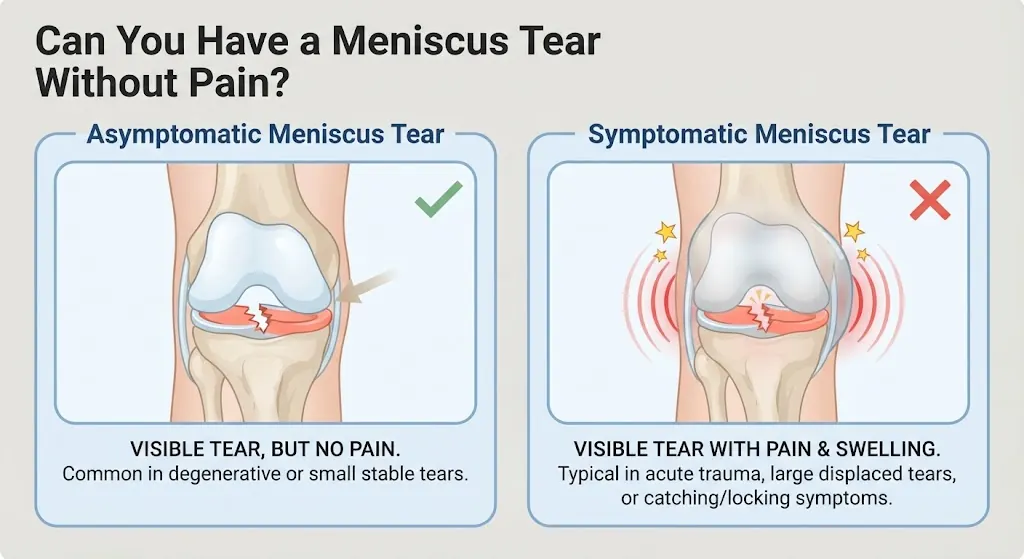
A tear does not always mean your knee is seriously damaged or that you need surgery. Some meniscus tears seen on MRI are incidental findings, particularly in adults with age-related joint changes. However, the absence of pain does not automatically mean a tear is harmless.
Understanding how a painless meniscus tear can occur, which symptoms to monitor, and when medical evaluation is appropriate can help you make informed decisions about activity and treatment.
How can a meniscus tear cause no pain?
The menisci are two crescent-shaped pieces of cartilage that cushion the knee, distribute weight, and help stabilize the joint. A tear may cause little or no discomfort depending on its location, size, pattern, and whether it irritates surrounding tissues.
The outer portion of the meniscus has a better blood supply than the inner portion. Tears in the outer region may have greater healing potential, while tears in the inner region generally have less. Nevertheless, blood supply alone does not determine whether a tear hurts or heals.
A gradual, degenerative tear may also develop without a clear injury. Some people discover one incidentally when an MRI is performed for another reason.
What are the signs of a painless meniscus tear?
A meniscus tear can exist without symptoms, but subtle changes may appear during daily activities.
Possible signs include:
-
Clicking or popping when bending or straightening the knee.
-
Mild stiffness after sitting or resting.
-
Occasional swelling after activity.
-
A catching sensation during twisting movements.
-
Reduced comfort when squatting or kneeling.
These symptoms do not confirm a tear. Knee clicking without pain or swelling is often harmless, while persistent catching or restricted movement deserves assessment. Learn about meniscus tear symptoms and recovery to understand how symptoms can vary.
Does a painless meniscus tear need treatment?
Not every meniscus tear requires treatment. If the tear causes no symptoms and does not limit knee function, a clinician may recommend observation rather than immediate intervention.
| Situation | Possible next step |
|---|---|
| No pain or movement limitation | Monitor symptoms and maintain comfortable activity |
| Mild stiffness or occasional discomfort | Modify aggravating activities and seek advice if symptoms persist |
| Recurrent swelling or catching | Arrange a clinical assessment |
| Locked knee or inability to bear weight after injury | Seek urgent medical evaluation |
Treatment decisions depend on symptoms, age, activity level, the tear’s characteristics, and whether arthritis or another knee condition is present. An MRI finding alone does not determine the need for surgery.
For people with symptoms, treatment may include activity modification and physical therapy. You can also review whether physical therapy can help a meniscus tear.
Can walking or exercise make a painless tear worse?
Walking does not automatically worsen a meniscus tear. Comfortable, level walking is often reasonable if the knee remains pain-free, does not swell, and moves normally.
However, deep squats, sudden pivots, twisting under load, and high-impact activity may aggravate some knee injuries. Increase activity gradually, and stop if pain, swelling, catching, or instability develops. Guidance on walking with a meniscus tear can help you understand when activity modification may be appropriate.
When should you see a doctor?
Arrange an evaluation if you develop recurring swelling, new pain, difficulty straightening the knee, or a feeling that the knee is giving way.
Seek urgent medical care if the knee becomes locked and cannot fully straighten, you cannot bear weight after an injury, or severe swelling develops quickly after trauma. A hot, red knee with fever also requires prompt assessment.
Frequently Asked Questions
1. Can an MRI show a meniscus tear if my knee does not hurt?
Yes. MRI can reveal meniscus changes even when you have no symptoms. A clinician should interpret the finding alongside your examination and medical history.
2. Can a meniscus tear heal without pain?
Some tears remain symptom-free, while others improve over time. Healing depends on factors such as tear location, blood supply, and tear pattern.
3. Can you walk normally with a torn meniscus?
Yes. Some people can walk, work, and exercise normally despite a tear. Normal walking does not confirm or rule out an injury.
4. Does every meniscus tear require surgery?
No. Many tears can be managed without surgery, particularly when symptoms are mild or absent. Surgery is considered based on the tear, symptoms, and response to conservative treatment.
5. Can a meniscus tear exist without swelling?
Yes. Swelling is not present with every tear, especially when the injury is small or degenerative. Its absence does not rule out a meniscus injury.
6. Is painless knee clicking a sign of a meniscus tear?
Not necessarily. Clicking can occur for several reasons, including normal joint movement. Clicking accompanied by pain, swelling, or catching is more concerning.
7. Can exercise be safe with a painless meniscus tear?
Often, yes, if the knee moves normally and activity does not trigger symptoms. Avoid forcing painful movements and seek professional advice before returning to demanding sports after an injury.
8. Can a meniscus tear become painful later?
Yes. Symptoms may develop after a new injury or changes in activity, although some tears remain symptom-free. New pain or swelling warrants reassessment.
9. How do doctors diagnose a meniscus tear?
Clinicians review the injury history, examine knee movement and tenderness, and may order MRI when appropriate. Imaging findings must be interpreted in context because not every tear causes symptoms.
10. What should I do if an MRI shows a tear but I feel fine?
Discuss the finding with your clinician rather than assuming you need treatment. Continue comfortable activities and seek reassessment if pain, swelling, locking, or instability develops.
Conclusion
A meniscus tear can exist without pain, and an MRI finding does not automatically require surgery. Monitor knee function, maintain comfortable activity, and seek medical advice if symptoms appear or movement becomes restricted.
Disclaimer: This article is provided for educational and informational purposes only.
This article is for education purpose only and is not a diagnosis or a substitute for medical advice.