
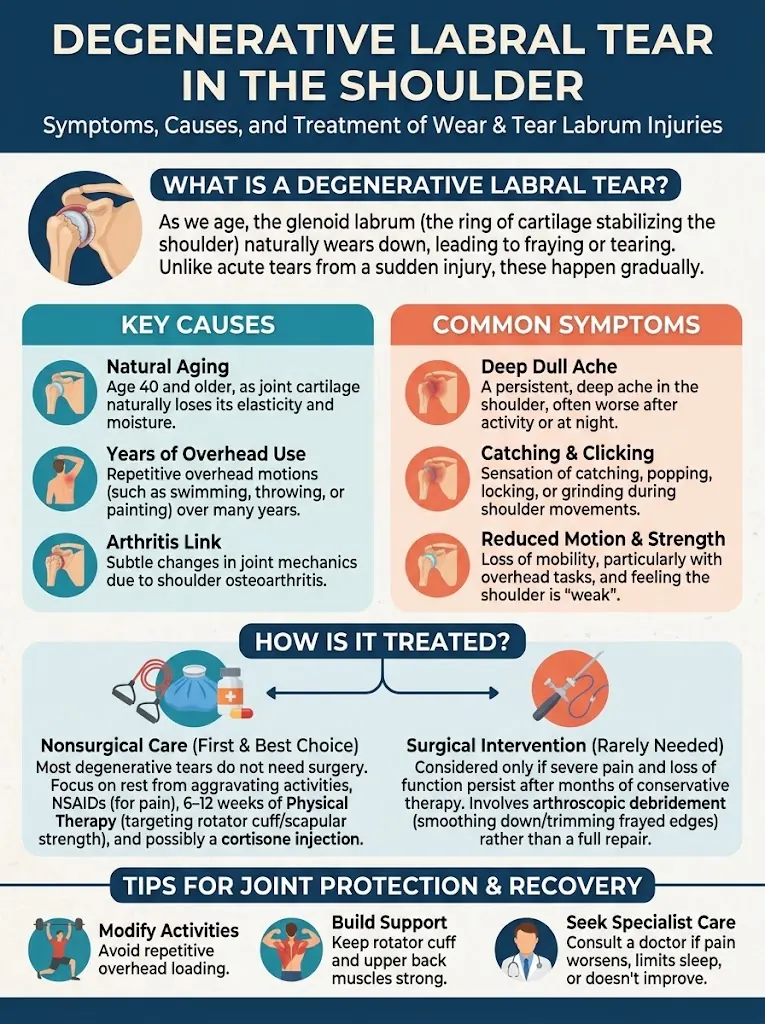
A degenerative labral tear in the shoulder can cause a deep, persistent ache, clicking during movement, discomfort when reaching overhead, or difficulty lifting objects. These symptoms may develop gradually rather than after a single injury, making everyday activities such as dressing, sleeping, exercising, and working more uncomfortable.
A degenerative tear does not automatically mean that the shoulder is severely damaged or that surgery is necessary. Labral changes can occur with aging, and some people have abnormalities on imaging without significant symptoms. However, persistent pain, weakness, or a feeling that the shoulder may slip out of place deserves medical evaluation.
Understanding what causes shoulder labrum degeneration, how clinicians assess it, and which treatments may help can make it easier to decide what to do next. This guide explains the symptoms, diagnosis, nonsurgical options, recovery expectations, and warning signs associated with a degenerative shoulder labral tear.
What Is a Degenerative Labral Tear in the Shoulder?
The shoulder labrum is a ring of tough fibrocartilage around the edge of the shoulder socket. It helps deepen the socket and supports shoulder stability while the arm moves.
A degenerative labral tear develops when this tissue gradually changes or wears down over time. Unlike an acute tear caused by a fall or sudden pulling force, degeneration may develop through a combination of aging, repeated shoulder loading, and previous joint stress.
A degenerative tear can affect different parts of the labrum. When the upper portion is involved, the condition may overlap with a superior labral tear involving the shoulder, sometimes called a SLAP tear.
What Are the Symptoms of a Degenerative Shoulder Labral Tear?
Symptoms vary according to the location and extent of the tear, associated shoulder conditions, and individual activity levels. Some people experience mild discomfort, while others have pain that interferes with daily tasks.
Common symptoms include:
- Deep shoulder pain: An ache inside the joint, especially during reaching, lifting, or overhead activity.
- Clicking or catching: A sensation of something shifting or catching during arm movement.
- Reduced strength or endurance: Difficulty performing repeated lifts or holding the arm in certain positions.
- Shoulder instability: A feeling that the shoulder is slipping, although this can have several causes.
- Nighttime discomfort: Pain when lying on the affected side or changing sleeping positions.
These symptoms are not specific to labral degeneration. Reviewing the early signs of a shoulder labral tear can help explain the possible symptom pattern, but symptoms alone cannot confirm the diagnosis.
What Causes Labral Degeneration in the Shoulder?
Degenerative labral tears usually develop gradually, although more than one factor may contribute.
Age-related tissue changes
As people age, the labrum and other shoulder structures can undergo changes in tissue quality. These changes may appear on imaging even when they do not cause pain.
Repetitive shoulder movements
Repeated overhead lifting, throwing, swimming, or physically demanding work can place ongoing stress on the shoulder. Repetitive activity does not guarantee a tear, but it may contribute to symptoms in susceptible shoulders.
Previous injuries and joint problems
An older shoulder injury, instability, or associated tendon condition may contribute to ongoing joint stress. Symptoms may also come from another problem, such as shoulder tendonitis and its common causes.
How degenerative and traumatic tears differ
| Feature | Degenerative labral tear | Traumatic labral tear |
|---|---|---|
| Typical onset | Gradual | Often sudden |
| Common context | Age-related changes or repeated loading | Fall, collision, forceful pull, or dislocation |
| Symptoms | May develop slowly or remain mild | May begin with sudden pain |
| Treatment | Often begins with nonsurgical care | Depends on injury severity and associated damage |
These patterns can overlap. A degenerative labrum can become symptomatic after an injury, so the onset alone does not establish the type of tear.
How Is a Degenerative Labral Tear Diagnosed?
Diagnosis usually combines your medical history, a physical examination, and imaging when appropriate. A clinician may ask when the pain began, which movements trigger it, whether there was an injury, and whether the shoulder feels unstable.
During the examination, the clinician may assess shoulder motion, strength, tenderness, and stability. Because several conditions can produce similar symptoms, the evaluation may also consider a labral tear versus a rotator cuff tear or labral tear versus shoulder impingement.
Can an MRI show a degenerative labral tear?
An MRI may identify changes in the labrum and nearby structures. In selected cases, a clinician may recommend an MRI arthrogram for a suspected shoulder labral tear, which uses contrast material inside the joint to improve visualization.
| Test | What it can help assess | Important limitation |
|---|---|---|
| Physical examination | Pain patterns, movement, strength, and stability | Cannot confirm every labral tear |
| X-ray | Bone alignment, arthritis, and certain bone abnormalities | Does not directly show the labrum |
| MRI | Labrum, tendons, cartilage, and other soft tissues | Degenerative findings may not explain symptoms |
| MRI arthrogram | Selected suspected labral injuries | Involves an injection and is not necessary for everyone |
One important consideration is that an imaging abnormality does not automatically identify the source of pain. Findings must be interpreted alongside symptoms, examination results, age, and activity demands. For a closer look at what a shoulder labral tear looks like on MRI, the key is understanding how the scan relates to the clinical picture.
What Is the Best Treatment for a Degenerative Labral Tear?
Treatment depends on symptom severity, daily demands, associated conditions, and whether the shoulder is stable. Many people begin with nonsurgical treatment rather than proceeding directly to an operation.
1. Modify painful activities
Temporarily reduce movements that repeatedly trigger pain, particularly heavy overhead lifting, forceful pulling, or exercises that cause catching. Complete immobilization is rarely appropriate unless a clinician recommends it for a specific reason.
Understanding which exercises to avoid with a shoulder labral tear can help you adjust workouts without unnecessarily stopping all physical activity.
2. Use physical therapy
Physical therapy may improve shoulder mobility, muscle coordination, and control of the shoulder blade. A rehabilitation program may include gentle range-of-motion work, rotator cuff strengthening, and gradual progression toward normal activities.
Exercises should match your symptoms and examination findings. Avoid pushing through sharp pain, increasing instability, or persistent symptom worsening. A therapist can help select exercises that support labral tear recovery and determine when to progress.
3. Consider appropriate pain relief
Depending on your health history, a clinician may recommend an over-the-counter pain reliever or anti-inflammatory medicine. These medications can have risks, including stomach bleeding, kidney problems, or cardiovascular effects with certain drugs, so check with a clinician or pharmacist if you have medical conditions, take other medicines, or are unsure what is safe.
Ice or heat may provide temporary comfort. Neither treatment repairs the labrum itself.
4. Decide whether surgery is appropriate
Surgery may be considered when symptoms remain limiting despite an appropriate course of nonsurgical care, or when associated structural problems require intervention. The decision depends on the specific tear, age, functional goals, shoulder stability, and involvement of the biceps tendon.
A surgeon may discuss different procedures rather than automatically recommending labral repair. Review the considerations involved in shoulder labral tear treatment: physical therapy versus surgery.
Can a Degenerative Labral Tear Heal Without Surgery?
Symptoms can improve without surgery, but improvement does not necessarily mean that the torn tissue has returned to its original structure. Rehabilitation can help the surrounding muscles support the shoulder and improve movement tolerance.
The outcome depends on the tear, other shoulder conditions, and the activities you need to perform. Learn more about whether a shoulder labral tear can improve without surgery.
How Long Does Recovery Take?
Recovery varies considerably. Some people notice improvement over several weeks of activity modification and rehabilitation, while others need several months of treatment or further evaluation.
| Recovery situation | What to expect |
|---|---|
| Mild symptoms managed at home with clinical guidance | Symptoms may settle as aggravating activity decreases |
| Structured physical therapy | Progress often occurs over weeks to months |
| Persistent symptoms or associated shoulder problems | Further assessment may be needed |
| Surgical treatment | Rehabilitation typically takes months, with return to demanding sports potentially taking longer |
These are general patterns, not guaranteed timelines. Follow your clinician’s advice about lifting, exercise, and returning to sports or physically demanding work. If surgery is recommended, discuss the expected recovery time after shoulder labral tear surgery.
Daily Tips for Managing Shoulder Symptoms
Small adjustments may reduce irritation while you recover.
- Sleep comfortably: Avoid lying directly on the painful shoulder. Try sleeping on your back or the opposite side with a pillow supporting the affected arm. See guidance on the best sleeping position for a SLAP tear.
- Adjust work tasks: Keep frequently used objects close to your body and reduce repeated overhead reaching when possible. Whether you can continue working with a shoulder labral tear depends on your duties and symptoms.
- Drive only when safe: You should be able to steer, check traffic, and react quickly without significant pain or restriction. Do not drive while taking sedating medication or when your arm control is impaired; review driving with a shoulder labral tear.
- Avoid repeatedly testing the shoulder: Frequent heavy lifting or painful movements to see whether the injury has improved can aggravate symptoms. Learn about common mistakes that may worsen a labral tear.
- Eat a balanced diet: Adequate protein, calories, and a varied diet support general tissue health, although no specific food has been shown to repair a labral tear. These nutrition choices that may support shoulder recovery should complement, not replace, appropriate treatment.
Warning Signs: When Should You Seek Medical Care?
Symptoms that may be monitored
Mild symptoms that occur only with particular movements and improve with activity modification may be monitored while arranging routine care if needed. Seek an assessment if symptoms persist, recur, or interfere with sleep and daily activities.
Symptoms that need medical evaluation
Arrange a clinical assessment for persistent pain, increasing weakness, repeated catching, reduced range of motion, or a feeling that the shoulder is unstable. Worsening symptoms do not prove that the tear has enlarged, but they warrant reassessment.
Symptoms requiring urgent care
Seek urgent medical attention after a major injury if the shoulder looks deformed, you cannot move the arm, or you suspect a dislocation. A suddenly cold, pale, numb, or markedly weak arm also requires urgent evaluation. Fever with a hot, red, swollen shoulder needs prompt medical assessment.
Frequently Asked Questions
1. Is a degenerative labral tear common with aging?
Labral tissue can change with age, and some people have degenerative findings without symptoms. Whether those findings matter depends on the clinical examination and the person’s function.
2. Can a degenerative labral tear cause clicking?
Yes, clicking or catching can occur, but painless clicking is not proof of a tear. Painful catching, locking, or instability deserves medical evaluation.
3. Does a degenerative labral tear always need surgery?
No. Many people begin with activity modification and physical therapy. Surgery is considered according to persistent symptoms, associated injuries, and functional needs.
4. Can exercise make a labral tear worse?
Exercises that repeatedly cause sharp pain, catching, or instability may aggravate symptoms. A tailored program can help maintain strength while limiting provocative movements.
5. Will an MRI confirm that the tear causes my pain?
An MRI can identify labral abnormalities, but it cannot always establish whether they are the source of symptoms. The findings must be considered alongside the examination and medical history.
6. Can the labrum heal naturally?
Symptoms may improve without surgery, even if the structural tear remains. The extent of tissue healing varies, and no home remedy guarantees that the labrum will repair itself.
7. How long does a degenerative labral tear take to improve?
Some people improve over several weeks, while others need months of rehabilitation or additional assessment. Recovery depends on symptom severity, activity demands, and other shoulder conditions.
8. Is it safe to sleep on the affected shoulder?
Sleeping directly on the painful side may increase discomfort. Try another position and support the arm with a pillow if that feels more comfortable.
9. Can I keep lifting weights with a degenerative labral tear?
You may be able to continue modified exercise, but temporarily avoid loads and movements that trigger symptoms. A clinician or physical therapist can guide a gradual return to lifting.
10. What happens if I leave a degenerative labral tear untreated?
The outcome varies. Some tears remain minimally symptomatic, while others continue to cause pain or functional limitations; persistent or worsening symptoms should be evaluated rather than ignored.
Conclusion
A degenerative labral tear in the shoulder is a gradual change in the cartilage-like rim around the shoulder socket. Imaging findings do not always explain pain, and surgery is not automatically necessary. Activity modification, appropriate pain management, and individualized physical therapy are common starting points. Seek medical evaluation when symptoms persist, worsen, or limit daily activities, and obtain urgent care for severe injury-related symptoms or signs of impaired circulation.
Disclaimer: This article is provided for educational and informational purposes only.
This article is for education purpose only and is not a diagnosis or a substitute for medical advice.