
Shoulder pain when lifting your arm, reaching overhead, or working out can make everyday activities uncomfortable. You might notice a deep ache, sharp pain during certain movements, or clicking inside the joint. These symptoms can occur with either a shoulder labral tear or shoulder impingement, making it difficult to know which condition is responsible.
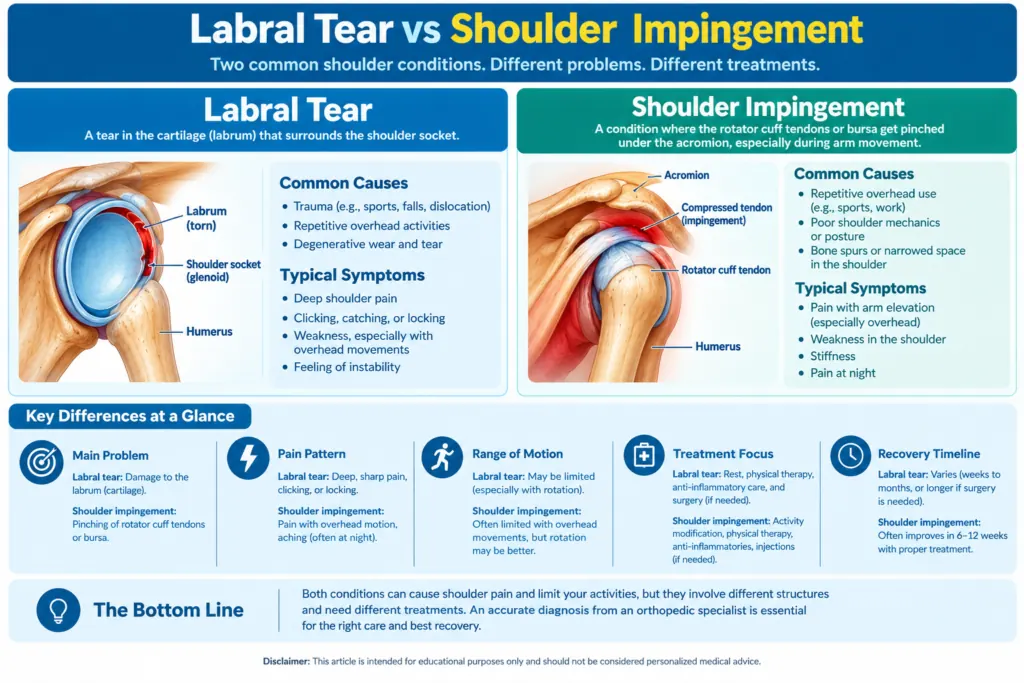
Although both conditions affect shoulder movement, they involve different structures. A labral tear damages the cartilage rim that helps stabilize the shoulder joint, while shoulder impingement involves irritation or compression of tissues, commonly the rotator cuff tendons and nearby bursa, during arm movement.
Understanding labral tear vs. shoulder impingement symptoms can help you recognize common patterns, understand how clinicians distinguish the conditions, and explore appropriate treatment options. However, symptoms alone cannot establish a diagnosis, and both conditions can occur together.
What Is the Difference Between a Labral Tear and Shoulder Impingement?
A labral tear is damage to the labrum, the cartilage ring surrounding the shoulder socket. Shoulder impingement, often described as subacromial pain syndrome, involves pain associated with irritated shoulder tissues during movement, particularly overhead activity.
A shoulder labral tear overview explains the structures involved, while this guide to shoulder impingement syndrome covers the mechanics behind impingement-related pain.
| Feature | Labral tear | Shoulder impingement |
|---|---|---|
| Main structure affected | Cartilage around the shoulder socket | Usually rotator cuff tendons and nearby bursa |
| Common onset | Injury, dislocation, repetitive loading, or gradual wear | Often gradual or associated with repetitive overhead activity |
| Typical pain | Deep shoulder pain during specific activities | Pain during arm elevation, particularly overhead |
| Clicking or catching | May occur | Not a defining feature |
| Instability | May occur, especially after dislocation | Less characteristic |
| First-line treatment | Activity modification and rehabilitation | Activity modification and rehabilitation |
What Are the Symptoms of a Shoulder Labral Tear?
A labral tear may cause deep shoulder pain, painful clicking, catching, or a feeling that the shoulder is loose. Symptoms depend on the tear’s location, severity, and whether other structures are injured.
Common signs include:
- Deep pain during throwing, pushing, or overhead lifting.
- Pain after a fall or shoulder dislocation.
- Clicking or catching accompanied by discomfort.
- Reduced strength or confidence when using the arm.
- A sensation that the shoulder may slip out of place.
The early symptoms of a shoulder labral tear may overlap with rotator cuff injuries. Labral tears also have different patterns, including a superior labral tear or SLAP injury and a SLAP tear versus Bankart tear, which commonly differ in location and mechanism.
What Are the Symptoms of Shoulder Impingement?
Shoulder impingement commonly causes pain when raising the arm, reaching behind the back, or lifting objects away from the body. The discomfort may extend from the outer shoulder into the upper arm and become more noticeable after repetitive activity.
Typical symptoms include:
- Pain when lifting the arm above shoulder height.
- Discomfort when reaching behind your back.
- Pain when lying on the affected shoulder.
- Weakness or difficulty lifting objects.
- An ache that increases after exercise or repeated overhead movement.
If you wonder why your shoulder hurts when you raise your arm or why reaching behind your back causes pain, impingement is one possibility. However, rotator cuff tendinopathy, bursitis, arthritis, and other shoulder problems can produce similar symptoms.
How Can You Tell Which Condition You Have?
The pattern of symptoms can offer clues, but no single symptom reliably distinguishes a labral tear from impingement.
| Symptom pattern | More suggestive of a labral tear | More suggestive of impingement |
|---|---|---|
| Pain after dislocation or sudden injury | Yes | Possible |
| Pain during overhead movement | Common | Common |
| Painful catching or locking | May occur | Less characteristic |
| Shoulder feels unstable | More suggestive | Less characteristic |
| Pain during repetitive lifting | Possible | Common |
| Pain without a clear injury | Possible | Common |
Other conditions should also be considered. A labral tear versus rotator cuff tear comparison helps explain why tendon injuries can resemble labral damage. Shoulder tendonitis symptoms and causes and shoulder bursitis symptoms and relief are also relevant when pain increases during arm movement.
How Are Labral Tears and Shoulder Impingement Diagnosed?
Diagnosis usually begins with a medical history and physical examination. A clinician will ask when the pain started, which activities aggravate it, and whether you have experienced trauma, instability, or progressive weakness.
For suspected impingement, examination may reproduce pain during specific arm movements. X-rays can help identify bone changes, while ultrasound or MRI may be appropriate when a rotator cuff injury or another diagnosis is suspected.
For a suspected labral tear, MRI or an MRI arthrogram may help assess the labrum. Imaging findings must be interpreted alongside symptoms and examination results because a scan alone does not always establish the source of pain.
Research and clinical guidance support an important distinction: physical examination is useful for identifying symptom patterns, but individual tests are not perfectly reliable. Labral injuries can be particularly difficult to confirm through examination alone.
What Treatment Works Best?
Both conditions are often treated initially without surgery. The right approach depends on the diagnosis, symptom severity, functional limitations, and response to rehabilitation.
For a labral tear, treatment may involve temporarily modifying painful activities, improving shoulder strength, and restoring control and stability. A clinician may recommend labral tear treatment with physical therapy versus surgery if symptoms persist or instability is significant.
For impingement, treatment commonly focuses on adjusting aggravating activities, strengthening the rotator cuff and shoulder-blade muscles, and improving shoulder movement. Persistent symptoms may warrant further assessment or additional treatment.
| Treatment approach | Labral tear | Shoulder impingement |
|---|---|---|
| Activity modification | Avoid painful loading and unstable positions | Reduce aggravating overhead movements |
| Physical therapy | Build strength, control, and stability | Improve strength, mobility, and shoulder mechanics |
| Pain medication | May help when medically appropriate | May help when medically appropriate |
| Injection | Selected cases, depending on the cause | Sometimes considered for persistent symptoms |
| Surgery | Selected tears with persistent symptoms or instability | Uncommon; considered in selected persistent cases |
Avoid pushing through sharp pain or repeatedly testing the shoulder under heavy loads. Review exercises to avoid with a shoulder labral tear and effective exercises for shoulder pain relief and strength before changing your routine. If shoulder pain develops after working out, reduce the movements that aggravate it rather than assuming the cause is a specific injury.
When Should You Seek Medical Care?
Arrange an evaluation if shoulder pain persists, strength decreases, movement becomes more restricted, or the joint repeatedly feels unstable. Seek urgent care after a significant injury, especially if the shoulder looks deformed or you cannot move the arm. A hot, swollen shoulder with fever also requires prompt assessment.
Seek emergency care for shoulder pain accompanied by chest pressure, shortness of breath, sweating, or other possible heart attack symptoms.
Frequently Asked Questions
1. Can shoulder impingement cause a labral tear?
Impingement and labral tears affect different structures, and one does not automatically cause the other. They can coexist, so persistent symptoms may require evaluation for more than one shoulder problem.
2. Which condition causes more pain?
Neither condition is consistently more painful. Severity depends on the underlying injury, irritated tissues, activity level, and individual response to pain.
3. Does clicking mean I have a labral tear?
No. Clicking can occur in several shoulder conditions and may also occur without a significant injury. Painful catching or clicking with instability deserves assessment.
4. Can shoulder impingement heal without surgery?
Many people improve with activity modification and physical therapy. Surgery is generally considered only when symptoms persist despite appropriate nonsurgical treatment and further assessment supports it.
5. Does a labral tear always need surgery?
No. Some labral tears can be managed with rehabilitation and changes to aggravating activities. Surgery may be considered for persistent symptoms or significant instability.
6. Can I continue working out with shoulder pain?
You may be able to continue activities that do not aggravate the shoulder, but heavy overhead lifting and painful movements should be modified. Seek professional advice if pain persists or weakness develops.
7. Will an MRI show shoulder impingement?
MRI can show tendons, bursae, and other soft tissues, but imaging findings must be interpreted alongside symptoms and examination results. An MRI is not always necessary for a straightforward impingement presentation.
8. Why does my shoulder hurt when lifting objects?
Pain during lifting can occur with impingement, rotator cuff problems, labral tears, and other conditions. The location of pain, associated weakness, injury history, and examination help narrow the possibilities.
9. Can you have impingement and a rotator cuff tear together?
Yes. Persistent irritation may coexist with rotator cuff tendinopathy or a tear, although impingement symptoms do not prove that a tear is present. Clinical assessment helps determine whether imaging is needed.
10. When should I see an orthopedic specialist?
Consider an orthopedic or sports medicine evaluation if pain persists, shoulder function declines, or the joint feels unstable. Seek urgent care for major injury, deformity, sudden severe weakness, or other concerning symptoms.
Conclusion
A labral tear primarily affects the cartilage that helps stabilize the shoulder, while impingement commonly involves irritated tissues during arm elevation. Because symptoms overlap, diagnosis should rely on the history, physical examination, and imaging when appropriate. Modify painful activities and seek medical evaluation if symptoms persist, worsen, or interfere with normal function.
Disclaimer: This article is provided for educational and informational purposes only.
This article is for education purpose only and is not a diagnosis or a substitute for medical advice.