
A SLAP tear can make sleep surprisingly difficult. You may feel a deep ache, catching, or discomfort in the shoulder when you roll over, reach across your body, or accidentally place weight on the injured side. Even finding a comfortable position can become frustrating when nighttime shoulder pain keeps waking you.
The good news is that changing your sleeping position can reduce pressure and unnecessary movement around the shoulder. However, there is no single position that works for everyone, and a comfortable position does not repair the tear itself. If you are still unsure whether your symptoms fit a labral injury, learning about the early signs of a shoulder labral tear can provide useful context.
A SLAP tear affects the superior part of the shoulder labrum, where the upper labrum connects near the biceps tendon. This guide explains the most comfortable sleep positions, how to use pillows for support, what positions may aggravate symptoms, and when nighttime pain deserves medical evaluation.
What Is the Best Sleeping Position for a SLAP Tear?
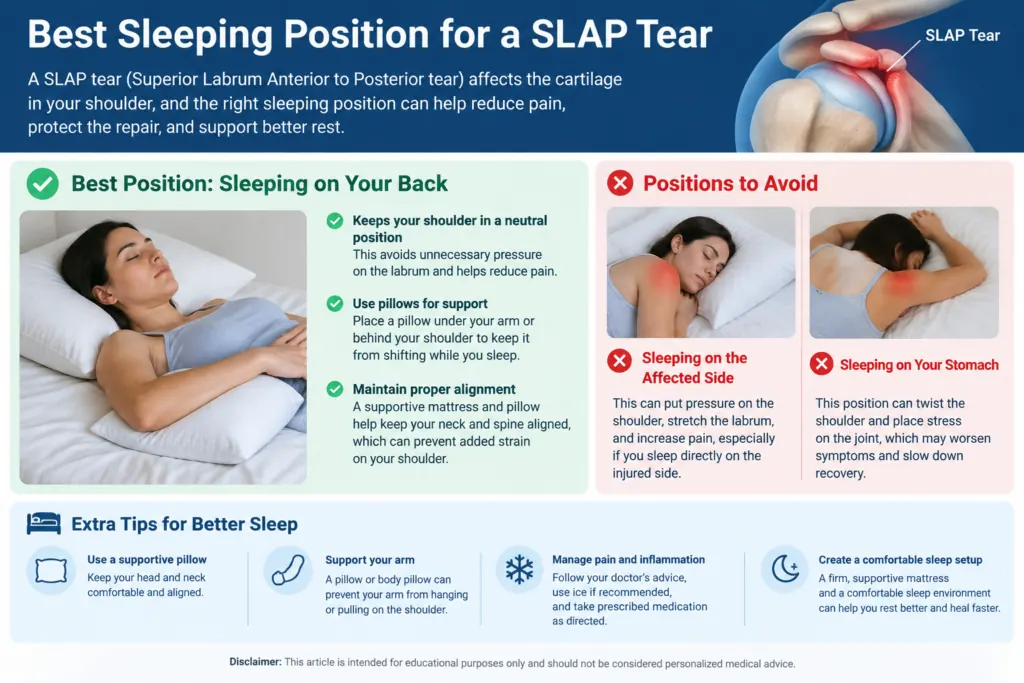
For many people, sleeping on your back or on the opposite side with the injured arm supported by a pillow is more comfortable than sleeping directly on the affected shoulder.
The goal is to keep the shoulder supported without forcing it into a stretched, overhead, or rotated position. Your ideal position may also change as symptoms improve during the SLAP tear healing timeline.
| Sleeping position | Potential benefit | What to watch for |
|---|---|---|
| On your back | Minimizes direct pressure on the shoulder | Arm may fall backward or outward |
| On the opposite side | Keeps weight off the injured shoulder | Injured arm needs pillow support |
| On the injured side | Usually puts direct pressure on the shoulder | May increase pain or irritation |
| Semi-reclined | Can reduce uncomfortable shoulder positioning | Avoid excessive neck or shoulder flexion |
How to Sleep on Your Back With a SLAP Tear
Back sleeping is often a practical starting point because the injured shoulder does not have to support your body weight. Place a pillow under the forearm and elbow so the affected arm remains comfortably supported.
Avoid letting the arm drop far away from your body if that creates pulling or aching. The objective is not to hold the shoulder rigidly in one position but to prevent painful movement while you sleep.
If you are trying to understand whether your symptoms are actually coming from the labrum, information about what a shoulder labral tear is and its symptoms can help explain the typical symptom pattern.
A Simple Pillow Setup
| Pillow placement | Purpose |
|---|---|
| Under elbow and forearm | Supports the injured arm |
| Against the side of your body | Helps prevent the arm from drifting outward |
| Behind your back when side sleeping | Reduces accidental rolling onto the injured shoulder |
| Under your upper body in a semi-reclined setup | May make lying down more comfortable |
A pillow should support the arm rather than force it into a particular angle. If a setup causes increased pain, numbness, tingling, or pressure, change it.
How to Sleep on Your Side With a SLAP Tear
If you prefer side sleeping, sleep on the non-injured side. Hold a pillow against your chest and rest the injured arm on it. This gives the shoulder a stable surface and can prevent the arm from hanging forward.
A second pillow placed behind your back may make it harder to roll onto the painful shoulder during sleep.
If you are experiencing instability or a sensation that the shoulder may slip, information about what shoulder instability feels like may help you understand why certain positions feel uncomfortable.
Should You Sleep on the Shoulder With a SLAP Tear?
Generally, avoid sleeping directly on the injured shoulder if it increases pain. Direct pressure can aggravate symptoms and make it harder to maintain a comfortable position.
This does not mean that briefly rolling onto the shoulder automatically makes the tear worse. However, repeatedly sleeping in a painful position is unlikely to help nighttime comfort. Understanding signs that a labral tear may be getting worse is more useful than judging the injury by one uncomfortable night.
What If Your Shoulder Hurts More at Night?
Nighttime pain does not necessarily mean the tear is worsening. Shoulder position, prolonged inactivity, muscle tension, and pressure on sensitive tissues can all affect symptoms.
Other shoulder problems can also cause nighttime discomfort. For example, knowing the differences in labral tear vs rotator cuff tear can be useful when symptoms include weakness or pain with lifting.
If the pain is primarily caused by another shoulder condition, treatment may need to address that problem rather than focusing only on sleep position.
Should You Use a Sling or Shoulder Brace While Sleeping?
Do not routinely sleep in a sling or brace unless your clinician has recommended it. A brace may be appropriate in selected situations, but prolonged immobilization can also contribute to stiffness or discomfort.
If support has been recommended, you can learn more about choosing shoulder support for a labral tear. After surgery, follow your surgeon’s specific instructions about sling use during sleep.
What Should You Avoid Before Bed?
Activities that repeatedly provoke shoulder symptoms may make it harder to settle at night. Avoid testing the shoulder with painful overhead movements, aggressive stretching, or exercises that reproduce catching or instability immediately before bedtime.
For more specific guidance, review exercises to avoid with a shoulder labral tear and common mistakes that can make a labral tear worse.
Gentle rehabilitation may be appropriate when recommended by a clinician or physical therapist. More information about SLAP tear physical therapy and recovery explains how rehabilitation can fit into recovery.
When Does Nighttime Pain Need Medical Attention?
Occasional discomfort can often be monitored, particularly when it improves with position changes. Persistent or progressively worsening symptoms deserve discussion with a healthcare professional.
| Symptom | Reason to seek care |
|---|---|
| Pain repeatedly disrupting sleep | Needs assessment if persistent |
| Increasing weakness or instability | May require clinical evaluation |
| New numbness or persistent tingling | Should be medically assessed |
| Sudden severe pain or deformity | Seek urgent evaluation |
| Fever, redness, drainage after surgery | Contact the surgical team promptly |
If imaging is being considered, an MRI for a shoulder labral tear may be used as part of the evaluation. In some situations, an MRI arthrogram for a shoulder labral tear may provide additional information.
Does Sleeping Position Help a SLAP Tear Heal?
Sleeping comfortably can help you rest, but sleeping position does not repair a torn labrum. Recovery depends on factors such as the type of tear, symptoms, activity demands, and whether treatment is conservative or surgical.
Some people improve with rehabilitation and activity modification, while others may continue to have symptoms. Understanding whether a shoulder labral tear can heal without surgery and shoulder labral tear treatment and physical therapy versus surgery can help explain those different paths.
For daily symptom management, how to live with a labral tear and manage daily activities may also be useful.
Frequently Asked Questions
1. What is the best sleeping position for a SLAP tear?
Back sleeping or sleeping on the non-injured side is often more comfortable. Support the affected arm with a pillow rather than allowing it to hang unsupported.
2. Can I sleep on my injured shoulder with a SLAP tear?
You can if it is comfortable, but direct pressure commonly increases shoulder discomfort. If sleeping on that side causes pain, choose your back or opposite side instead.
3. Where should I put a pillow with a SLAP tear?
When sleeping on your back, place a pillow under the injured arm’s elbow and forearm. When sleeping on the opposite side, place a pillow in front of your chest for the injured arm to rest on.
4. Why does my SLAP tear hurt more at night?
Nighttime symptoms can be influenced by shoulder position, pressure, prolonged inactivity, and associated shoulder irritation. Increased nighttime pain alone does not prove that the tear is worsening.
5. Is sleeping in a recliner good for a SLAP tear?
A semi-reclined position can be more comfortable for some people, particularly when lying flat aggravates symptoms. Keep the shoulder and neck supported rather than forcing the arm into an elevated position.
6. Should I wear a sling to bed for a SLAP tear?
Only use a sling during sleep if your healthcare professional has instructed you to do so. After surgery, follow the surgeon’s instructions because restrictions can differ depending on the repair.
7. Can sleeping on the wrong side make a SLAP tear worse?
Repeatedly putting painful pressure on the shoulder may aggravate symptoms, but one uncomfortable sleeping position does not necessarily mean the tear has become larger. Persistent worsening symptoms should be evaluated.
8. Should I exercise a SLAP tear before bed?
Avoid exercises that reproduce significant pain, catching, or instability before sleeping. Rehabilitation exercises should generally follow a plan appropriate for your injury and recovery stage.
9. How long can nighttime pain from a SLAP tear last?
There is no single recovery period. Symptoms can vary according to the tear, treatment approach, activity level, and individual healing, so persistent sleep disruption should be discussed with a clinician.
10. When should I see a doctor about SLAP tear pain at night?
Seek medical evaluation when nighttime pain is persistent, worsening, or accompanied by weakness, instability, numbness, or loss of function. Sudden severe pain, obvious deformity, or concerning postoperative symptoms require more urgent attention.
Conclusion
The most practical starting point for sleeping with a SLAP tear is to avoid direct pressure on the injured shoulder and support the affected arm with pillows. Back sleeping, opposite-side sleeping, and sometimes a semi-reclined position can improve comfort, but the best position is the one that reduces symptoms without forcing the shoulder into an uncomfortable angle. If pain continues to disrupt sleep or your shoulder becomes weaker or more unstable, discuss the symptoms with a healthcare professional.
Disclaimer: This article is provided for educational and informational purposes only. It is not a substitute for professional medical advice, diagnosis, or treatment.
This article is for education purpose only and is not a diagnosis or a substitute for medical advice.