
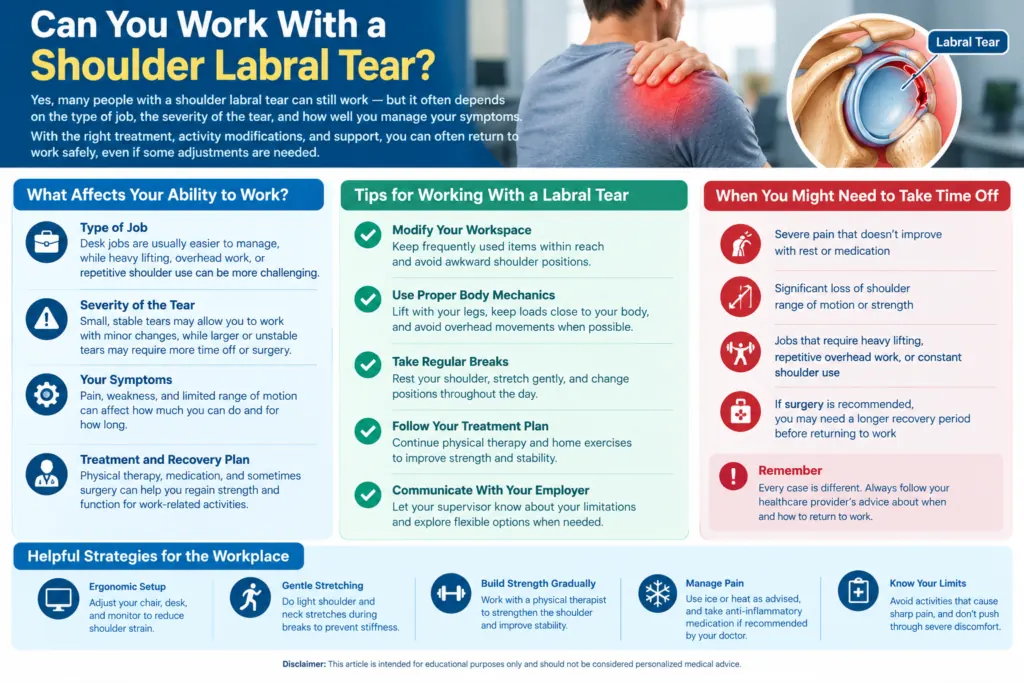
A shoulder labral tear can make ordinary work tasks uncomfortable, especially when they involve lifting, reaching overhead, carrying equipment, or repetitive arm movements. Even desk work may become difficult if sitting in one position increases shoulder discomfort or using a keyboard aggravates symptoms.
Whether you can continue working depends on the tear’s location and severity, your pain, shoulder stability, and the physical demands of your job. Some people can remain at work with temporary modifications, while others need restricted duties or time off. However, being able to tolerate pain does not necessarily mean an activity is safe for the injured shoulder.
Understanding how a shoulder labral tear affects movement can help you decide which tasks to modify, when to seek medical guidance, and how to plan a return to normal duties. This guide explains work restrictions, practical adjustments, recovery considerations, and warning signs that should not be ignored.
Can You Work With a Shoulder Labral Tear?
Yes, many people can work with a shoulder labral tear, but the safest approach depends on their symptoms and job responsibilities. Office workers may be able to continue with ergonomic adjustments, while workers who lift heavy objects, perform overhead tasks, or operate demanding equipment may need temporary restrictions.
The shoulder labrum is a ring of cartilage that helps deepen the shoulder socket and supports joint stability. A tear can cause pain, clicking, catching, weakness, or a feeling that the shoulder may slip out of place. Symptoms vary, and some tears found on imaging may not be the main source of a person’s pain.
Learn more about what a shoulder labral tear is, including its symptoms and causes.
How job demands affect your ability to work
| Type of work | Common challenges | Possible adjustments |
|---|---|---|
| Desk or computer work | Prolonged positioning, reaching for a mouse, shoulder fatigue | Adjust desk height, support the forearm, take movement breaks |
| Retail or light service work | Reaching shelves, stocking, carrying items | Keep items close to the body and limit overhead reaching |
| Warehouse or construction work | Heavy lifting, pushing, pulling, overhead tasks | Request temporary light duty or reassignment |
| Healthcare or caregiving | Transferring patients, lifting, supporting another person | Avoid unsafe lifting and arrange assistance |
| Driving or equipment operation | Steering, gear changes, rapid reactions | Assess pain, arm control, medication effects, and safety |
These are general examples, not universal restrictions. A clinician or occupational health professional can help determine which duties are appropriate for your specific injury.
Which Work Activities Should You Avoid With a Shoulder Labral Tear?
Activities that trigger sharp pain, catching, instability, or increasing weakness may aggravate symptoms. The goal is not to stop moving the shoulder entirely but to reduce excessive strain while maintaining safe, comfortable movement.
Depending on the tear and your symptoms, you may need to limit:
- Repeated overhead reaching, especially with added weight.
- Heavy lifting, forceful pushing, and pulling.
- Repetitive throwing or fast shoulder rotation.
- Carrying heavy objects with the affected arm.
- Exercises or work tasks that cause painful clicking or a slipping sensation.
Review exercises to avoid with a shoulder labral tear and common mistakes that may worsen a labral tear.
A task that causes mild, short-lived discomfort may be manageable for some people, but increasing pain or instability is a reason to stop and reassess. Do not repeatedly push through symptoms to meet a work target.
How to Modify Your Workday
Small changes can reduce unnecessary shoulder loading. The best adjustments depend on the movements your job requires.
If you work at a desk
- Keep your keyboard and mouse close enough that you do not need to reach forward.
- Support your forearm when possible, without pressing directly on a painful area.
- Adjust the chair and desk so your shoulders can remain relaxed.
- Change positions regularly rather than staying still for long periods.
- Use a headset if holding a phone against your shoulder causes discomfort.
If your job involves physical labor
Ask your supervisor about temporary light duty, team lifting, reduced overhead work, or tasks that keep loads close to your body. Avoid lifting objects that make you twist suddenly or compensate by shrugging or leaning.
If your job cannot be modified safely, a temporary leave may be appropriate while your symptoms are evaluated and a treatment plan is developed.
For everyday strategies, see practical ways to manage pain and daily activities with a labral tear.
How Long Should You Stay Off Work?
There is no single recovery timeline for every shoulder labral tear. Some people continue working with adjustments, while others need time away from demanding duties. The timeline also changes if surgery is necessary.
| Situation | Possible work approach | Important consideration |
|---|---|---|
| Mild symptoms with desk work | Continue with ergonomic adjustments if tolerated | Monitor whether symptoms worsen during the day |
| Pain with lifting or reaching | Temporary modified duties | Avoid tasks that provoke sharp pain or instability |
| Significant weakness or repeated slipping | Medical assessment before strenuous work | The shoulder may need further evaluation |
| After labral repair surgery | Gradual return under the surgeon’s instructions | Lifting and active shoulder use may be restricted for weeks or months |
These categories are general guidance, not prescribed return-to-work dates. Your actual timeline depends on the injury, treatment, healing, and job demands.
If surgery is recommended, review how long recovery from shoulder labral tear surgery takes. People considering treatment can also compare physical therapy and surgery for a shoulder labral tear.
Can Working Make a Shoulder Labral Tear Worse?
It can, particularly when work repeatedly loads the injured shoulder or causes episodes of instability. Heavy lifting, forceful rotation, repetitive overhead activity, and working through worsening symptoms may increase irritation or aggravate an existing injury.
However, not every work activity damages the labrum, and pain alone cannot establish whether a tear has become larger. Persistent or worsening symptoms deserve assessment rather than assumptions about the injury.
Read about whether a shoulder labral tear can get worse and the long-term effects of leaving a shoulder labral tear untreated.
How Is a Shoulder Labral Tear Evaluated?
A clinician may ask how the injury occurred, which movements hurt, whether the shoulder feels unstable, and how symptoms affect work. The examination may include shoulder movement, strength, and stability tests.
Imaging may be considered when the history and examination suggest a labral injury. An MRI or MRI arthrogram can help assess the labrum, although imaging findings must be interpreted alongside symptoms and examination results.
See how doctors evaluate a shoulder labral tear with MRI and how an MRI arthrogram can assess a shoulder labral tear.
Other shoulder conditions can cause similar symptoms. For example, a labral tear and a rotator cuff tear have different features, so the correct evaluation matters before deciding on work restrictions.
Can Physical Therapy Help You Return to Work?
Physical therapy may help improve shoulder movement, strength, coordination, and tolerance for everyday tasks. A therapist can tailor rehabilitation to your injury and work demands, progressing exercises as appropriate rather than immediately returning you to heavy lifting.
A program may include controlled range-of-motion work, gradual strengthening, and movement retraining. Exercises should not be advanced without guidance if the shoulder feels unstable or symptoms are worsening.
Explore physical therapy exercises and recovery for a SLAP tear and the stages of SLAP tear healing and recovery.
A brace or shoulder support is not suitable for everyone and should not be used to make unsafe work tasks possible. If you are considering one, discuss whether a shoulder brace is appropriate for a labral tear with a healthcare professional.
Warning Signs: When to Seek Medical Care
Symptoms you can monitor: Mild discomfort that settles with rest and does not interfere with safe arm use may be monitored while you arrange appropriate guidance. Reduce activities that repeatedly trigger symptoms.
Symptoms needing medical evaluation: Arrange an assessment if pain persists, your range of motion decreases, weakness develops, clicking becomes painful, or the shoulder repeatedly feels unstable.
Symptoms requiring urgent care: Seek urgent evaluation after a major injury if the shoulder looks deformed, you cannot move the arm, or you develop sudden severe pain. A cold or pale hand, marked swelling, new numbness, or loss of circulation also requires urgent assessment. If shoulder pain occurs with chest pressure, shortness of breath, sweating, or faintness, call 911 because these may indicate a medical emergency.
Frequently Asked Questions
1. Can I work a full eight-hour shift with a shoulder labral tear?
Possibly, particularly if your job is sedentary and symptoms remain manageable. You may need breaks, ergonomic changes, or temporary restrictions if pain increases during the shift.
2. Can I do a physically demanding job with a labral tear?
Some people can return to physical work, but heavy lifting and repetitive overhead tasks may require modification. Ask a clinician to assess your shoulder and help define safe duties.
3. Should I tell my employer about my shoulder injury?
Consider informing the appropriate supervisor or occupational health contact if the injury affects safe performance or requires adjustments. You generally do not need to share more medical detail than necessary to explain your work limitations, subject to workplace policies and applicable law.
4. Can I drive to work with a shoulder labral tear?
Only if you can steer, turn, and react safely without significant pain or restricted movement. Do not drive if medication makes you drowsy or if you cannot reliably control the vehicle.
5. Should I keep working if my shoulder clicks?
Painless clicking can occur for several reasons, but clicking with pain, catching, weakness, or instability should be assessed. Stop tasks that reproduce concerning symptoms.
6. Can typing make a shoulder labral tear worse?
Typing is not automatically harmful, but prolonged reaching, unsupported arm positioning, and sustained tension can increase discomfort. Adjust your workstation and take regular movement breaks.
7. Do I need a doctor’s note for light duty?
Your employer may require documentation under its policies or applicable leave and accommodation rules. A clinician can describe functional restrictions, such as limits on lifting or overhead work, without necessarily specifying a diagnosis to every supervisor.
8. How soon can I return to work after labral tear surgery?
Return depends on the procedure, healing, rehabilitation progress, and job requirements. Desk work may resume earlier than heavy manual labor, but your surgeon’s restrictions take priority.
9. Can physical therapy help me avoid time off work?
It may improve function and help you manage work tasks, but it cannot guarantee that you will avoid leave or surgery. Your plan should account for symptom severity and whether your duties can be modified safely.
10. What if my shoulder pain keeps getting worse at work?
Stop the activity that aggravates it and seek medical guidance, particularly if you develop weakness or instability. Sudden severe pain, deformity, or circulation changes require urgent evaluation.
Conclusion
You may be able to work with a shoulder labral tear if your symptoms and job demands allow it, but continuing unchanged is not always the safest option. Modify painful tasks, discuss temporary restrictions with your employer, and seek professional guidance if symptoms persist or worsen. A tailored treatment and rehabilitation plan can help you work toward a safe return to normal duties.
Disclaimer: This article is provided for educational and informational purposes only.
This article is for education purpose only and is not a diagnosis or a substitute for medical advice.