
There’s a specific kind of anxiety that comes with being told to “start exercising” a joint that’s already causing you pain — it feels almost counterintuitive, like you’re being asked to poke at something fragile. That hesitation is completely understandable, especially when every small movement still reminds you that something isn’t quite right in there.
The exercises used in labral tear recovery are deliberately gentle and controlled, built specifically to avoid stressing the injured tissue while strengthening everything around it. None of what follows is about pushing through pain or “working through it” — it’s a measured, progressive process where each stage earns the next one through actual strength gains, not guesswork.
Below is a practical, phase-based exercise list you can bring to a physical therapist or use as a reference alongside professional guidance, covering exactly which movements matter at each stage of recovery.
Before You Start: A Few Ground Rules
These exercises assume you’ve already been evaluated and cleared for a home or supervised exercise program. If you haven’t read our overview of labral tear treatment options, it’s worth doing that first to understand where exercise fits into your specific recovery path.
- Stop immediately if any exercise causes sharp, shooting, or worsening pain rather than mild working discomfort.
- Progress based on strength, not the calendar — moving to the next phase should depend on hitting specific benchmarks, not just counting weeks.
Phase 1 Exercises: Gentle Motion (Weeks 1–3)
- Pendulum swings: Lean forward, let the arm hang loosely, and gently swing it in small circles for 1–2 minutes, twice daily.
- Table slides: Rest your forearm on a table and slide it forward and side to side, keeping the movement pain-free and slow.
- Passive external rotation: Using your other arm or a light stick, gently rotate the affected arm outward without active muscle effort.
Phase 2 Exercises: Stability and Activation (Weeks 4–8)
- Isometric external rotation: Press the back of your hand against a wall or doorframe at elbow height, holding for 10 seconds, 3 sets of 10.
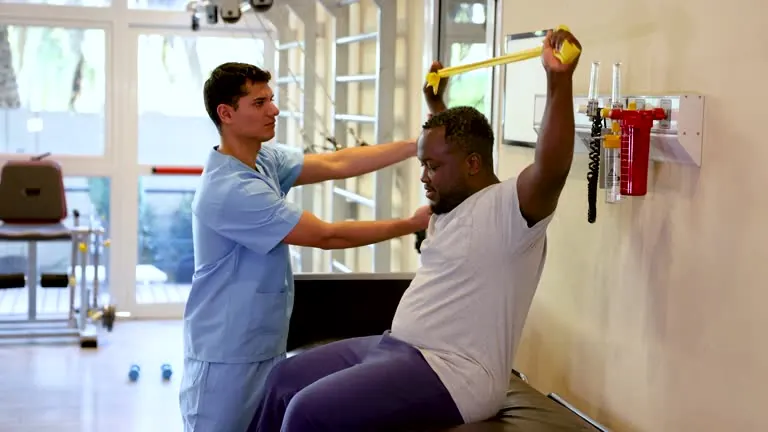
- Scapular retraction (rows): Using a light resistance band, pull your shoulder blades together and hold briefly, 3 sets of 12.
- Wall slides: Slide both arms up a wall while keeping contact, focusing on smooth scapular movement, 3 sets of 10.
- Side-lying external rotation: Lying on your unaffected side, rotate a light dumbbell upward while keeping the elbow tucked, 3 sets of 12.
Phase 3 Exercises: Progressive Strengthening (Weeks 8–12+)
- Resisted external and internal rotation: Using a moderate resistance band, perform controlled rotations at your side, 3 sets of 12–15.
- Standing rows: Add resistance band rows at chest height to continue building scapular and upper back strength.
- Modified push-up plus: A wall or knee push-up with an added scapular protraction at the top, 2–3 sets of 8–10.
- Overhead press progressions: Light, controlled overhead pressing only once cleared, starting with very light resistance.
Phase 4 Exercises: Return to Activity (Months 3–6+)
At this stage, exercises shift toward whatever your specific goals require, whether that’s returning to throwing, overhead lifting, or a physically demanding job. This typically includes sport-specific drills, plyometric shoulder exercises for athletes, and gradually increasing load closer to pre-injury levels, always under a therapist’s supervision.
How to Know If You’re Progressing Correctly
A few signs suggest your recovery is on track: pain during exercise is mild and settles quickly afterward, strength is gradually improving session to session, and you’re not experiencing new catching or instability sensations. If any of the common mistakes that make labral tears worse — like rushing through phases or skipping the stability stage — start creeping into your routine, it’s worth stepping back and reassessing with your therapist.
Adjusting for Athletes vs. Everyday Activity
Athletes returning to throwing or overhead sports generally need a longer, more sport-specific progression, often incorporating dedicated shoulder strengthening programs before full return to competition. If your goals are simply pain-free daily function rather than athletic performance, your program may reasonably plateau at Phase 3 without needing the full return-to-sport progression.
Conclusion
Recovering from a labral tear isn’t about pushing through discomfort — it’s about methodically rebuilding strength in the right order, giving each phase enough time to actually take hold before moving forward. Following a structured, phase-based approach like this one, ideally under a physical therapist’s guidance, gives your shoulder the best realistic chance at a full, lasting recovery.
Frequently Asked Questions
How soon can I start exercising after a labral tear diagnosis? Gentle, passive motion exercises are often appropriate within the first week or two, but always confirm timing with your doctor or therapist first.
Can I do these exercises without a physical therapist? Early, gentle exercises are often safe to do independently, but professional guidance is strongly recommended for progressing through later, more demanding phases.
How many days a week should I do labral tear exercises? Most programs recommend daily gentle motion in early phases, transitioning to 3–4 sessions per week for strengthening exercises later on.
What if an exercise causes pain? Mild discomfort during strengthening is normal, but sharp or worsening pain means you should stop and reassess with your therapist.
How long until I notice strength improvements? Many people notice initial improvements within 3–4 weeks of consistent phase-two exercises, though full strength gains take longer.
Can these exercises help without surgery? Yes, for many labral tears, a structured exercise program is the primary treatment and can meaningfully reduce symptoms without surgery.
Should I use weights or resistance bands? Resistance bands are often preferred early on for controlled, adjustable resistance, with light weights introduced later in strengthening phases.
Is stretching helpful for a labral tear? Gentle stretching supports range of motion, but aggressive stretching into painful positions can aggravate an already unstable joint.
Can I still exercise other body parts during recovery? Yes, lower body and core training is generally encouraged, as long as it doesn’t involve movements that load the injured shoulder.
When can I return to full overhead activity? This varies by individual but generally isn’t recommended until a therapist confirms adequate strength and stability, often 3–6 months into recovery.
Medical Disclaimer
This article is for informational purposes only and is not a substitute for professional medical advice.
This article is for education purpose only and is not a diagnosis or a substitute for medical advice.