
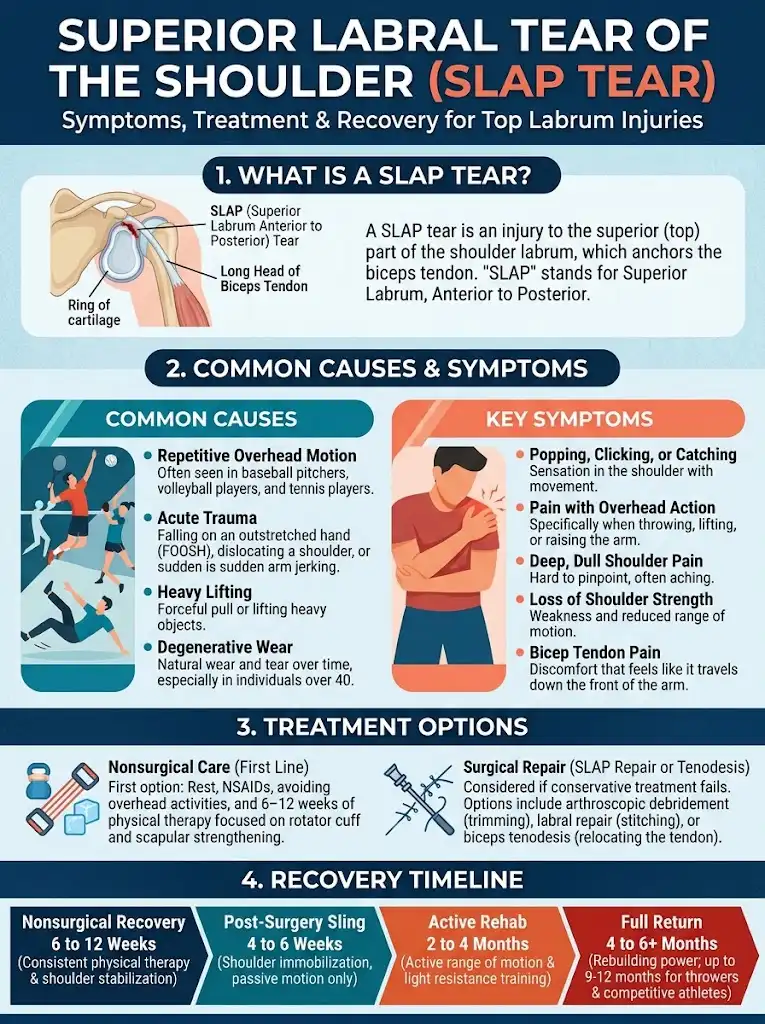
A superior labral tear can cause deep shoulder pain, clicking, weakness, or discomfort when lifting weights, throwing a ball, or reaching overhead. Some people notice symptoms during exercise, while others experience pain at night or difficulty returning to normal activities. Because the injury affects a structure inside the shoulder joint, the discomfort may be difficult to pinpoint.
A superior labral tear does not always mean the shoulder needs surgery. Symptoms can overlap with rotator cuff injuries, shoulder impingement, and other conditions, and some labral abnormalities on imaging may not be the actual cause of pain. The severity of symptoms, shoulder stability, activity demands, and associated injuries all influence treatment decisions.
This guide explains what a superior labral tear is, how a SLAP tear differs from other labral injuries, which symptoms to watch for, how clinicians diagnose the condition, and what to expect from treatment and recovery.
What Is a Superior Labral Tear?
A superior labral tear affects the upper portion of the labrum, a ring of fibrocartilage that surrounds the shoulder socket and helps stabilize the joint. The upper labrum is also connected to the long head of the biceps tendon, which can be involved in some injuries.
A tear in this area is often called a SLAP tear, meaning superior labrum anterior to posterior. The term describes a tear that extends from the front toward the back of the upper labrum.
Superior labral injuries can develop after a fall onto an outstretched arm, sudden traction on the arm, repetitive overhead activity, or gradual tissue changes. They occur in athletes who throw, but they can also affect people who lift weights or perform repetitive overhead work.
For an overview of the different types of shoulder labral tears, it helps to distinguish a superior tear from anterior and posterior injuries, which affect different parts of the labrum.
What Are the Symptoms of a Superior Labral Tear?
Symptoms vary by tear type and severity. Some people experience several symptoms, while others have only mild discomfort or no noticeable symptoms.
Common signs include:
- Deep pain inside the shoulder, especially during overhead movement.
- Clicking, catching, or popping that occurs with discomfort.
- Pain during throwing, serving, swimming, or weightlifting.
- Reduced strength or endurance during shoulder activity.
- Discomfort when reaching overhead or lifting an object away from the body.
- Shoulder pain that worsens during or after exercise.
- Occasional pain at night, particularly when lying on the affected side.
A clicking shoulder alone does not confirm a labral tear. If you are experiencing shoulder popping or clicking with pain, a clinical examination can help distinguish a labral injury from other causes.
How Is a SLAP Tear Different From a Bankart Tear?
Both injuries affect the labrum, but they occur in different locations and are often associated with different injury patterns.
| Feature | Superior labral tear (SLAP) | Bankart tear |
|---|---|---|
| Location | Upper labrum, extending from front toward back | Front-lower portion of the labrum |
| Common mechanism | Repetitive overhead activity, traction, or trauma | Often associated with shoulder dislocation |
| Structures involved | May involve the attachment of the biceps tendon | May affect structures that help prevent forward dislocation |
| Possible symptoms | Deep pain, clicking, discomfort with overhead activity | Pain, instability, or a feeling that the shoulder may slip out |
| Treatment | Rehabilitation or selected surgical procedures | Rehabilitation or surgery, depending on instability and injury severity |
Symptoms can overlap, and some people have more than one shoulder injury. The difference between a SLAP tear and a Bankart tear is therefore best assessed using the injury history, examination, and appropriate imaging.
How Is a Superior Labral Tear Diagnosed?
Diagnosis usually begins with a medical history and physical examination. A clinician may ask about previous injuries, throwing or lifting activities, painful movements, clicking, and any history of shoulder dislocation.
Physical examination may include tests of shoulder movement, strength, and stability. No single maneuver reliably identifies every SLAP tear, because similar symptoms can arise from other shoulder conditions.
Imaging may be recommended when the results are likely to affect treatment.
| Assessment | What it can show | Key limitation |
|---|---|---|
| Physical examination | Painful movements, weakness, range of motion, and instability | Findings may overlap with other injuries |
| X-ray | Bone injury, alignment, and some joint changes | Does not directly show the labrum |
| MRI | Labrum and other soft tissues | Abnormalities may not explain symptoms |
| MRI arthrogram | May help clarify certain labral injuries using contrast inside the joint | Requires an injection and is not necessary for everyone |
Your clinician may recommend MRI findings that help identify a shoulder labral tear or an MRI arthrogram for a suspected labral tear when further detail is needed.
What Is the Best Treatment for a Superior Labral Tear?
Treatment depends on symptoms, the tear’s characteristics, associated biceps tendon problems, shoulder stability, and the person’s goals. Many patients begin with nonsurgical care rather than proceeding directly to surgery.
Nonsurgical treatment
A clinician or physical therapist may recommend:
- Activity modification: Temporarily reduce painful throwing, overhead lifting, or pressing movements.
- Physical therapy: Improve shoulder control, strength, mobility, and coordination with a gradual exercise program.
- Pain management: Ice or appropriate medication may help, depending on personal health risks and clinician advice.
- Gradual return to activity: Increase the demands on the shoulder as symptoms, strength, and control improve.
Avoid repeatedly testing the shoulder with heavy lifts or throwing through pain. Exercises should be selected for your injury and adjusted if they cause sharp pain, catching, or instability.
For more detail, explore SLAP tear physical therapy exercises and recovery and exercises to avoid with a shoulder labral tear.
When is surgery considered?
Surgery may be considered when symptoms remain disabling despite appropriate rehabilitation, when shoulder instability or associated damage requires repair, or when the injury and activity demands make an operation a reasonable option.
The procedure depends on the specific injury. Some tears may be repaired, while others may be treated with a procedure involving the biceps tendon. Not every superior labral tear requires the same operation, and imaging alone does not determine whether surgery is appropriate.
The comparison of physical therapy and surgery for shoulder labral tears can help explain the broad treatment choices to discuss with your clinician.
How Long Does Recovery Take?
Recovery varies according to the tear, treatment, associated injuries, and the physical demands of work or sport. Symptoms may improve over weeks to months with nonsurgical care, while surgical recovery usually involves a longer, structured rehabilitation process.
| Recovery phase | Main goal | Important consideration |
|---|---|---|
| Early symptom management | Reduce aggravating activities and control pain | Follow any restrictions provided by your clinician |
| Mobility and strength | Restore controlled movement and shoulder function | Progress gradually rather than forcing painful movements |
| Functional rehabilitation | Prepare for work, lifting, or sport-specific activity | Strength and movement control matter as much as pain reduction |
| Return to full activity | Resume demanding movements safely | Timing depends on recovery and professional guidance |
After surgery, sling use and exercise restrictions depend on the procedure. Returning to throwing, heavy lifting, or contact sports too early may interfere with recovery. For more detail, see the SLAP tear healing stages and recovery timeline and recovery after shoulder labral tear surgery.
When Should You Seek Medical Care?
Arrange a medical evaluation if shoulder pain persists, strength decreases, movement becomes restricted, or clicking is accompanied by pain or instability.
Seek urgent assessment after a significant injury if you cannot move your arm, have severe pain or visible deformity, or develop new numbness or weakness. A suspected dislocation requires urgent medical care; do not try to force the joint back into place yourself.
Frequently Asked Questions
1. Is a superior labral tear the same as a SLAP tear?
A SLAP tear is a type of superior labral tear involving the upper labrum and extending from anterior to posterior. The exact pattern and involvement of the biceps tendon can vary.
2. Can a superior labral tear heal without surgery?
Symptoms and function may improve with activity modification and rehabilitation. However, symptom improvement does not necessarily mean the torn tissue has returned to its original structure.
3. Does a SLAP tear always cause shoulder pain?
No. Some labral abnormalities cause few or no symptoms. A clinician must determine whether an imaging finding fits the person’s symptoms and examination.
4. Can you lift weights with a superior labral tear?
You may need to temporarily avoid heavy pressing, overhead lifting, or movements that reproduce pain or instability. A physical therapist can help determine which exercises are appropriate and when to increase resistance.
5. Does a SLAP tear cause clicking or popping?
It can cause painful clicking or catching, but painless shoulder noises are common and do not confirm a tear. Persistent painful clicking should be evaluated.
6. Is an MRI enough to diagnose a SLAP tear?
MRI can help identify labral abnormalities, but it cannot always determine whether the finding is responsible for symptoms. Diagnosis combines imaging with the medical history and physical examination.
7. How should you sleep with a superior labral tear?
Avoid positions that increase shoulder pain. Sleeping on the unaffected side or on your back with the affected arm supported by a pillow may be more comfortable.
8. How long does a SLAP tear take to recover?
Recovery may take weeks to months with nonsurgical treatment, while recovery after surgery often takes longer. The timeline depends on the injury, procedure if any, rehabilitation progress, and activity goals.
9. Can a superior labral tear get worse?
Symptoms can worsen when activities repeatedly aggravate the shoulder, although not every tear progresses. Increasing pain, new weakness, or a feeling that the shoulder is slipping warrants assessment.
10. When does a superior labral tear need surgery?
Surgery may be considered when symptoms significantly limit function despite appropriate nonsurgical treatment or when associated instability or other damage requires intervention. The decision depends on the full clinical picture and individual goals.
Conclusion
A superior labral tear, often called a SLAP tear, affects the upper labrum of the shoulder and may cause deep pain, painful clicking, or difficulty with overhead activity. Treatment often begins with activity modification and physical therapy, while surgery is reserved for selected cases. Seek an assessment if symptoms persist or shoulder function declines, and return to demanding activities gradually under appropriate guidance.
Disclaimer: This article is provided for educational and informational purposes only.
This article is for education purpose only and is not a diagnosis or a substitute for medical advice.