
Quick answer
There is no single exercise list that every person with a shoulder labral tear must avoid. Painful heavy overhead lifts, deep dips, and movements that provoke catching or a feeling of instability may need to be paused or modified. Restrictions depend on the tear pattern, associated injuries and rehabilitation stage; follow individualized clinical advice.
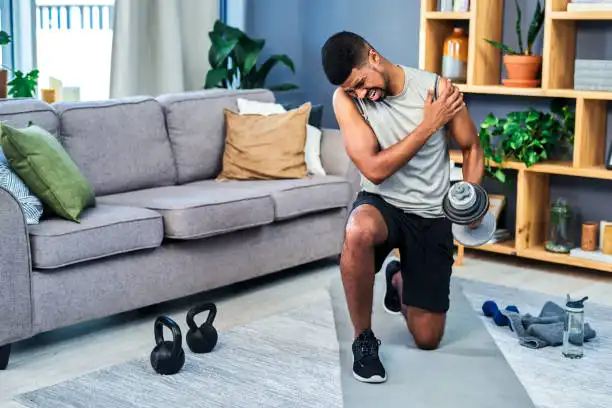
A shoulder labral tear can make ordinary movements—reaching overhead, pushing open a heavy door, lifting a bag, or getting dressed—uncomfortable or unpredictable. Exercise may still be part of recovery, but some positions and loads can aggravate pain, catching, or a feeling that the shoulder may slip. The right approach is not necessarily to stop all movement; it is to identify which activities are unsuitable for your injury and recovery stage.
It can be confusing to find lists that label certain exercises as completely forbidden. A movement that bothers one person may be tolerated by another, depending on the tear pattern, shoulder stability, other injuries, and treatment plan. Continuing a painful workout is not a good way to test the joint, but avoiding every form of exercise for too long can also contribute to stiffness and loss of strength.
This guide explains which exercises commonly need to be paused or modified with a shoulder labral tear, why they may cause problems, what lower-load options a clinician may consider, and how to return to training safely. It also covers SLAP tears, push-ups, weightlifting, warning signs, and when to get medical advice.
What Is a Shoulder Labral Tear?
The shoulder labrum is a rim of fibrocartilage around the glenoid, the socket of the shoulder blade. It helps deepen the socket and contributes to joint stability. A labral tear is damage to part of this rim. It may happen after a fall, shoulder dislocation, traction injury, or repeated overhead loading. You can learn more in our guide to shoulder labral tear symptoms, causes, and treatment.
Different tear patterns can affect the shoulder in different ways. A SLAP tear involves the upper labrum near the attachment of the long head of the biceps tendon. A Bankart lesion involves the front-lower part of the labrum and is often associated with shoulder dislocation. Posterior tears affect the back of the labrum. The exact diagnosis matters because exercise restrictions and rehabilitation priorities are not identical for every tear.
What Exercises Should You Avoid With a Shoulder Labral Tear?
There is no universal list of exercises that every person with a labral tear must avoid forever. The movements below are common examples that may need to be paused, shortened, unloaded, or reintroduced only with professional guidance—particularly when they trigger pain, catching, weakness, or instability.
| Exercise or movement | Why it may be a problem | Possible modification to discuss |
|---|---|---|
| Behind-the-neck presses or pulldowns | Place the shoulder in a demanding overhead and rotated position. | Use a front-of-body or neutral-grip variation only if cleared and comfortable. |
| Heavy overhead presses | Load the shoulder while the arm is elevated and require good control. | Reduce load and range, or temporarily use a clinician-selected alternative. |
| Deep dips | Move the upper arm far behind the body and can stress the front of the shoulder. | Pause during symptomatic or early rehabilitation stages; ask about safer triceps options. |
| Deep or wide-grip bench press | Can place the shoulder in substantial extension and horizontal abduction under load. | Reduce depth and load, adjust grip, or use a different press only if approved. |
| Upright rows | Combine shoulder elevation with internal rotation, which may irritate some shoulders. | Choose a different pulling or shoulder-strengthening movement with a therapist. |
| Kipping pull-ups and explosive hangs | Use momentum and rapid changes in force that can be difficult to control. | Delay dynamic hanging or kipping until strength and control have been assessed. |
| Heavy pull-ups or chin-ups | Require the shoulder to support body weight through a large range. | Use a graded pulling progression if the treating clinician considers it appropriate. |
| Medicine-ball throws and forceful throwing | Use rapid acceleration and deceleration at the shoulder. | Return through a supervised throwing progression rather than jumping straight to full effort. |
| Snatches, jerks, and other heavy overhead lifts | Combine speed, load, and overhead stability demands. | Temporarily avoid or modify until sport- or lifting-specific clearance. |
| Deep push-ups or wide hand positions | Increase shoulder range and load, which may provoke symptoms in some people. | Try a higher surface or smaller range only if pain-free and approved. |
This table is a guide for discussion, not a prescription. Do not assume that a modified version is automatically safe. Your clinician or physical therapist can match exercises to the type of tear, symptoms, and stage of recovery.
Why Can Certain Exercises Aggravate a Torn Shoulder Labrum?
The shoulder relies on the labrum, capsule, ligaments, rotator cuff, and shoulder-blade muscles working together. When the labrum is injured, a position that places the arm at the limit of its range, adds heavy resistance, or involves sudden force may reproduce pain or a sense of instability. A movement may also irritate another structure—such as the biceps tendon or rotator cuff—rather than the labrum alone.
Overhead loading, deep shoulder extension, forceful rotation, and uncontrolled momentum are common reasons a movement may need adjustment. However, the effect depends on the individual. A person with a stable tear and improving strength may tolerate activities that are unsuitable for someone with recent dislocation or repeated episodes of the shoulder slipping.
It is also important to understand that pain during exercise does not tell you exactly which tissue is injured or whether a tear has become larger. Stop the provoking movement and discuss recurring symptoms with your treating professional. For more on setbacks and activity choices, see our guide to mistakes that may aggravate a labral tear.
Are There Specific Exercises to Avoid With a SLAP Tear?
A SLAP tear affects the upper labrum near the biceps tendon attachment. Some people notice pain with overhead activity, throwing, pulling, or lifting, but symptoms and restrictions vary. Heavy curls, forceful pulling, loaded overhead work, and throwing may need adjustment when they reproduce pain or place excessive demand on the biceps-shoulder complex.
Do not assume that every person with a SLAP tear must avoid all biceps exercises or all overhead movement. Your rehabilitation plan may reintroduce selected exercises as symptoms, strength, and control improve. Our guide to SLAP tear physical therapy exercises and recovery explains how rehabilitation is commonly approached.
Can You Do Push-Ups With a Shoulder Labral Tear?
It depends on your symptoms, tear type, shoulder stability, and stage of rehabilitation. A full push-up places body weight through the arms and requires the shoulder blade and rotator cuff to control the joint. Deep repetitions, wide hand placement, or pushing through pain may be unsuitable for some people.
A physical therapist may consider a wall push-up or an incline variation as a progression for selected patients, but these are not automatically safe for every tear. Stop if you feel sharp pain, catching, a slipping sensation, or worsening symptoms during or after the exercise. Ask your clinician when and how to reintroduce pressing movements.
What Exercises May Be Appropriate Instead?
Recovery does not always mean complete inactivity. Depending on the injury and treatment plan, a clinician may use gentle range-of-motion work, supported movement, isometric muscle activation, or gradual strengthening of the rotator cuff and shoulder-blade muscles. The goal is to maintain or rebuild function without provoking instability or a flare-up.
- Gentle mobility: Pendulum movements or assisted range of motion may be considered when permitted by the treating professional.
- Isometric activation: Gentle muscle contractions without large joint movement may be used in some rehabilitation plans.
- Rotator cuff strengthening: Carefully selected band or light-resistance exercises may be introduced when appropriate.
- Scapular control: Exercises that build shoulder-blade awareness and control may form part of rehabilitation.
- General fitness: Lower-body exercise or walking may help maintain activity when these do not cause shoulder strain or conflict with post-injury instructions.
These examples are not a ready-made workout. The timing, range, resistance, and number of repetitions should be based on your assessment. For more examples, read our guide to exercises used during labral tear recovery.
How Should You Modify Everyday Activities?
Exercise is only one part of shoulder loading. Work tasks, carrying bags, reaching into high cupboards, lifting children, and sleeping positions may also affect symptoms. Keep objects close to your body when lifting, avoid sudden jerking, and use both hands for loads when practical. Place frequently used items within easy reach so you do not repeatedly reach overhead.
Do not keep testing a movement that repeatedly causes pain or a slipping sensation. Take breaks from tasks that flare symptoms and follow your rehabilitation team’s activity guidance. Our article on living with a labral tear and daily pain-management tips covers practical adjustments.
How Does a Safe Return to Exercise Work?
There is no fixed timetable that fits every shoulder labral tear. Progress depends on the tear pattern, whether the shoulder has been unstable or dislocated, whether surgery was performed, and how strength and movement respond. After surgery, follow the surgeon’s specific restrictions; do not use a general online exercise list to override them.
A gradual return often moves from protecting the shoulder and restoring permitted motion, to rebuilding muscle control and strength, and finally to task-specific or sport-specific activity. Before increasing resistance or range, check that the current level is tolerated during exercise and afterward. Throwing, contact sport, heavy pressing, and overhead lifting generally need a more deliberate return plan than ordinary daily movement.
Ask your clinician what signs show that you are ready to progress, which movements remain restricted, and what to do if symptoms return. A planned progression is safer than testing maximum weight or full-speed movement to see whether the shoulder is ready.
Who Should Get Medical Advice Before Exercising?
Speak with an orthopedic clinician or physical therapist before starting or changing a program if you have a diagnosed labral tear, recent shoulder dislocation, surgery, repeated episodes of instability, or significant weakness. Your plan may need to account for a SLAP tear, Bankart lesion, rotator cuff injury, biceps tendon problem, or another condition occurring at the same time.
Seek urgent assessment after a major injury if the shoulder looks deformed, you cannot move or use the arm, or you have sudden severe pain. New numbness, marked weakness, a cold or pale hand, or other concerning symptoms also need prompt medical attention. Arrange a routine review for persistent pain, repeated catching, or a shoulder that feels as though it may slip. More information about early signs of a shoulder labral tear can help you prepare for that discussion.
Can a Shoulder Labral Tear Heal Without Surgery?
Some people improve with activity modification and rehabilitation, even when the labrum itself does not fully return to its original structure. Treatment depends on the tear, instability, associated injuries, activity goals, and response to conservative care. A scan finding alone does not determine whether surgery is necessary. Read more about whether a shoulder labral tear can improve without surgery.
Frequently Asked Questions
1. What exercises should I avoid with a shoulder labral tear?
Movements that may need pausing or modification include heavy overhead presses, deep dips, behind-the-neck presses, heavy or deep bench presses, kipping pull-ups, explosive throws, and painful push-ups. The right restrictions depend on your tear and rehabilitation plan.
2. Are push-ups bad for a shoulder labral tear?
Not for everyone, but full or deep push-ups can aggravate some shoulders because they load the joint. Ask your physical therapist whether a wall or incline variation is appropriate and stop if symptoms increase.
3. What exercises should I avoid with a SLAP tear?
Heavy overhead work, throwing, forceful pulling, and some biceps-loading exercises may need modification if they reproduce symptoms. Follow a plan based on your tear and the biceps tendon involvement.
4. Can I lift weights with a torn shoulder labrum?
Possibly, but the exercises, load, and range may need to change. Avoid testing heavy or painful lifts and get guidance on a gradual return to resistance training.
5. Can a shoulder labral tear get worse from exercise?
Some activity can aggravate symptoms, particularly when it involves painful positions, excessive load, or uncontrolled movement. Pain does not prove that the tear has enlarged, so seek an assessment if symptoms persist or instability develops.
6. Are pull-ups safe with a shoulder labral tear?
Pull-ups and chin-ups place substantial demand on shoulder control and may not be suitable during some stages of recovery. Ask when a graded pulling progression is appropriate for your injury.
7. What are safer exercises during shoulder labral tear recovery?
Depending on the stage of recovery, a clinician may recommend gentle mobility, isometric activation, and progressive rotator cuff or shoulder-blade strengthening. The specific exercises should be individualized.
8. Should I stop exercising completely after a labral tear?
Not necessarily. You may need to stop certain upper-body movements while maintaining activities that do not strain the shoulder and are allowed by your clinician. Follow any post-injury or post-surgery restrictions.
9. How long should I avoid weightlifting after a shoulder labral tear?
There is no single timeframe. It depends on the injury, treatment, stability, symptoms, and strength recovery. After surgery, use your surgeon’s protocol rather than a general timeline.
10. When should I stop an exercise and contact my clinician?
Stop a movement that causes sharp or increasing pain, catching, a slipping sensation, new weakness, or numbness. Seek urgent care for a deformed shoulder, inability to use the arm after injury, or other severe or sudden symptoms.
Disclaimer: This article is intended for educational purposes only and should not be considered personalized medical advice.
This article is for education purpose only and is not a diagnosis or a substitute for medical advice.