
A shoulder labral tear MRI can help doctors evaluate the cartilage around the shoulder socket when pain, clicking, catching, instability, or weakness suggests a labral injury. You may wonder whether an MRI can actually show the tear, what the images look for, or why your report uses unfamiliar terms such as “SLAP lesion” or “labral irregularity.”
An MRI can provide detailed images of soft tissues that are difficult to assess on an X-ray, but an abnormal MRI does not automatically mean that a labral tear is the sole cause of your symptoms. Labral changes can sometimes occur without significant symptoms, so imaging findings need to be interpreted alongside your history and physical examination.
This guide explains what an MRI can show, how doctors look for a labral tear, when an MRI arthrogram may be used, how different labral tears appear, and what happens after an abnormal result.
What Does an MRI Show in a Shoulder Labral Tear?
An MRI creates detailed images of the shoulder’s soft tissues, including the labrum, rotator cuff tendons, muscles, joint capsule, and other structures.
For someone being evaluated for a suspected tear, the radiologist may look for changes in the normal shape, position, or signal of the labrum.
| MRI finding | What it may indicate |
|---|---|
| Irregular labral contour | Possible labral injury or degeneration |
| Fluid extending into the labrum | May suggest a tear |
| Separation from the socket | Can indicate labral detachment |
| Abnormal labral shape | May occur with injury or degeneration |
| Associated bone changes | May accompany certain injuries |
| Rotator cuff abnormality | May indicate another or additional shoulder problem |
An MRI can therefore help identify structural abnormalities, but the report should not be interpreted in isolation. Understanding the broader shoulder labral tear symptoms can help put an imaging finding into context.
What Does a Shoulder Labral Tear Look Like on MRI?
A normal labrum has a characteristic appearance around the edge of the shoulder socket. A tear can alter its normal contour or create an abnormal line or area of fluid signal extending into or beneath the labral tissue.
However, normal anatomy varies, particularly in the upper portion of the labrum. This is one reason radiologists consider the patient’s age, symptoms, injury history, and the exact location of an abnormality before calling it a tear.
The types of shoulder labral tears also matter because a superior tear does not necessarily have the same appearance or clinical significance as an anterior or posterior tear.
Can an MRI Always Detect a Labral Tear?
No. A conventional MRI can identify many shoulder abnormalities, but small or subtle labral injuries may be difficult to characterize.
When a labral injury remains strongly suspected despite inconclusive conventional imaging, a clinician may consider an MRI arthrogram. This examination involves placing contrast into the shoulder joint before MRI imaging, which can make certain abnormalities easier to visualize.
| Imaging test | What it is best suited to show | Role in suspected labral tear |
|---|---|---|
| X-ray | Bone structure and alignment | May help exclude fracture or major bone abnormality |
| Conventional MRI | Soft tissues and joint structures | Can evaluate the labrum and associated tissues |
| MRI arthrogram | Joint structures with intra-articular contrast | May improve visualization of certain labral abnormalities |
For a broader comparison of imaging choices, see X-ray or MRI for shoulder pain. For more detail about contrast-enhanced imaging, see MRI arthrogram for a shoulder labral tear.
What Is a SLAP Tear on an MRI?
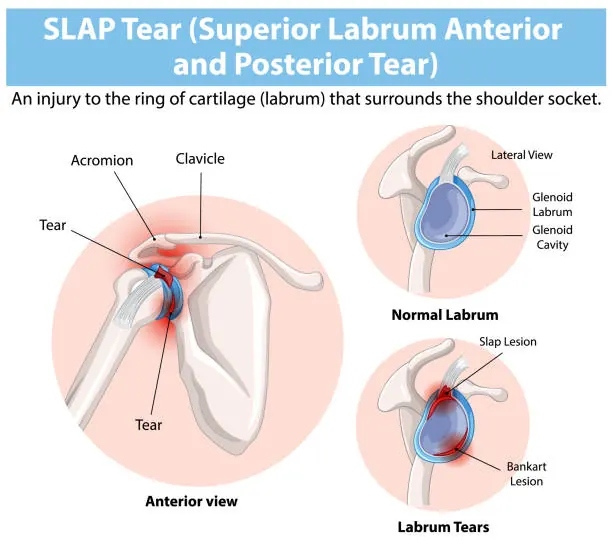
A SLAP tear affects the superior part of the labrum, where the labrum is associated with the attachment of the long head of the biceps tendon.
An MRI may show an abnormal signal or separation involving the superior labrum. The precise appearance depends on the type and extent of the injury.
If your report mentions a SLAP lesion, the information about superior labral tear shoulder can help explain what that terminology means.
Different labral locations can produce different symptoms and treatment considerations. For example, an anterior or posterior injury is not necessarily equivalent to a superior tear, which is why the exact location in the MRI report matters.
MRI Findings for Different Labral Tears
| Labral problem | Location | Common MRI consideration |
|---|---|---|
| SLAP tear | Superior labrum | Abnormality around the upper labrum |
| Anterior tear | Front of socket | Labral detachment or abnormality anteriorly |
| Posterior tear | Back of socket | Abnormality involving the posterior labrum |
| Degenerative labral change | Variable | Irregularity or age-related tissue changes |
If your report describes an anterior or posterior abnormality, learning about anterior vs posterior shoulder labral tear may make the terminology easier to understand. Degenerative findings are discussed in degenerative labral tear of the shoulder.
What Else Can a Shoulder MRI Show?
One advantage of MRI is that it can evaluate structures beyond the labrum. Depending on the scan, the radiologist may also assess the rotator cuff, cartilage, muscles, tendons, joint fluid, and surrounding soft tissues.
This matters because shoulder symptoms can come from more than one structure. A person with clicking and pain may have a labral abnormality, rotator cuff pathology, or another condition.
For example, comparing a labral tear vs rotator cuff tear can help explain why similar symptoms sometimes require different evaluations and treatments.
Does an Abnormal MRI Mean You Need Surgery?
No. An MRI finding alone does not determine whether surgery is necessary.
Doctors generally consider the MRI alongside symptoms, physical examination findings, activity demands, duration of symptoms, previous treatment, and functional limitations. Some labral abnormalities can be managed without surgery, particularly when symptoms improve with appropriate rehabilitation.
The question can a shoulder labral tear heal without surgery is therefore best understood in terms of symptom improvement and function rather than assuming that every structural abnormality must be surgically repaired.
Treatment may include activity modification, medication when appropriate, and physical therapy. More information is available about shoulder labral tear treatment and physical therapy versus surgery.
What Happens After an MRI Shows a Labral Tear?
The next step depends on what the scan shows and whether the finding matches your symptoms.
| MRI result | What may happen next |
|---|---|
| Clear tear matching symptoms | Conservative treatment or surgical discussion depending on severity |
| Small or uncertain abnormality | Clinical correlation and possibly further evaluation |
| Labral finding without significant symptoms | Observation may be appropriate |
| Labral tear plus instability | Further assessment of shoulder stability may be needed |
| Labral tear plus other abnormalities | Treatment may address multiple structures |
If instability is part of your symptoms, understanding what shoulder instability feels like can help you describe the problem more precisely.
If surgery is eventually recommended, knowing about shoulder labral tear surgery recovery time can help you understand the rehabilitation process.
When Should You Discuss Your MRI With a Doctor?
Arrange medical follow-up if your MRI shows a labral abnormality and you have persistent pain, catching, weakness, recurrent instability, or difficulty using the shoulder.
Prompt evaluation is particularly important after a significant injury if you cannot move the arm normally, notice a visible deformity, experience repeated dislocation, or develop persistent numbness or weakness.
An MRI report should be viewed as one part of the diagnostic process rather than a standalone diagnosis.
Frequently Asked Questions
1. Can a shoulder labral tear be seen on MRI?
Yes, many labral tears can be identified on MRI, although small or subtle abnormalities may be difficult to detect. The accuracy depends on the tear, imaging technique, and individual anatomy.
2. What does a torn shoulder labrum look like on MRI?
A tear may appear as an abnormal labral contour, signal change, or separation from the socket. The exact appearance varies according to the location and type of tear.
3. Is an MRI or MRI arthrogram better for a labral tear?
Both can provide useful information. An MRI arthrogram may make certain intra-articular labral abnormalities easier to visualize, but the appropriate test depends on the clinical situation.
4. Can an MRI miss a SLAP tear?
A conventional MRI may not identify every subtle SLAP lesion. If symptoms and examination findings continue to suggest a labral injury, a clinician may consider additional evaluation.
5. Does a labral tear always show up clearly on an MRI report?
Not necessarily. Some findings may be described as subtle, indeterminate, irregular, or degenerative rather than as a definite tear. Your clinician interprets these findings in the context of your symptoms.
6. Can an MRI show a labral tear and rotator cuff tear at the same time?
Yes. MRI can evaluate multiple shoulder structures during the same examination, so abnormalities involving both the labrum and rotator cuff may sometimes be identified.
7. Does every MRI-confirmed labral tear need surgery?
No. Treatment depends on symptoms, functional limitations, tear characteristics, instability, and response to conservative treatment. An imaging finding alone does not establish the need for surgery.
8. Can a labral tear heal without surgery?
Some people improve without surgery through activity modification and rehabilitation, depending on the type of tear and symptoms. Structural changes on imaging and improvement in pain or function are not always the same thing.
9. How long does it take to recover from a labral tear?
Recovery varies substantially depending on whether treatment is nonsurgical or surgical, the type of tear, and the individual’s response to rehabilitation. Your clinician or physical therapist can provide a more individualized recovery framework.
10. What should I do if my MRI says “labral tear” but I have little pain?
Discuss the finding with the clinician who ordered the scan rather than assuming treatment is necessary. MRI abnormalities can sometimes occur without being the main source of symptoms, so the imaging should be correlated with your examination and history.
Conclusion
A shoulder labral tear MRI can provide valuable information about the labrum and other soft tissues around the shoulder. It may show abnormalities involving the superior, anterior, posterior, or degenerative portions of the labrum, but not every MRI finding represents the primary cause of pain.
The most useful interpretation combines the MRI report with symptoms, physical examination findings, injury history, and functional limitations. If the diagnosis remains uncertain, your clinician can determine whether conventional MRI, MRI arthrography, rehabilitation, further evaluation, or another treatment approach is appropriate.
Disclaimer: This article is provided for educational and informational purposes only. It is not a substitute for professional medical advice, diagnosis, or treatment.
This article is for education purpose only and is not a diagnosis or a substitute for medical advice.