
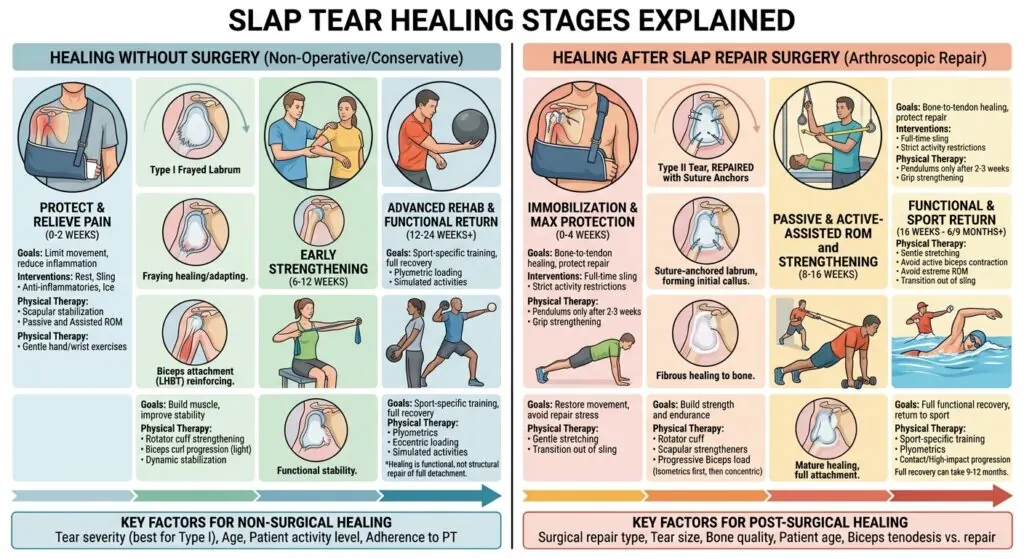
A SLAP tear can make everyday shoulder movements feel surprisingly difficult. Reaching overhead, lifting something, sleeping on the affected side, or throwing a ball may cause pain, catching, clicking, or weakness. Understanding the SLAP tear healing stages can help you know what changes to expect instead of assuming that every painful day means the injury is getting worse.
A common concern is whether a SLAP tear can actually heal and how long recovery should take. The answer depends on the type and extent of the tear and whether treatment is nonsurgical or involves surgery. Recovery is usually gradual, and persistent symptoms do not automatically mean that treatment has failed.
A SLAP tear affects the superior part of the shoulder’s labrum near the attachment of the biceps tendon. This guide explains the typical recovery stages, what happens during rehabilitation, how long improvement may take, and which symptoms should prompt medical evaluation.
What Are the SLAP Tear Healing Stages?
There is no single biological timeline that applies to every SLAP tear. Some tears are managed with activity modification and physical therapy, while others require surgery followed by a longer rehabilitation period.
If you are still unsure what your diagnosis means, start with an explanation of what a labral tear is and its symptoms and then review the different types of shoulder labral tears.
| Recovery stage | What may happen | Main goal |
|---|---|---|
| Early/protection | Pain, soreness, limited movement, or clicking may persist | Reduce aggravating activity |
| Mobility and control | Range of motion and shoulder control gradually improve | Restore comfortable movement |
| Strengthening | Rotator-cuff and shoulder-blade muscles become stronger | Improve stability and function |
| Functional return | Daily activities, work, exercise, or sport are gradually reintroduced | Return safely to desired activity |
Stage 1: Early Recovery
During the early stage, symptoms may include pain with overhead movement, catching, clicking, or discomfort during lifting. The priority is usually to avoid movements that repeatedly aggravate the shoulder rather than trying to force painful range of motion.
If you are experiencing new or unexplained symptoms, compare them with the typical early signs of a shoulder labral tear. Imaging may also be used when the diagnosis remains uncertain; an MRI for a shoulder labral tear or MRI arthrogram for a shoulder labral tear may be considered depending on the clinical situation.
Stage 2: Restoring Motion and Shoulder Control
Once symptoms are settling, rehabilitation typically focuses on restoring comfortable motion and improving control of the shoulder joint. A physical therapist may work on the rotator cuff, shoulder-blade muscles, range of motion, endurance, and movement mechanics.
A systematic review of nonsurgical treatment in athletes found that return-to-play outcomes were better among athletes who completed their rehabilitation program, although the evidence was limited and mainly involved athletic populations. This supports gradual rehabilitation rather than rushing back to demanding activities.
For structured rehabilitation, see SLAP tear physical therapy and recovery exercises.
Stage 3: Strengthening
Strengthening generally becomes more important as pain and motion improve. Exercises may target the rotator cuff and muscles around the shoulder blade to improve stability and endurance.
However, more exercise is not automatically better. Painful or high-load movements can aggravate symptoms, so rehabilitation should progress according to function and clinical guidance. Helpful guidance is available on exercises for labral tear recovery and exercises to avoid with a shoulder labral tear.
Stage 4: Return to Normal Activity
The final stage is not simply reaching a certain number of weeks. The shoulder should demonstrate adequate motion, strength, control, and tolerance for the specific activity you want to resume.
For athletes, this may involve progressive sport-specific training. For someone who works with their arms, recovery may instead focus on lifting, reaching, carrying, and repetitive tasks.
Research on surgically treated SLAP injuries has found substantial variation in return-to-sport rates and timing. One systematic review of 42 studies involving 1,759 cases reported a 77.5% overall return-to-sport rate and a 68.2% return to the same level, with an average of 8.2 months for those returning to the same level. These figures describe surgical populations and should not be treated as a personal recovery prediction.
How Long Does a SLAP Tear Take to Heal?
There is no reliable single healing time. Nonsurgical recovery may take several months, while recovery after surgical repair commonly requires a longer period of protected movement followed by progressive strengthening and sport-specific rehabilitation.
| Situation | General recovery pattern |
|---|---|
| Nonsurgical treatment | Gradual symptom and function improvement over weeks to months |
| SLAP repair | Early protection followed by progressive motion and strengthening |
| Return to everyday activities | Usually precedes return to demanding sports |
| Return to overhead sport | Often requires the longest progression |
The important distinction is between symptom improvement and complete structural healing. A person can function better even when imaging abnormalities remain, while another person may continue having symptoms despite completing rehabilitation.
If you are considering nonsurgical treatment, see whether a shoulder labral tear can heal without surgery. Treatment decisions may involve rehabilitation, activity modification, symptoms, tear characteristics, and functional demands; a detailed overview is available on shoulder labral tear treatment and physical therapy versus surgery.
What Can Slow SLAP Tear Recovery?
Recovery may be slower when the shoulder is repeatedly exposed to painful overhead activity, heavy lifting, throwing, or other aggravating movements. Poor adherence to rehabilitation can also interfere with progress.
Other shoulder problems can complicate recovery. For example, SLAP tears may coexist with other injuries, making it important to understand whether symptoms are coming from the labrum alone.
Avoid repeatedly provoking symptoms, and review common mistakes that can make a labral tear worse and signs that a labral tear may be getting worse.
What Happens After SLAP Surgery?
After surgical repair, rehabilitation is typically divided into protection, mobility, strengthening, and functional or sport-specific progression. Published rehabilitation protocols vary, so your surgeon’s restrictions should take priority over a generic timeline.
Research reviews have reported return-to-sport timing commonly measured in several months rather than several weeks. One review found a mean return-to-sport time of about 8.9 months after arthroscopic SLAP repair, although individual results varied considerably.
For practical expectations, see shoulder labral tear surgery recovery time.
Can Daily Activities Affect Healing?
Yes. Repeatedly pushing through painful movements can make symptom control more difficult. Everyday decisions about sleeping, working, driving, lifting, and exercise should be adjusted according to your symptoms and the restrictions provided by your clinician.
For practical day-to-day management, see how to live with a labral tear and manage daily activities. If nighttime symptoms are interfering with sleep, guidance on the best sleeping position for a SLAP tear may also help.
Nutrition cannot repair a torn labrum by itself, but adequate calories, protein, vitamins, and minerals support normal tissue repair. Learn more about nutrition for labral tear healing.
Warning Signs During Recovery
Some soreness after increasing activity can occur, but worsening symptoms deserve attention.
| Usually monitor | Contact a clinician | Seek urgent care |
|---|---|---|
| Mild soreness after rehabilitation | Increasing pain or weakness | Major new deformity |
| Temporary muscle fatigue | Recurrent catching or instability | Shoulder dislocation that does not reduce |
| Gradual improvement | Symptoms that stop improving | New numbness, severe weakness, or loss of circulation |
If shoulder instability is becoming a recurring problem, understanding what shoulder instability feels like and what causes it can help you discuss the symptoms with a clinician.
Frequently Asked Questions
1. Can a SLAP tear heal naturally?
Some SLAP tears can become much less symptomatic with rehabilitation and activity modification, even when the structural tear remains visible. Whether nonsurgical treatment is appropriate depends on the individual injury and symptoms.
2. How long do SLAP tear healing stages take?
There is no universal timeline. Meaningful improvement may take weeks to months, while return to high-demand overhead sports can take considerably longer.
3. Does a SLAP tear always need surgery?
No. Nonsurgical treatment is commonly considered before surgery for many patients, particularly when symptoms can be controlled with rehabilitation and activity modification.
4. Can I exercise with a SLAP tear?
Exercise may be part of recovery, but painful or high-load movements may need to be modified. Rehabilitation should progress gradually rather than relying on pain tolerance alone.
5. Why does my shoulder still hurt during recovery?
Pain can persist while strength, mobility, and movement control are improving. Persistent or worsening pain should be discussed with the clinician managing your shoulder.
6. When can I return to sports after a SLAP tear?
Return depends on the sport, treatment, shoulder strength, motion, symptoms, and functional testing. Overhead throwing sports often require a more gradual progression than ordinary daily activities.
7. Can a SLAP tear get worse during recovery?
Repeatedly aggravating the shoulder can increase symptoms and may interfere with recovery. New instability, increasing weakness, or progressively worsening pain warrants reassessment.
8. Is clicking normal with a SLAP tear?
Clicking or catching can occur with labral injuries, but clicking alone does not establish the cause of shoulder pain. Persistent painful clicking should be evaluated in context with other symptoms.
9. Can I work while recovering from a SLAP tear?
Many people can continue working if their duties can be modified to avoid painful or excessive shoulder loading. Heavy overhead work may require temporary restrictions.
10. What is the most important part of SLAP tear recovery?
Consistent, appropriately progressed rehabilitation is usually more useful than trying to accelerate the timeline. The goal is to restore comfortable motion, strength, shoulder control, and tolerance for the activities you need to perform.
Conclusion
SLAP tear healing stages are gradual rather than predictable by a single calendar. Early recovery usually emphasizes symptom control and protection, followed by mobility, strengthening, and a progressive return to daily activities, work, exercise, or sport. If symptoms are worsening, function is declining, or recovery has stalled, a clinician can reassess the diagnosis and treatment plan.
Disclaimer: This article is provided for educational and informational purposes only.
This article is for education purpose only and is not a diagnosis or a substitute for medical advice.