
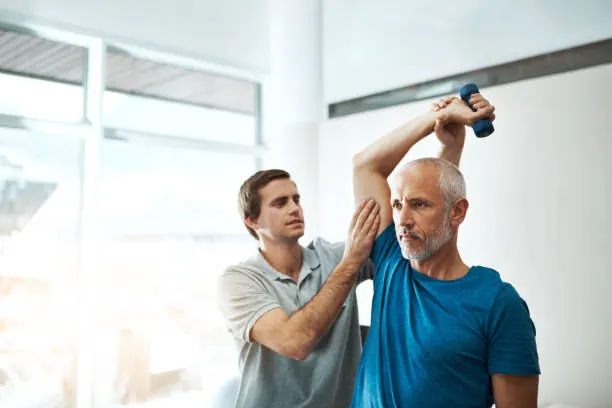
Being handed a physical therapy plan after a SLAP tear diagnosis can feel oddly underwhelming at first. After weeks of worrying about your shoulder, the prescription is often just a folder of stretches and light band exercises, and it’s fair to wonder whether something that gentle can really fix a torn structure deep inside the joint.
It’s worth understanding what physical therapy is actually trying to do here, because it’s not attempting to regrow the labrum. Instead, it’s rebuilding the surrounding muscular support system so your shoulder can function well despite the tear, while calming the inflammation and irritation that’s driving your symptoms in the first place. That distinction matters, because it explains why the exercises look the way they do.
This guide breaks SLAP tear physical therapy into its real clinical phases, explains what’s happening at each stage, and lays out the specific exercise categories that consistently show up in evidence-based rehab protocols.
The Goal of Physical Therapy for a SLAP Tear
Physical therapy for a SLAP tear focuses on three main targets: reducing pain and inflammation early on, restoring safe range of motion, and building strength in the rotator cuff and scapular stabilizers that support the joint from the outside. For a full picture of how this compares to surgical treatment, see our breakdown of physical therapy vs. surgery for labral tears more broadly.
Phase 1: Pain Control and Gentle Motion (Weeks 1–3)
The earliest phase prioritizes calming the joint down rather than building strength. Pushing too hard here often backfires, aggravating symptoms instead of resolving them.
- Pendulum exercises, letting the arm hang and gently swing to encourage motion without muscular effort.
- Passive range-of-motion stretching, where a therapist or the other arm moves the joint rather than the affected muscles.
- Ice and anti-inflammatory strategies to manage swelling alongside these early movements.
Phase 2: Rebuilding Stability (Weeks 4–8)
Once pain has settled, therapy shifts toward activating the muscles that stabilize the shoulder joint from the outside, compensating for the labrum’s reduced grip.
- Rotator cuff isometrics, gentle resisted holds that activate the cuff muscles without joint movement.
- Scapular stabilization exercises, like rows and wall slides, which retrain how the shoulder blade supports arm motion.
- Light resistance band work, introducing controlled external rotation and internal rotation movements.
This is often the phase people find most frustrating, since progress feels slow — but it’s doing essential groundwork for everything that follows. If you’d rather see a complete list of specific movements with sets and reps, our best exercises for labral tear recovery guide picks up right where this phase leaves off.
Phase 3: Progressive Strengthening (Weeks 8–12+)
With stability established, therapy introduces heavier resistance and more functional movement patterns that mimic real-world or sport-specific demands.
- Progressive resistance training, gradually increasing load on rotator cuff and shoulder girdle muscles.
- Closed-chain exercises, like modified push-up variations, that challenge joint stability under load.
- Sport- or activity-specific drills, reintroducing overhead motion, throwing mechanics, or lifting patterns in a controlled way.
Phase 4: Return to Activity (Months 3–6+)
The final phase focuses on rebuilding confidence and full capacity, particularly for athletes or physically demanding jobs. This stage is often paced by a therapist tracking strength benchmarks rather than a fixed calendar date, since returning too early is one of the most common setbacks in SLAP tear recovery.
What the Evidence Says About “What Works”
Research on SLAP tear rehabilitation consistently points to a few themes: early motion without overloading the joint, prioritizing scapular and rotator cuff strengthening before heavier lifting, and gradual, criteria-based progression rather than rushing through a fixed timeline. Programs that skip the stabilization phase in favor of jumping straight to strength training tend to see higher rates of setbacks and lingering symptoms.
Common Physical Therapy Mistakes to Avoid
- Progressing too quickly through phases based on how you feel rather than measurable strength and stability benchmarks.
- Skipping scapular stabilization work because it feels less intense than direct strength training.
- Returning to overhead sport or lifting before a therapist has confirmed adequate strength and control.
For a more complete list, our guide on common mistakes that make labral tears worse covers pitfalls beyond just the physical therapy phase.
Conclusion
SLAP tear physical therapy works because it rebuilds the support system around the injury rather than trying to repair the torn tissue directly — and that structured, phase-based approach is exactly why patience with the early “boring” exercises pays off later. If you’re a few weeks into this process and it feels slower than expected, that’s often a sign the program is being done correctly rather than a sign it isn’t working.
Frequently Asked Questions
How long does SLAP tear physical therapy take? Most programs run 8–12 weeks for meaningful improvement, though full functional recovery for athletes can extend to several months.
Can physical therapy alone heal a SLAP tear? It can significantly reduce symptoms and restore function for many tears, even though it doesn’t regenerate the torn labral tissue itself.
What exercises should I avoid with a SLAP tear? Heavy overhead pressing, aggressive throwing, and deep stretching into painful positions are typically avoided until a therapist confirms it’s safe.
Is it normal for physical therapy to feel slow at first? Yes. Early phases intentionally prioritize calming symptoms over visible progress, which is a normal and necessary part of the process.
Can I do SLAP tear exercises at home without a therapist? Basic phase-one exercises are often safe at home, but a therapist’s guidance is strongly recommended for progressing through later phases correctly.
How do I know when to move to the next phase? Progression should be based on specific strength and pain criteria set by your therapist, not a fixed number of weeks.
Does physical therapy hurt? Some discomfort during strengthening phases is normal, but sharp or worsening pain is a sign to slow down and consult your therapist.
Can athletes return to their sport after physical therapy alone? Many can, particularly with smaller tears, though high-level throwing athletes sometimes need surgery to fully restore performance.
What happens if physical therapy doesn’t improve symptoms? If there’s no meaningful progress after 8–12 weeks, it’s usually time to revisit surgical options with your orthopedic surgeon.
Should I combine physical therapy with medication? Many people use NSAIDs alongside therapy in the early phases to manage pain and inflammation, though this should be discussed with your doctor.
Medical Disclaimer
This article is for informational purposes only and is not a substitute for professional medical advice
This article is for education purpose only and is not a diagnosis or a substitute for medical advice.