
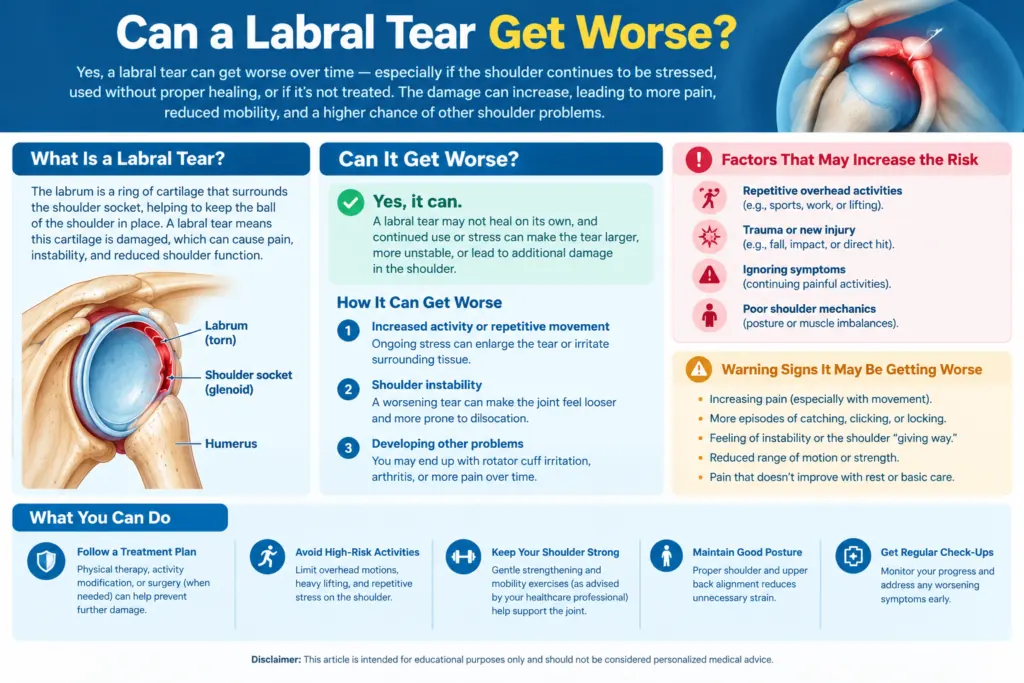
A shoulder labral tear can become more painful or disruptive over time, especially if activities repeatedly strain the injured tissue. You might notice deeper shoulder pain when lifting your arm, clicking during movement, weakness, or a feeling that your shoulder could slip out of place. Symptoms may fluctuate, so a more painful day does not automatically mean the tear has physically enlarged.
It is also possible to have a labral tear without severe symptoms. The labrum helps deepen the shoulder socket and stabilize the joint, but the effects of an injury depend on its location, severity, cause, and the demands you place on your shoulder. Understanding shoulder labral tear symptoms and early signs can help you recognize changes worth discussing with a clinician.
This guide explains whether a labral tear can worsen, which activities may aggravate it, how to monitor symptoms, and when medical evaluation is important. It also covers practical steps to protect your shoulder without unnecessarily stopping every daily activity.
Can a Shoulder Labral Tear Get Worse Over Time?
Yes, a shoulder labral tear can become more symptomatic and, in some cases, progress. Repeated overhead movements, heavy lifting, falls, or episodes of shoulder instability may place additional stress on the injured area. However, worsening pain alone cannot confirm that the tear has grown.
A tear may also remain relatively stable while surrounding tissues become irritated or shoulder muscles weaken. A clinician can assess the cause of changing symptoms and determine whether further imaging is appropriate. Learn more about what a labral tear is and how it is treated.
What Makes a Labral Tear Worse?
Common aggravating factors include:
- Repeated overhead activity: Throwing, serving, swimming, or lifting overhead can stress parts of the labrum.
- Heavy or painful lifting: Loads that cause sharp pain, catching, or instability may exceed your current tolerance.
- Sudden pulling or twisting: Unexpected force can aggravate an existing injury.
- Returning to exercise too quickly: Increasing resistance or training volume before symptoms settle may trigger flare-ups.
- Shoulder instability: Repeated slipping or dislocation can place additional stress on the labrum.
The risk depends on the tear’s location and your activities. A SLAP tear compared with a Bankart tear involves different parts of the labrum and may cause different problems.
Activities to Modify
| Activity | Why it may aggravate symptoms | Practical adjustment |
|---|---|---|
| Heavy overhead presses | Loads the shoulder in an elevated position | Reduce load or pause if painful |
| Throwing or serving | Repeated high-speed shoulder motion | Temporarily reduce frequency and intensity |
| Deep push-ups or dips | Can place the shoulder in a demanding position | Use a pain-free range only if approved |
| Heavy lifting away from the body | Increases shoulder demand | Keep loads close and lighter |
| Contact sports | May involve sudden impact or instability | Seek clinical guidance before returning |
Do not assume every listed movement is permanently unsafe. Your appropriate limits depend on symptoms, injury type, and rehabilitation guidance. This guide to exercises to avoid with a shoulder labral tear can help you identify movements to discuss with a physical therapist.
What Are the Signs a Labral Tear Is Getting Worse?
Changes that deserve attention include increasing pain, more frequent catching or clicking accompanied by pain, declining strength, reduced range of motion, or a growing sense that the shoulder is unstable. These symptoms are not proof of structural progression, because rotator cuff problems, tendon irritation, and other shoulder conditions can produce similar complaints.
| Symptom change | What it may indicate | Suggested response |
|---|---|---|
| Mild soreness after activity that settles | Temporary irritation or overload | Reduce the provoking activity and monitor |
| Pain that persists or keeps returning | Ongoing irritation or another shoulder problem | Arrange a clinical assessment |
| Increasing weakness or instability | A potentially significant change in shoulder function | Seek prompt medical evaluation |
| Sudden severe pain, visible deformity, or suspected dislocation | Possible acute injury | Seek urgent medical care |
For additional context, compare your symptoms with those of a rotator cuff tear versus a labral tear. Symptoms overlap, so self-assessment cannot reliably identify the injured structure.
How Can You Keep a Labral Tear From Getting Worse?
The goal is to avoid repeated aggravation while maintaining safe movement. Complete immobilization is not usually necessary unless a clinician recommends it, and prolonged inactivity can contribute to stiffness and weakness.
- Temporarily reduce movements that repeatedly cause sharp pain, catching, or instability.
- Keep loads lighter and avoid sudden increases in exercise intensity.
- Follow a personalized rehabilitation plan rather than pushing through worsening symptoms.
- Use ice wrapped in a cloth for short periods if it helps ease discomfort.
- Ask a clinician or pharmacist whether pain-relief medicines are safe for you, particularly if you have other medical conditions or take other medications.
A physical therapist may recommend controlled mobility, shoulder-blade exercises, and gradual strengthening based on your assessment. Appropriate physical therapy exercises for a SLAP tear can support function, but exercises that provoke instability or sharp pain should be reviewed. Also consider common mistakes that can make a labral tear worse.
What Does Evidence Suggest About Recovery?
There is no single timeline or percentage that predicts whether every labral tear will worsen. Clinical decisions depend on factors such as tear type, age, activity demands, shoulder stability, and response to rehabilitation. Imaging findings also need to be interpreted alongside symptoms because a scan alone does not establish how much pain or disability a person should experience.
| Clinical factor | Why it matters |
|---|---|
| Tear location and pattern | Different tear types affect shoulder mechanics differently |
| Recurrent instability | Repeated slipping or dislocation warrants assessment |
| Daily and sports demands | High-load activities may require more careful modification |
| Response to rehabilitation | Persistent symptoms may prompt a change in the treatment plan |
A clinician may consider an examination and, when indicated, MRI or an MRI arthrogram. Read about MRI findings for a shoulder labral tear and treatment with physical therapy versus surgery. Surgery is not automatically required because a tear is present.
When Should You Seek Medical Care?
Arrange a medical evaluation if pain is worsening, symptoms repeatedly return, strength or motion is declining, or the shoulder feels unstable. Seek urgent care after a significant injury if you have severe pain, a visible change in shoulder shape, or cannot move the arm normally. A suspected dislocation should be assessed promptly; do not try to force the joint back into place yourself.
If the shoulder becomes suddenly cold, pale, numb, or markedly weak after an injury, seek emergency care. These symptoms may indicate a problem that needs immediate assessment.
Frequently Asked Questions
1. Can a labral tear get bigger without another injury?
It may progress in some circumstances, but not every tear enlarges over time. Repeated loading and instability can contribute to worsening, although symptoms alone cannot show whether the tear has changed structurally.
2. Can I make a labral tear worse by working out?
Yes, certain exercises can aggravate symptoms, particularly those involving heavy overhead loads or painful shoulder positions. Modify the movements that provoke symptoms and ask a clinician how to return to training safely.
3. Does more pain mean my labral tear is worse?
Not necessarily. Pain can increase because of irritation, muscle fatigue, or another shoulder condition without a larger tear.
4. Can a labral tear heal on its own?
Some people improve without surgery, but the labrum’s ability to heal depends on the tear and its location. Symptom improvement does not necessarily mean the tissue has fully healed; see whether a shoulder labral tear can heal without surgery.
5. Should I stop moving my shoulder?
Avoiding painful or risky movements may help, but complete rest can cause stiffness and weakness. Follow professional advice about safe movement and rehabilitation.
6. Can sleeping on my shoulder make it worse?
Sleeping directly on the affected shoulder may increase discomfort, even if it does not enlarge the tear. Try a comfortable position that supports the arm and avoids pressure.
7. Can a labral tear cause shoulder instability?
Yes. Some tears, particularly those associated with dislocation, can contribute to instability. Repeated slipping or a sensation that the shoulder may come out of place deserves assessment.
8. When might I need surgery?
Surgery may be considered when symptoms and instability persist despite appropriate nonsurgical treatment or when the injury pattern and activity needs warrant it. The decision depends on a clinical evaluation, not imaging alone.
9. Can I keep working with a labral tear?
Many people can continue working with modified tasks, depending on pain and job demands. Heavy lifting, repetitive overhead work, and sudden pulling may require temporary restrictions.
10. How do I know if I need another scan?
A scan may be considered if symptoms change significantly, persist despite treatment, or suggest another injury. A clinician should decide whether imaging is likely to change management.
Conclusion
A shoulder labral tear can become more symptomatic and may worsen in some cases, especially with repeated strain or instability. Reduce activities that trigger pain, maintain safe movement, and seek assessment if symptoms persist, strength declines, or the shoulder feels unstable. Sudden severe symptoms after an injury need prompt care.
Disclaimer: This article is provided for educational and informational purposes only.
This article is for education purpose only and is not a diagnosis or a substitute for medical advice.