
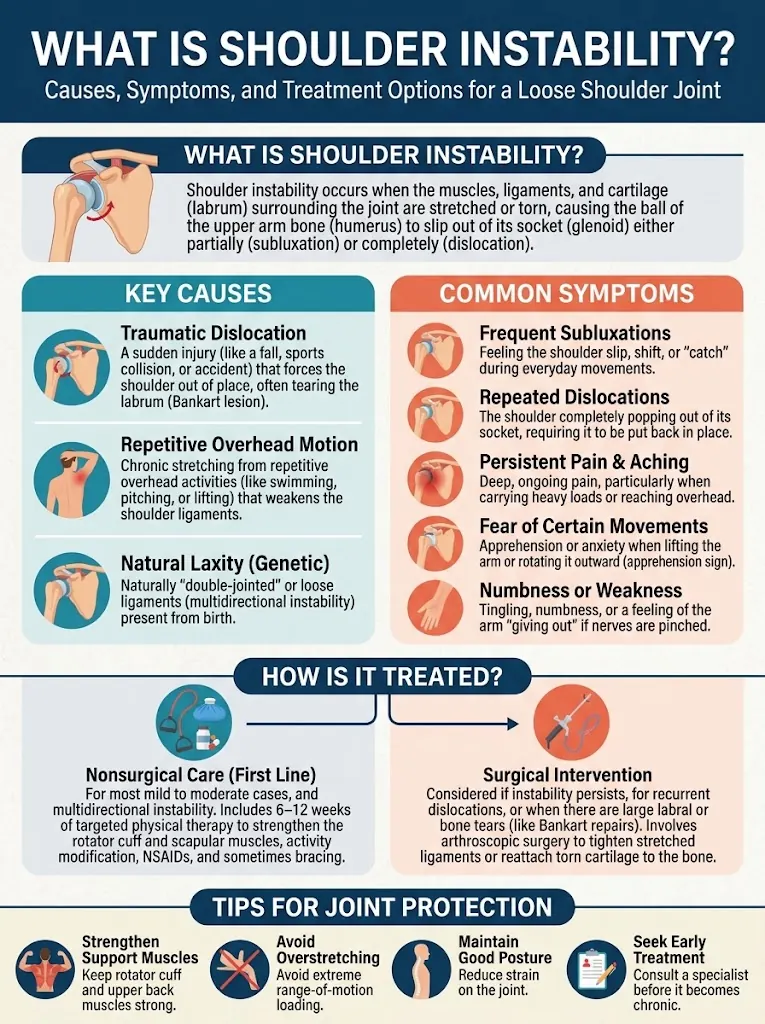
Shoulder instability can make your arm feel as though it might slip out of place when you reach overhead, lift something, throw a ball, or change positions in bed. Some people experience repeated episodes of the shoulder partially shifting, while others have a complete dislocation that causes sudden pain and difficulty moving the arm.
An unstable shoulder does not always mean the joint is dislocated. Symptoms can range from occasional slipping or clicking to repeated dislocations and a persistent feeling that the shoulder cannot support normal movement. However, new or severe symptoms after an injury should not be ignored.
Shoulder instability occurs when the structures that keep the shoulder joint centered do not provide enough stability. Understanding the causes, recognizing warning signs, and choosing appropriate treatment can help you protect the joint and determine when professional evaluation is needed.
What Is Shoulder Instability?
Shoulder instability happens when the head of the upper arm bone moves excessively within the shoulder socket. The shoulder has a wide range of motion, so it relies on the labrum, ligaments, joint capsule, and surrounding muscles to maintain control.
Instability may involve subluxation, when the joint partially slips out of position, or dislocation, when the bones lose their normal joint alignment. Repeated episodes can sometimes damage the supporting tissues further.
What Causes Shoulder Instability?
Common causes include:
- Previous dislocation: Stretched or torn ligaments may not stabilize the shoulder as effectively after the first injury.
- Labral tears: Damage to the cartilage rim around the socket can reduce joint stability. Learn about the types of shoulder labral tears.
- Sports injuries: Throwing, swimming, weightlifting, and contact sports can place repeated stress on the shoulder.
- Loose ligaments: Some people naturally have greater joint flexibility, which may contribute to instability.
- Trauma: Falls, collisions, or sudden pulling forces can injure the structures supporting the joint.
The location of a labral injury can matter. For example, a SLAP tear versus a Bankart tear involves different areas of the labrum and may affect treatment decisions.
What Are the Symptoms of Shoulder Instability?
Symptoms depend on the severity and underlying cause. You may notice:
- A slipping, shifting, or “coming out” sensation.
- Pain when reaching overhead or moving the arm away from the body.
- Clicking, catching, or a feeling that the shoulder is not secure.
- Weakness or reduced confidence using the arm.
- Repeated episodes of partial or complete dislocation.
A shoulder that suddenly changes shape, becomes severely painful, or cannot move normally after an injury may be dislocated. Review the signs of a shoulder dislocation and its treatment.
Not every painful or clicking shoulder is unstable. Conditions such as rotator cuff tears and shoulder tendonitis can cause overlapping symptoms.
How Is Shoulder Instability Diagnosed?
A clinician usually reviews your injury history, asks when the shoulder slips or hurts, and examines your range of motion, strength, and joint stability. Certain examination maneuvers may help identify the direction and degree of instability.
Imaging may be recommended when a significant injury or structural damage is suspected. X-rays can help identify a dislocation or bone injury, while MRI may help assess soft tissues such as the labrum and ligaments. An MRI finding must be interpreted alongside symptoms and examination results.
| Evaluation method | What it can help identify |
|---|---|
| Physical examination | Joint looseness, movement limitations, and patterns of instability |
| X-ray | Dislocation and certain bone injuries |
| MRI | Labral, ligament, and other soft-tissue injuries |
| CT scan, when indicated | Detailed assessment of bone damage |
What Are the Treatment Options for Shoulder Instability?
Treatment depends on the cause, severity, number of episodes, activity level, and presence of structural damage.
Nonsurgical treatment
For some people, treatment begins with activity modification and physical therapy. Rehabilitation may focus on strengthening the rotator cuff and shoulder blade muscles, improving coordination, and gradually restoring control of the joint.
Avoid movements that repeatedly trigger slipping, particularly under heavy loads. Do not force painful stretches or start intense strengthening exercises without guidance. A shoulder labral tear treatment comparison of physical therapy and surgery can help explain how treatment choices vary when labral damage contributes to symptoms.
Surgical treatment
Surgery may be considered when instability keeps recurring despite appropriate rehabilitation, or when significant structural damage makes nonsurgical care less suitable. Procedures may repair the labrum, tighten stretched tissues, or address bone loss, depending on the injury.
Recovery involves a staged rehabilitation plan. Progress depends on the procedure and individual healing, so follow the surgeon’s restrictions rather than returning to sports or heavy lifting based only on pain improvement.
| Treatment approach | Often considered when | Important consideration |
|---|---|---|
| Activity modification | Certain movements trigger symptoms | Avoidance alone may not restore stability |
| Physical therapy | Symptoms may improve with better muscle control | Exercises should be tailored to the injury |
| Surgery | Recurrent instability or significant structural damage | Requires postoperative protection and rehabilitation |
What Can Make Shoulder Instability Worse?
Repeatedly allowing the shoulder to slip, returning to demanding activities too soon, or exercising through sharp pain may aggravate symptoms. Avoid heavy overhead lifting and movements that reproduce instability until you receive appropriate guidance.
If your shoulder is already symptomatic, review exercises to avoid with a shoulder labral tear and common mistakes that can make a labral tear worse. These resources are particularly relevant when labral damage is suspected or confirmed.
When Should You Seek Medical Care?
Symptoms that may be monitored
Mild discomfort after activity without slipping, deformity, or loss of function may be monitored briefly while avoiding aggravating movements. Arrange an appointment if symptoms persist or recur.
Symptoms needing prompt evaluation
Seek medical assessment for repeated slipping, increasing pain, persistent weakness, reduced movement, or symptoms that interfere with everyday tasks.
Emergency warning signs
Seek emergency care for a suspected dislocation, severe pain after an injury, an obvious change in shoulder shape, or inability to move the arm normally. Numbness, marked weakness, or a cold, pale, or blue hand can indicate nerve or blood-vessel involvement and also require urgent care. Do not attempt to force a dislocated shoulder back into place yourself.
Frequently Asked Questions
1. Can shoulder instability heal on its own?
Mild symptoms may improve with activity modification and rehabilitation, but damaged ligaments or labral tissue may not regain normal stability without treatment. Repeated slipping should be evaluated.
2. Does shoulder instability always cause pain?
No. Some people mainly feel looseness or slipping, while others experience pain, weakness, or apprehension during movement.
3. Can shoulder instability happen without a dislocation?
Yes. Subluxation and excessive joint movement can cause instability even when the shoulder never fully dislocates.
4. Can exercise help an unstable shoulder?
Targeted rehabilitation can improve muscular control and support joint stability. The right exercises depend on the cause, and movements that trigger slipping should be avoided.
5. Is shoulder instability the same as a labral tear?
No. Instability describes excessive or uncontrolled joint movement, while a labral tear is damage to cartilage around the socket. A labral tear can contribute to instability, but the two are not identical.
6. Can sleeping make shoulder instability worse?
Certain positions may trigger discomfort or a slipping sensation. Avoid positions that reproduce symptoms and discuss recurring nighttime instability with a clinician.
7. Will I need surgery for shoulder instability?
Not everyone needs surgery. Treatment decisions depend on recurrence, structural damage, activity demands, and response to rehabilitation.
8. How long does shoulder instability recovery take?
Recovery varies with the cause and treatment. Rehabilitation may take weeks to months, while recovery after surgery can take longer and requires following specific restrictions.
9. Can shoulder instability return after treatment?
Yes. Recurrence is possible, particularly after significant injury or repeated dislocations. Rehabilitation and gradual return to activity may help reduce risk, but cannot guarantee prevention.
10. Can I keep playing sports with shoulder instability?
Sports that involve contact, throwing, or overhead movements may increase the risk of another episode. Get individualized guidance before returning, especially if the shoulder has dislocated or repeatedly slipped.
Conclusion
Shoulder instability can result from previous dislocations, labral injuries, loose ligaments, or trauma. Treatment may include activity changes, physical therapy, or surgery, depending on the cause and severity. Repeated slipping warrants evaluation, while a suspected dislocation or signs of impaired circulation require urgent care.
Disclaimer: This article is provided for educational and informational purposes only.
This article is for education purpose only and is not a diagnosis or a substitute for medical advice.