
Pain at the top of your shoulder can make everyday movements surprisingly uncomfortable. Reaching overhead, lifting an object, putting on a shirt, sleeping on the affected side, or carrying a bag may suddenly become difficult after an injury.
An acromioclavicular, or AC, joint injury is particularly common after a fall directly onto the shoulder or during contact sports. Some injuries cause mild tenderness, while more serious injuries can result in swelling, instability, and a visible bump at the top of the shoulder.
Understanding the symptoms, grades, treatment options, and recovery process can help you recognize when an AC joint injury may need medical attention. Most mild injuries improve with appropriate activity modification and rehabilitation, while higher-grade injuries may require more specialized treatment.
Disclaimer: This article is intended for educational purposes only and should not be considered personalized medical advice.
What Is an AC Joint Injury?
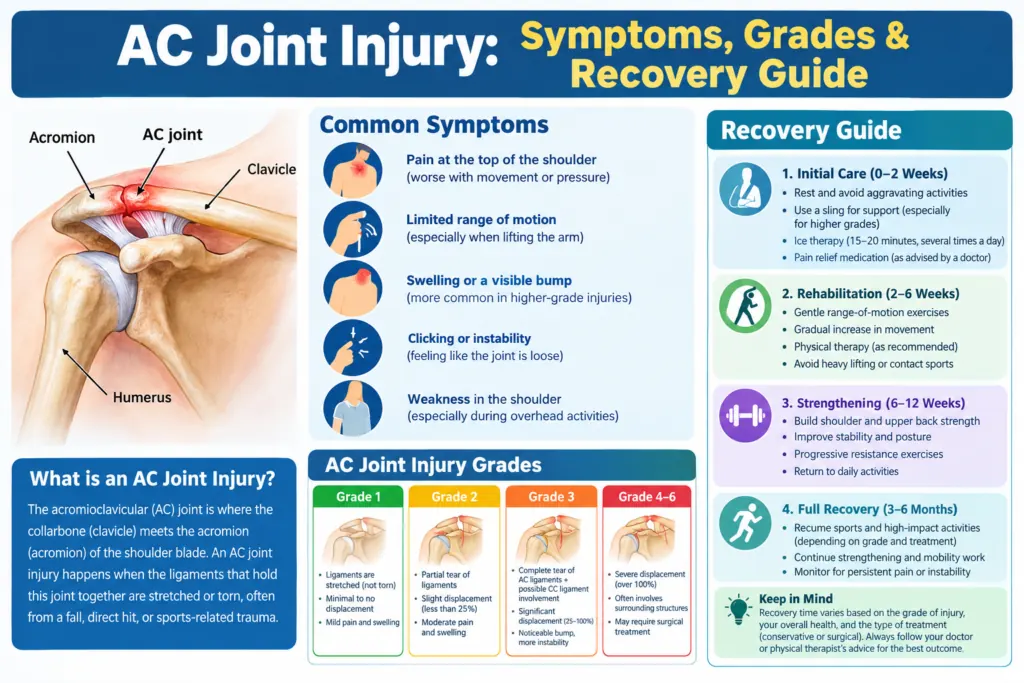
The acromioclavicular joint connects the outer end of the collarbone, or clavicle, to a part of the shoulder blade called the acromion.
Several ligaments help stabilize this joint. A sudden force can stretch or tear these ligaments, resulting in an AC joint sprain or separation.
An AC joint injury is sometimes called ashoulder separation, although it is different from a shoulder dislocation.
The severity depends largely on how much the supporting ligaments have been damaged and whether the collarbone has moved out of its normal position.
What Causes an AC Joint Injury?
AC joint injuries most commonly occur when a person lands directly on the outside of the shoulder.
Common causes include:
- Falling onto the shoulder during sports.
- Bicycle or motorcycle accidents.
- Contact sports such as football or hockey.
- Falling down stairs or onto a hard surface.
- Direct blows to the shoulder.
- Certain workplace accidents.
A fall onto an outstretched hand can also transmit force through the arm and shoulder, although direct impact to the shoulder is a particularly common mechanism.
If shoulder pain develops after an accident, it is important not to assume that the AC joint is the only possible source. Rotator cuff injuries, fractures, labral injuries, and other conditions can cause similar symptoms.
AC Joint Injury Symptoms
Symptoms vary according to the severity of the injury.
The most common AC joint injury symptoms include:
- Pain at the top of the shoulder.
- Tenderness over the AC joint.
- Swelling or bruising.
- Pain when lifting the arm.
- Discomfort when reaching across the body.
- Difficulty carrying objects.
- Pain when sleeping on the injured side.
- Reduced shoulder strength or movement.
- A visible bump in more significant injuries.
Pain may become particularly noticeable when you bring the affected arm across your chest.
Some people also experience a feeling of weakness or instability after a significant injury.
If your shoulder pain feels burning rather than localized tenderness, other causes may need to be considered. Our guide to burning shoulder pain explains several possible causes and treatment approaches.
What Does an AC Joint Separation Look Like?
A visible bump at the top of the shoulder can occur after a more significant AC joint injury.
This happens because the collarbone may become elevated relative to the acromion when the stabilizing ligaments are damaged.
However, the appearance of the shoulder alone does not determine the severity of the injury. Pain, stability, ligament damage, and imaging findings all contribute to diagnosis and treatment decisions.
Not every shoulder bump is caused by an AC joint separation, so a new deformity following trauma should be evaluated.
AC Joint Injury Grades
AC joint injuries are commonly classified into six grades using the Rockwood classification system.
Grade 1
A Grade 1 injury generally involves stretching or a mild sprain of the AC joint ligaments without significant displacement.
Symptoms may include localized tenderness and mild pain, particularly with shoulder movement.
Grade 2
A Grade 2 injury involves more significant damage to the AC ligaments, with partial disruption of the supporting structures.
There may be increased tenderness, swelling, and some change in the position of the joint.
Grade 3
A Grade 3 injury involves complete disruption of the AC and coracoclavicular ligaments.
The collarbone may become visibly elevated, producing the characteristic shoulder bump.
Treatment can depend on activity level, symptoms, shoulder function, and other individual factors.
Grades 4–6
Higher-grade injuries involve greater displacement or more complex disruption of the supporting structures.
These injuries may require specialist assessment to determine whether surgical management is appropriate.
The grade is important, but it is not the only factor that determines treatment.
How Is an AC Joint Injury Diagnosed?
A healthcare professional will typically begin by asking how the injury occurred and where you feel pain.
A physical examination may assess:
- Tenderness over the AC joint.
- Shoulder range of motion.
- Shoulder strength.
- Joint stability.
- Visible deformity.
- Pain with specific movements.
X-rays are commonly used to assess the alignment of the joint and identify displacement or associated bone injuries.
In some situations, additional imaging may be considered if another injury is suspected.
Because several shoulder conditions can cause similar symptoms, an accurate diagnosis is important before beginning an aggressive exercise program.
AC Joint Injury Treatment
Treatment depends on the grade of the injury, symptoms, activity requirements, and whether the joint is stable.
Conservative Treatment
Many lower-grade AC joint injuries can be treated without surgery.
Conservative treatment may include:
- Temporary activity modification.
- Ice during the early stage when appropriate.
- Pain-relieving medication when medically suitable.
- A sling for a limited period when recommended.
- Gradual range-of-motion exercises.
- Progressive strengthening.
- Physical therapy.
The goal is to reduce symptoms while gradually restoring shoulder movement and strength.
For a broader overview of nonsurgical and surgical approaches to shoulder problems, see our guide to shoulder pain treatment options.
AC Joint Injury Recovery Timeline
Recovery varies considerably depending on the injury grade and individual circumstances.
A mild AC joint sprain may improve within several weeks, while more significant injuries can take considerably longer.
Recovery generally progresses through several stages.
Early Recovery
The initial goal is to control pain and protect the injured joint from unnecessary stress.
Activities that reproduce significant pain should generally be reduced or modified.
Restoring Movement
As symptoms improve, gentle shoulder movement can help prevent excessive stiffness.
The shoulder should gradually regain a comfortable range of motion before more demanding strengthening is introduced.
Strengthening
Strengthening exercises can then be progressively added to rebuild shoulder and upper-back function.
Exercises should be increased gradually rather than returning immediately to heavy lifting.
Return to Activity
The final stage focuses on returning to work, sports, or other activities.
The timing depends on pain, strength, range of motion, joint stability, and the demands of the activity.
If you have undergone shoulder surgery for another condition, recovery can be substantially different. For example, our guide on shoulder labral tear surgery recovery explains why rehabilitation often progresses in stages.
Exercises for AC Joint Injury Recovery
Exercise can play an important role in recovery, but the appropriate exercises depend on the stage of healing.
Early in recovery, gentle range-of-motion exercises may be emphasized.
Later, strengthening may include:
- Scapular retraction exercises.
- Resistance-band exercises.
- Controlled external rotation.
- Rows.
- Gradual shoulder raises.
- Functional strengthening exercises.
Exercises should not consistently produce sharp or increasing pain.
Once strength and movement improve, a structured strengthening program can help prepare the shoulder for normal activities.
Our guide to shoulder strengthening exercises for athletes provides additional information about building shoulder strength.
What Exercises Should You Avoid With an AC Joint Injury?
During the painful stage, exercises that place significant stress directly through the AC joint may need to be avoided or modified.
Depending on your injury, this may include:
- Heavy bench pressing.
- Heavy overhead pressing.
- Deep dips.
- Heavy push-ups.
- Exercises involving painful cross-body movement.
- Heavy lifting before adequate recovery.
- Contact sports before the shoulder is ready.
Avoiding a movement temporarily does not necessarily mean you will never perform it again. Rehabilitation should gradually restore tolerance to activity.
If a particular exercise produces sharp pain at the top of the shoulder, do not repeatedly test it with heavier weight.
Can an AC Joint Injury Heal Without Surgery?
Many AC joint injuries can improve without surgery, particularly lower-grade injuries.
Treatment usually focuses on pain management, activity modification, restoring movement, and progressive strengthening.
Some higher-grade injuries may require a surgical consultation, especially when there is significant displacement, persistent symptoms, functional limitations, or specific athletic or occupational requirements.
The decision should be based on the individual’s injury and functional needs rather than the injury grade alone.
Can You Still Exercise With an AC Joint Injury?
You may be able to remain physically active while recovering, but the activity should be modified to avoid aggravating the injured shoulder.
For example, lower-body exercises that do not place stress on the shoulder may sometimes be possible.
Walking, stationary cycling, or other appropriate activities may allow you to maintain general fitness while the shoulder recovers.
However, if walking itself causes pain because of another lower-extremity injury, the cause should also be addressed. Our article on walking with a torn meniscus explains why knee injury symptoms can influence activity decisions.
AC Joint Injury vs. Shoulder Impingement
AC joint injuries and shoulder impingement can both cause pain during shoulder movement, but they involve different structures.
AC joint pain is often localized to the top of the shoulder and may be particularly noticeable with direct pressure or cross-body movement.
Shoulder impingement symptoms may involve pain during certain overhead movements and can have different underlying causes.
If your pain developed gradually without a specific injury, learning about shoulder impingement syndrome may help you understand another possible source of shoulder symptoms.
How Can You Prevent AC Joint Injuries?
Not every AC joint injury can be prevented because accidents and falls can happen unexpectedly.
However, you can reduce some risks by improving general shoulder strength, maintaining good exercise technique, and using appropriate protective equipment during contact or high-risk sports.
Useful strategies include:
- Strengthen the shoulder and upper-back muscles.
- Increase workout intensity gradually.
- Use proper exercise technique.
- Warm up before demanding activities.
- Avoid training through significant pain.
- Use appropriate protective equipment for contact sports.
- Maintain adequate recovery between demanding workouts.
Good shoulder conditioning can improve your ability to handle exercise demands, although it cannot guarantee injury prevention.
When Should You See a Doctor?
You should consider professional evaluation after a significant shoulder injury, particularly if you notice a visible deformity or have difficulty moving the arm.
Seek prompt medical attention if you experience:
- Severe shoulder pain after a fall.
- A visible change in shoulder shape.
- Inability to raise the arm.
- Significant swelling.
- Severe weakness.
- Numbness or tingling.
- Persistent pain that does not improve.
- A suspected fracture or dislocation.
Early assessment can help identify the injury and establish an appropriate recovery plan.
Frequently Asked Questions
1. What is an AC joint injury?
An AC joint injury occurs when the ligaments supporting the acromioclavicular joint are stretched or torn, commonly after a direct fall or blow to the shoulder.
2. What are the most common symptoms of an AC joint injury?
Common symptoms include pain at the top of the shoulder, tenderness, swelling, reduced movement, and sometimes a visible bump over the joint.
3. How long does an AC joint injury take to heal?
Recovery varies by injury severity. Mild injuries may improve within several weeks, while more serious injuries can take considerably longer.
4. Can an AC joint injury heal on its own?
Many lower-grade injuries can heal with conservative treatment, including activity modification and rehabilitation. More severe injuries may require specialist assessment.
5. Is an AC joint injury the same as a shoulder dislocation?
No. An AC joint separation affects the joint between the collarbone and shoulder blade, while a shoulder dislocation involves the main shoulder joint.
6. Can I lift weights with an AC joint injury?
Heavy or painful exercises may need to be temporarily avoided. Gradual strengthening can usually be introduced as symptoms and shoulder function improve.
7. Does an AC joint injury require surgery?
Not always. Many injuries are successfully managed without surgery, while some higher-grade or persistent injuries may require a surgical evaluation.
8. Why is there a bump on my shoulder after an injury?
A bump can occur when the collarbone becomes displaced relative to the acromion after damage to the supporting ligaments.
9. Can I sleep on an injured AC joint?
Sleeping directly on the injured side may increase discomfort. Many people find it more comfortable to sleep on the opposite side or on their back while recovering.
10. When can I return to sports after an AC joint injury?
Return to sports depends on pain, strength, range of motion, stability, and the physical demands of the sport. A gradual return is generally preferable to an immediate return to full activity.
Conclusion
An AC joint injury can range from a mild sprain to a significant separation involving several stabilizing ligaments. Recognizing symptoms such as pain at the top of the shoulder, swelling, tenderness, reduced movement, and a visible bump can help you know when evaluation may be necessary.
Treatment depends on the severity of the injury. Many lower-grade injuries improve with activity modification, pain management, mobility exercises, and progressive strengthening, while more serious injuries may require specialist care.
The safest approach is to avoid rushing back to heavy lifting or contact sports. Give the shoulder time to recover, follow a gradual rehabilitation program, and seek professional assessment if pain, weakness, deformity, or loss of function persists.
Disclaimer: This article is intended for educational purposes only and should not be considered personalized medical advice
This article is for education purpose only and is not a diagnosis or a substitute for medical advice.