
Quick answer
The hollow at the back of the knee is called the popliteal fossa. It contains blood vessels, nerves, lymph nodes and fat. Pain or swelling in this area can have several causes, so the location alone does not establish a diagnosis.
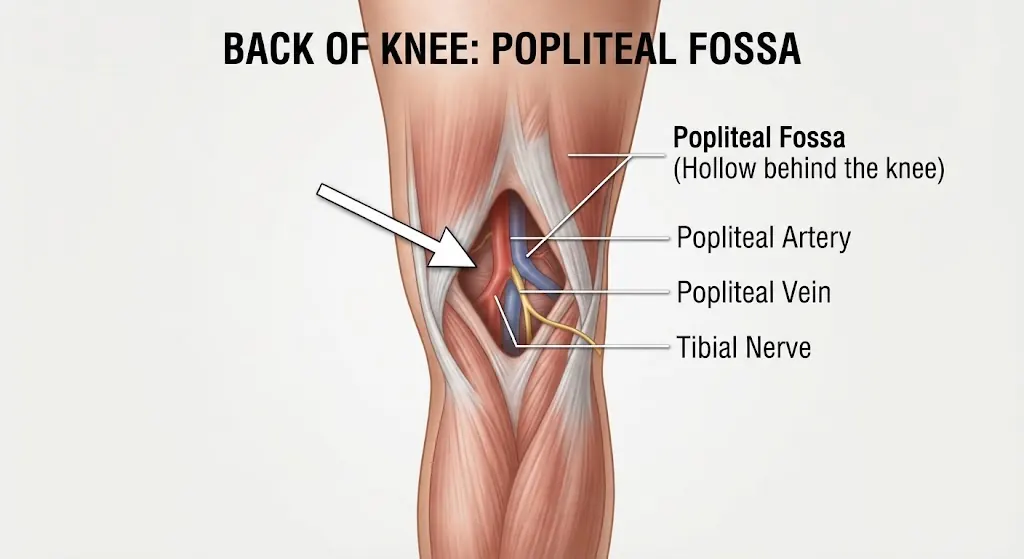
The back of the knee contains several important structures, including tendons, muscles, blood vessels, nerves, and the joint capsule. Discomfort in this area can result from muscle strain, a meniscus injury, fluid buildup, or other conditions. The location and type of symptoms can offer clues, but pain alone cannot establish the cause.
This guide explains what the back of your knee is called, which structures are located there, why the area may hurt or swell, and when you should seek medical attention. It also covers common differences between symptoms that can usually be monitored and warning signs that require prompt evaluation.
What Is the Medical Name for the Back of Your Knee?
The medical name for the back of the knee is the popliteal region. The specific hollow behind the knee joint is called the popliteal fossa.
You may encounter these terms in medical reports, physical therapy instructions, or discussions with a healthcare professional. They describe the same general area, although the popliteal fossa refers more specifically to the hollow between surrounding muscles and tendons.
The knee’s anatomy is complex because multiple structures meet in a relatively small space. Pain in this region may originate from the knee joint itself, nearby muscles and tendons, or blood vessels and nerves.
What Structures Are Located Behind the Knee?
The popliteal region contains several structures that help your knee bend, straighten, and remain stable.
| Structure | What it does | What problems may feel like |
|---|---|---|
| Hamstring tendons | Help bend the knee | Pulling or tenderness during bending |
| Gastrocnemius muscle | Helps bend the knee and push off while walking | Pain that may extend into the upper calf |
| Popliteus muscle | Helps control knee rotation | Discomfort during certain movements |
| Menisci and joint capsule | Cushion the joint and help maintain stability | Deep pain, catching, or restricted movement |
| Popliteal artery and vein | Carry blood to and from the lower leg | Circulation-related symptoms when affected |
| Tibial and common fibular nerves | Carry signals between the leg and nervous system | Tingling, numbness, or weakness when affected |
The symptoms in this table are possibilities, not reliable ways to identify an injured structure without an examination.
Why Does the Back of Your Knee Hurt?
Pain behind the knee can develop gradually from repetitive activity or appear suddenly after a twist, fall, or sports injury. The likely causes depend on whether the pain is sharp, aching, swollen, movement-related, or accompanied by other symptoms.
Common causes of pain behind the knee
-
Hamstring strain: Overstretching or tearing the muscles at the back of the thigh may cause pain near the knee, especially during bending or stretching. Learn what a strained hamstring feels like.
-
Meniscus injury: A tear in the knee’s cushioning cartilage can cause pain, catching, stiffness, or difficulty fully straightening the joint. Review meniscus tear symptoms and recovery.
-
Baker’s cyst: This is a fluid-filled swelling behind the knee that may cause tightness, pressure, or difficulty bending the leg. It can occur alongside arthritis or a meniscus injury.
-
Ligament injury: Damage to a knee ligament may cause pain, swelling, or instability after a sudden movement. The differences between an ACL injury and a meniscus tear can help explain why these injuries sometimes feel similar.
-
Tendon irritation: Repetitive running, jumping, or exercise can irritate tissues around the knee. Symptoms may worsen during activity or when bending the leg against resistance.
Other conditions, including arthritis and less common circulation problems, can also cause discomfort in this area. A broader overview of common knee pain causes and when to see a doctor may help you understand what needs evaluation.
What Does Pain Behind the Knee Mean During Movement?
The movement that triggers discomfort can help a clinician narrow down possible causes, although it cannot confirm a diagnosis.
| Symptom pattern | Possible explanations | What to consider |
|---|---|---|
| Pain when bending the knee | Meniscus irritation, a Baker’s cyst, or muscle strain | Note whether bending is restricted |
| Pain when straightening the leg | Joint irritation, swelling, or a meniscus injury | Seek evaluation if the knee becomes locked |
| Pain during walking | Muscle, tendon, joint, or ligament problems | Reduce activity if pain or instability increases |
| Tightness with visible swelling | Fluid buildup or a Baker’s cyst | Arrange an assessment if swelling persists |
| Sudden calf swelling and pain | A possible blood clot or another urgent condition | Seek urgent medical evaluation |
If your symptoms are mainly triggered by bending, see why your knee hurts when you bend it. If straightening is the main problem, knee pain when straightening the leg provides more focused information.
For movement-related symptoms, it may also help to understand why knee pain develops when twisting or why the knee may feel like it is giving out.
How Can You Relieve Mild Discomfort Behind the Knee?
If the discomfort is mild and there are no warning signs, temporarily reducing aggravating activities may help. Avoid running, deep squats, and repeated bending if these movements increase pain.
You can also try the following:
-
Apply a wrapped cold pack for 15–20 minutes at a time.
-
Elevate the leg when resting.
-
Avoid forceful stretching or massage over a swollen or painful area.
-
Resume activity gradually as symptoms improve.
Do not assume that swelling behind the knee is simply a muscle strain. A clinician may examine your knee and calf and recommend imaging or other tests if needed. For additional guidance, explore ways to manage knee arthritis symptoms or safe low-impact exercises for painful joints when appropriate for your condition.
When Should You Seek Medical Attention?
Most mild muscle-related discomfort is not an emergency, but certain symptoms need prompt attention.
Monitor mild symptoms
Mild discomfort after activity that improves with rest and does not involve significant swelling or instability may be monitored briefly.
Arrange medical evaluation
Seek an assessment for persistent pain, recurrent swelling, restricted movement, knee locking, or difficulty walking after an injury. A sharp pain behind the knee deserves particular attention if it begins suddenly or worsens.
Seek urgent or emergency care
Sudden swelling or pain in one calf may indicate a blood clot, especially with warmth or redness. Seek urgent evaluation. If you also develop chest pain, shortness of breath, fainting, or coughing up blood, call 911 in the United States.
A cold or pale foot, new significant numbness, or severe pain after an injury also warrants emergency assessment.
Frequently Asked Questions
1. What is the hollow behind the knee called?
It is called the popliteal fossa. This hollow contains important blood vessels, nerves, and surrounding soft tissues.
2. What muscle is at the back of the knee?
The hamstrings and gastrocnemius are major muscles associated with the region. The smaller popliteus muscle also helps control knee rotation.
3. Is pain behind the knee serious?
Not always. Muscle strain and joint irritation are possible causes, but sudden calf swelling, severe pain, or circulation-related symptoms require prompt attention.
4. Why does the back of my knee hurt when I bend it?
Possible causes include a Baker’s cyst, meniscus injury, or muscle and tendon irritation. Persistent pain or restricted movement should be evaluated.
5. Can a Baker’s cyst cause pain behind the knee?
Yes. It may cause a feeling of fullness, tightness, or swelling behind the knee. A ruptured cyst can cause calf pain and swelling that resembles a blood clot, so medical assessment is important.
6. What is the difference between the popliteal fossa and the popliteal region?
The popliteal region refers to the general area behind the knee. The popliteal fossa describes the specific hollow within that area.
7. Why does the back of my knee hurt when walking?
Walking can aggravate muscle, tendon, cartilage, or joint problems. Pain accompanied by instability, swelling, or difficulty bearing weight deserves evaluation.
8. Should I stretch pain behind the knee?
Not automatically. Gentle movement may help some causes, but forceful stretching can aggravate an injury. Identify the likely cause before beginning targeted exercises.
9. Can a blood clot cause pain behind the knee?
A deep vein thrombosis can cause pain or swelling in the calf and sometimes around the knee. Symptoms alone cannot rule it in or out, so suspected blood clots require urgent medical evaluation.
10. Which doctor should I see for pain behind the knee?
A primary care clinician or orthopedic specialist can assess many knee-related problems. Suspected blood clots or other urgent symptoms require prompt medical care rather than a routine appointment.
Conclusion
The back of your knee is called the popliteal region, and its central hollow is the popliteal fossa. Understanding these terms can help you describe symptoms, but the location of pain alone cannot identify its cause. If discomfort persists, swelling develops, or walking becomes difficult, arrange a medical assessment. Sudden calf swelling or symptoms suggesting a circulation problem need urgent attention.
Disclaimer: This article is provided for educational and informational purposes only.
This article is for education purpose only and is not a diagnosis or a substitute for medical advice.