
Shoulder impingement syndrome is one of the most common causes of shoulder pain seen by doctors and physical therapists across the United States, yet it remains widely misunderstood by the people who suffer from it. The condition typically begins as a nagging ache felt deep in the shoulder when reaching overhead, lifting objects, or even performing routine activities like washing hair or reaching across a table. Over time, what starts as occasional discomfort can progress into persistent pain that disrupts sleep, limits work productivity, and prevents participation in sports or exercise. Many people live with this pain for months before seeking help, assuming it will simply go away on its own.
If you have been experiencing shoulder pain that worsens with overhead activity or reaching behind your back, it is important to understand that shoulder impingement is highly treatable — particularly when identified early. The vast majority of patients recover fully with conservative treatment, and surgery is rarely necessary. The frustration many people feel comes not from the severity of the condition itself but from not understanding what is happening inside the shoulder and therefore not addressing it correctly. With the right diagnosis and treatment plan, most people see meaningful improvement within weeks.
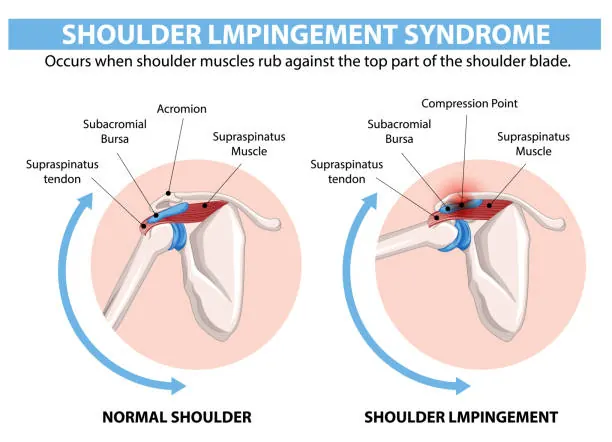
Shoulder impingement syndrome occurs when the tendons of the rotator cuff — particularly the supraspinatus tendon — become compressed or pinched between the head of the humerus (upper arm bone) and the acromion (the bony roof of the shoulder) during arm elevation. This repeated mechanical compression causes tendon irritation, inflammation, and pain. Over time, if left unaddressed, impingement can progress to rotator cuff tears, bursitis, and significant functional loss. Understanding what drives this compression, how it manifests, and how to treat it effectively is the first step toward lasting shoulder health.
Anatomy of the Shoulder and the Impingement Zone
The shoulder joint is a ball-and-socket joint offering the greatest range of motion of any joint in the body. The rotator cuff tendons pass through a narrow space called the subacromial space — located between the head of the humerus below and the acromion bone above. This space also contains the subacromial bursa, a fluid-filled sac that reduces friction during shoulder movement. When the mechanics of the shoulder are disrupted — through muscle imbalance, postural changes, or structural abnormalities — this already narrow space becomes even smaller, causing the tendons and bursa to be repeatedly pinched during shoulder elevation. This repetitive impingement triggers the inflammatory cascade that produces the characteristic pain of shoulder impingement syndrome.
Types of Shoulder Impingement
Primary Impingement
Primary impingement is caused by a structural reduction in the subacromial space itself. A hooked or curved acromion shape, bone spurs on the underside of the acromion, or acromioclavicular joint arthritis all physically narrow the space available for the rotator cuff tendons, creating mechanical compression during arm elevation regardless of muscular function.
Secondary Impingement
Secondary impingement is far more common and results from dynamic instability of the shoulder — meaning the ball of the humerus is not properly centered in the socket during movement due to rotator cuff weakness, scapular muscle dysfunction, or poor posture. When the muscles that control shoulder mechanics are weak or imbalanced, the humeral head migrates upward during arm elevation, compressing the supraspinatus tendon against the acromion. This is the most common and most correctable form of impingement, responding excellently to targeted physical therapy.
Causes and Risk Factors
Poor Posture and Muscle Imbalance
Rounded shoulders and forward head posture — increasingly common in people who spend long hours at desks or looking at screens — tilt the scapula forward and downward, significantly narrowing the subacromial space. This postural dysfunction is one of the leading drivers of secondary shoulder impingement in office workers and students. Addressing how back pain starts and the role of poor posture is directly relevant to shoulder health, since thoracic spine posture and scapular positioning are intimately connected.
Repetitive Overhead Activity
- Occupational risk: Painters, electricians, carpenters, and assembly line workers who perform repetitive overhead reaching are at significantly elevated risk of developing shoulder impingement due to cumulative subacromial compression throughout their working lives.
- Athletic overuse: Swimmers, tennis players, baseball pitchers, and volleyball players all perform high volumes of overhead movement, creating repeated impingement forces on the supraspinatus tendon that accumulate over time.
Rotator Cuff Weakness
Weakness in the rotator cuff muscles — particularly the external rotators — reduces their ability to compress and center the humeral head in the socket during arm elevation. This allows the humerus to migrate superiorly, narrowing the subacromial space and increasing tendon compression. Scapular stabilizer weakness compounds this problem by reducing the stable platform the rotator cuff needs to function optimally.
Structural Factors
- Acromion morphology: A type II (curved) or type III (hooked) acromion shape intrinsically reduces subacromial clearance and predisposes individuals to primary impingement regardless of muscular function.
- Bone spurs: Calcium deposits and bone spurs forming on the acromion or acromioclavicular joint further encroach on the subacromial space and abrade the supraspinatus tendon during movement.
- Previous shoulder injury: A history of shoulder trauma, including previous rotator cuff tears, dislocations, or fractures, alters shoulder mechanics and increases impingement risk significantly.
Lifestyle Factors
Sedentary lifestyle combined with prolonged sitting weakens the postural muscles that maintain proper scapular positioning. Smoking reduces tendon blood supply and healing capacity. These factors collectively create the conditions in which impingement develops and persists. Understanding how everyday choices influence your body joint health provides important context for the lifestyle changes that support both prevention and recovery.
Symptoms of Shoulder Impingement Syndrome
Pain Location and Character
The pain of shoulder impingement is typically felt as a deep ache in the front or outer side of the shoulder, often radiating into the upper arm but rarely below the elbow. It is characteristically described as a dull, persistent ache at rest that sharpens significantly during specific movements. Many patients point to a painful arc of motion — the shoulder hurts most when the arm is elevated between 60 and 120 degrees, which is precisely the range where subacromial compression is greatest.
Activity-Related Pain
Reaching overhead — such as lifting objects from high shelves, hanging laundry, or performing overhead press exercises — reliably reproduces impingement pain. Reaching behind the back to fasten clothing, reaching across the body, or lying on the affected shoulder during sleep are also commonly painful. Night pain that wakes patients from sleep is particularly significant and suggests more advanced impingement with significant bursal inflammation or early tendon damage.
Weakness and Stiffness
- Functional weakness: Patients often notice reduced shoulder strength during lifting and reaching, not because the muscles themselves are weak but because pain inhibits full muscular activation during impingement-provoking movements.
- Progressive stiffness: Chronic impingement that remains untreated can progressively restrict shoulder range of motion as protective muscle guarding and capsular tightening develop over time.
Progression of Symptoms
Shoulder impingement tends to follow a progressive course if left unaddressed. Initially symptoms are activity-related and resolve with rest. Over weeks to months, pain becomes more persistent, affecting rest and sleep. In the advanced stage, rotator cuff tendon damage accumulates, potentially leading to partial or full thickness tears — a significantly more complex problem to manage.
Diagnosis
Clinical Examination
An experienced clinician can diagnose shoulder impingement confidently through physical examination. The Neer impingement sign involves passively elevating the patient’s arm while stabilizing the scapula — reproduction of anterior shoulder pain is a positive test indicating subacromial compression. The Hawkins-Kennedy test flexes the shoulder to 90 degrees and internally rotates the arm — pain reproduction indicates supraspinatus tendon impingement between the humerus and coracoacromial ligament. Assessment of rotator cuff strength, scapular dyskinesis, and cervical spine contribution completes the clinical picture.
Imaging
X-rays are the initial imaging investigation, assessing acromion shape, bone spur formation, acromioclavicular joint arthritis, and glenohumeral joint space. MRI provides detailed visualization of the rotator cuff tendons, subacromial bursa, and any associated tendon pathology. Ultrasound is a dynamic and cost-effective alternative that allows real-time assessment of tendon impingement during shoulder movement, providing clinically valuable information not available from static MRI.
Treatment Options
Physical Therapy — The Most Important Treatment
Physical therapy is the single most effective and evidence-based treatment for shoulder impingement syndrome, producing excellent outcomes in the vast majority of patients when performed consistently and correctly. A comprehensive program targets all the mechanical drivers of impingement simultaneously rather than simply treating pain in isolation.
The initial phase focuses on reducing pain and inflammation through activity modification, ice therapy, and gentle range of motion exercises. As pain subsides, the rehabilitation emphasis shifts to restoring normal scapular mechanics through targeted periscapular strengthening — particularly the lower and middle trapezius and serratus anterior muscles that control scapular upward rotation. Rotator cuff strengthening follows, with particular emphasis on external rotation strength to restore the dynamic centering mechanism that prevents superior humeral migration. Incorporating structured shoulder strengthening exercises for athletes alongside formal physical therapy provides a comprehensive strength foundation that addresses both the immediate impingement problem and long-term shoulder resilience.
Postural correction is equally central to recovery. Specific thoracic spine mobilization, pectoral stretching, and cervical alignment work address the upstream postural contributors to scapular dysfunction that perpetuate impingement. Without correcting posture, rotator cuff strengthening alone rarely produces lasting results.
Medications
NSAIDs such as ibuprofen or naproxen reduce subacromial inflammation and provide meaningful pain relief during the active treatment phase. They should be used as a bridge to enable physical therapy engagement rather than as a standalone long-term solution. Topical anti-inflammatory gels applied directly over the shoulder can provide localized relief with fewer systemic side effects.
Corticosteroid Injections
A subacromial corticosteroid injection delivers anti-inflammatory medication directly into the subacromial bursa, rapidly reducing inflammation and providing significant pain relief that typically lasts several weeks to months. Injections are particularly valuable when pain is severe enough to prevent effective participation in physical therapy. They are most effective when combined with structured rehabilitation rather than used in isolation. Most guidelines recommend limiting subacromial steroid injections to three per year at any single site to avoid potential tendon weakening with repeated exposure.
Activity Modification and Ergonomic Adjustments
During active treatment, temporarily avoiding overhead reaching, heavy lifting, and any activity that consistently reproduces sharp shoulder pain allows inflamed tissue to settle and prevents ongoing mechanical damage. Ergonomic adjustments — raising a computer monitor to eye level, adjusting desk and chair height to maintain neutral shoulder posture, and using a supportive pillow at night — reduce cumulative subacromial stress during daily activities. Dietary modifications that reduce systemic inflammation also support tissue recovery, and our guide on how changing your diet can help reduce pain naturally offers practical strategies directly applicable to shoulder recovery.
Surgical Treatment
Surgery is considered only after a minimum of 3–6 months of consistent conservative treatment has failed to provide adequate relief. Arthroscopic subacromial decompression is the standard surgical procedure, involving removal of the inflamed bursa (bursectomy) and shaving of the undersurface of the acromion (acromioplasty) to increase subacromial clearance and eliminate mechanical impingement. If bone spurs are present they are removed simultaneously. The procedure is performed as day surgery through small keyhole incisions, with most patients returning to light activities within 2–4 weeks and full activity within 3–6 months following structured post-operative rehabilitation.
Recovery Timeline
Conservative Recovery
- Weeks 1–3: Pain management, activity modification, gentle range of motion restoration, and initiation of periscapular muscle activation exercises.
- Weeks 3–8: Progressive rotator cuff and scapular stabilizer strengthening. Postural correction program intensifies. Most patients notice meaningful pain reduction during this phase.
- Weeks 8–16: Advanced strengthening, functional movement training, and sport or work-specific rehabilitation. Return to full overhead activity as pain allows.
- 4–6 months: Full recovery for most patients with consistent engagement in rehabilitation.
Post-Surgical Recovery
- Weeks 0–2: Arm in a sling. Ice, pain management, and gentle pendulum exercises only.
- Weeks 2–6: Sling discontinued. Active range of motion restored. Physical therapy begins formally.
- Weeks 6–12: Progressive strengthening targeting rotator cuff and scapular stabilizers.
- 3–6 months: Return to full activity including overhead sports and manual work.
Prevention Strategies
- Maintain thoracic spine mobility: Regular thoracic extension exercises and mobility work counteract the rounded posture that narrows the subacromial space and drives secondary impingement.
- Strengthen scapular stabilizers consistently: Regular lower trapezius, middle trapezius, and serratus anterior strengthening maintains proper scapular mechanics and subacromial clearance during all overhead activities.
- Warm up before overhead exercise: Dynamic shoulder warm-up including band pull-aparts, wall slides, and arm circles prepares the rotator cuff and reduces impingement risk during training.
- Progress overhead volume gradually: Sudden increases in overhead training volume — a common mistake among gym-goers and athletes — are a primary trigger for acute impingement episodes.
- Address postural habits proactively: Regular movement breaks, ergonomic workstation setup, and conscious postural awareness during daily activities significantly reduce cumulative impingement forces over time.
Conclusion
Shoulder impingement syndrome is a common, painful, and highly treatable condition that responds excellently to the right combination of physical therapy, postural correction, and activity modification. The vast majority of patients recover fully without surgery when they engage consistently with a structured rehabilitation program that addresses the underlying mechanical drivers of impingement rather than simply managing pain. Early diagnosis and prompt intervention are the most important factors in preventing progression to more serious rotator cuff damage. By understanding your condition clearly, committing to your rehabilitation program, and making the lifestyle adjustments that support shoulder health, you can overcome impingement and build a more resilient, pain-free shoulder for the long term.
Frequently Asked Questions
1. How long does shoulder impingement take to heal? Most cases resolve within 3–6 months of consistent physical therapy and activity modification. Mild cases may improve within 6–8 weeks, while more chronic cases with significant tendon involvement take longer.
2. Can shoulder impingement heal without treatment? Mild cases may settle with rest and activity modification alone. However, without addressing the underlying mechanical causes, impingement typically recurs and can progressively worsen, potentially leading to rotator cuff tears.
3. Is it safe to exercise with shoulder impingement? Yes, with appropriate modifications. Avoid overhead pressing, upright rows, and behind-the-neck exercises. Focus on pain-free range of motion, scapular strengthening, and rotator cuff activation under physiotherapy guidance.
4. What is the difference between shoulder impingement and a rotator cuff tear? Impingement is the mechanical compression of the rotator cuff tendons causing pain and inflammation. A rotator cuff tear is actual structural damage to the tendon tissue. Chronic untreated impingement can lead to rotator cuff tears over time.
5. Does a cortisone injection cure shoulder impingement? No — a cortisone injection reduces inflammation and pain but does not address the mechanical causes of impingement. It is most valuable as a bridge to enable effective engagement in physical therapy rehabilitation.
6. Can poor posture cause shoulder impingement? Yes. Rounded shoulders and forward head posture tilt the scapula in a way that significantly reduces subacromial space, making impingement much more likely during arm elevation. Postural correction is a central component of effective treatment.
7. What movements should I avoid with shoulder impingement? Avoid overhead pressing, reaching behind the back, upright rows, and any activity consistently reproducing sharp shoulder pain. Temporary avoidance of provocative movements allows inflamed tissue to settle.
8. How is shoulder impingement different from frozen shoulder? Impingement causes pain primarily with specific movements and overhead activity. Frozen shoulder causes global restriction of all shoulder movements in all directions. Both can coexist and impingement can progress to frozen shoulder if left untreated.
9. Will I need surgery for shoulder impingement? The majority of patients do not require surgery. Arthroscopic subacromial decompression is considered only after 3–6 months of consistent conservative treatment has failed to provide adequate relief.
10. What is the best sleeping position for shoulder impingement? Sleep on your unaffected side with a pillow supporting the injured arm in a neutral position, or flat on your back with a small pillow supporting the affected arm. Avoid lying directly on the impinged shoulder.
Disclaimer
The information provided in this article is intended for educational purposes only and does not constitute professional medical advice, diagnosis, or treatment
This article is for education purpose only and is not a diagnosis or a substitute for medical advice.