
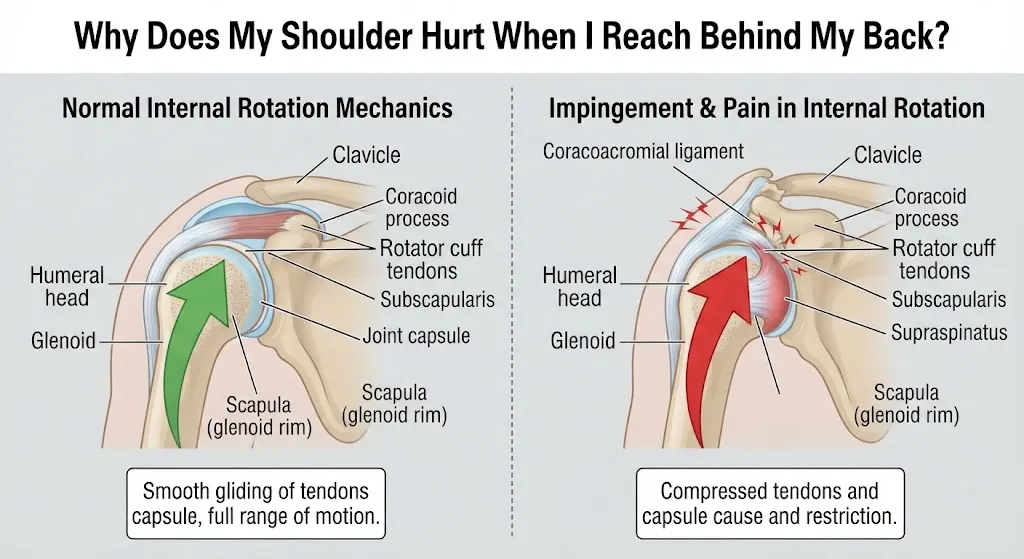
Shoulder pain when reaching behind your back does not automatically mean you have a torn tendon or a serious injury. Several shoulder conditions can cause similar symptoms, and stiffness may be just as important as pain. However, sudden weakness, severe pain after an injury, or a visibly deformed shoulder should not be ignored.
Understanding why this movement hurts can help you identify possible causes, modify activities safely, and decide when to seek medical care. The location of the pain, how quickly it started, and whether other shoulder movements are restricted can all provide useful clues.
Why does reaching behind your back hurt your shoulder?
Reaching behind your back requires your shoulder to extend, rotate inward, and move your arm toward your spine. This combination places different demands on the rotator cuff, joint capsule, tendons, and surrounding tissues. If one or more structures are irritated or stiff, the movement may become painful.
Common causes include rotator cuff problems, shoulder impingement-related pain, frozen shoulder, bursitis, and arthritis. The symptoms can overlap, so the movement that triggers pain cannot identify the exact condition on its own.
Common causes of shoulder pain when reaching behind your back
| Possible cause | Symptoms that may occur | Helpful clue |
|---|---|---|
| Rotator cuff tendinopathy or tear | Aching, weakness, pain with lifting or rotation | Pain or weakness during several shoulder movements |
| Frozen shoulder | Pain with progressive stiffness | Difficulty reaching behind your back and overhead |
| Shoulder impingement-related pain | Pinching or aching with certain arm positions | Overhead movement may also hurt |
| Shoulder bursitis | Pain with movement or lying on the affected side | Symptoms may worsen after repeated activity |
| Arthritis or AC joint problems | Stiffness or pain around the joint | Other movements may be restricted, too |
| Labral injury | Deep pain, catching, or instability | May follow trauma or repetitive overhead activity |
1. Rotator cuff irritation or a tear
The rotator cuff consists of muscles and tendons that help control shoulder movement and stabilize the joint. Irritation or a tear can cause pain during rotation, reaching, or lifting. A tear is more concerning when symptoms begin after a fall or sudden injury and are accompanied by noticeable weakness.
Learn more about rotator cuff tear symptoms, treatment, and recovery.
2. Frozen shoulder
Frozen shoulder causes pain and progressive loss of shoulder movement as the joint capsule becomes stiff. Reaching behind your back may become particularly difficult, but lifting your arm or rotating it outward can also be limited. Recovery can take months or longer, and treatment depends on the stage and severity.
See the early signs and stages of frozen shoulder.
3. Impingement-related pain and bursitis
Shoulder impingement is a commonly used term for pain associated with irritated tissues during certain shoulder movements. Bursitis involves inflammation of a small fluid-filled sac that helps reduce friction. Either condition may hurt during reaching, although symptoms alone cannot reliably distinguish them.
Read about shoulder impingement symptoms and treatment and shoulder bursitis symptoms and possible relief.
4. Arthritis, joint injury, or a labral tear
Arthritis can contribute to pain and stiffness, while an injury to the acromioclavicular (AC) joint may cause pain near the top of the shoulder. A labral tear affects the cartilage rim around the shoulder socket and may cause deep pain, catching, or instability. A clinician can assess whether these conditions fit your symptoms.
Explore AC joint injury symptoms and recovery or early signs of a shoulder labral tear.
What can you safely do at home?
If the pain is mild and there are no warning signs, start by reducing movements that trigger it. Avoid repeatedly forcing your hand higher up your back to test your range of motion.
-
Modify daily tasks. Use clothing and dressing techniques that require less shoulder rotation, and avoid heavy lifting that aggravates symptoms.
-
Try a cold pack. Apply a wrapped cold pack for 15–20 minutes at a time. Do not place ice directly against your skin.
-
Keep the shoulder moving gently. Comfortable movement may help prevent additional stiffness, but stop if it causes sharp or increasing pain.
-
Review your posture and routine. Take breaks from prolonged positions and adjust repetitive work or exercise that aggravates symptoms.
-
Use medication cautiously. Ask a clinician or pharmacist about suitable pain relief, particularly if you have kidney disease, stomach ulcers, heart disease, take blood thinners, or are pregnant.
Avoid aggressive stretching or heavy strengthening until the cause is clearer. If exercises worsen the pain, stop and seek professional guidance. You may find it useful to review posture correction exercises for shoulder and neck pain and home remedies for shoulder pain relief.
When should you see a doctor?
Arrange a medical appointment if shoulder pain persists, worsens, disrupts sleep, repeatedly returns, or limits dressing and other daily activities. Seek assessment sooner if you develop significant weakness, increasing stiffness, or symptoms after an injury.
| Level of concern | Signs | What to do |
|---|---|---|
| Mild symptoms | Pain after activity that is improving, with movement mostly preserved | Modify activity and monitor |
| Needs medical evaluation | Persistent pain, progressive stiffness, recurring symptoms, or weakness | Arrange a clinical appointment |
| Urgent assessment | Sudden severe pain, major injury, visible deformity, inability to move the arm, or a hot shoulder with fever | Seek urgent medical care |
| Emergency | Shoulder or arm pain with chest pressure, shortness of breath, sweating, nausea, or faintness | Call 911 in the United States |
A clinician may check your shoulder’s range of motion, strength, and neck function. Imaging is not always needed immediately; the decision depends on the history and examination. If a scan is recommended, understand the differences between X-ray and MRI for shoulder pain.
Frequently Asked Questions
1. Why does my shoulder hurt only when I reach behind my back?
This movement combines inward rotation and extension, which may aggravate irritated tendons or expose stiffness in the joint. The symptom is not specific to one condition.
2. Is shoulder pain when reaching behind my back a sign of frozen shoulder?
It can be, especially if your shoulder is gradually becoming stiff in several directions. Pain during this movement alone does not confirm frozen shoulder.
3. Can a rotator cuff tear make it hard to reach behind my back?
Yes, a rotator cuff injury may cause pain or weakness during shoulder rotation. Similar symptoms can occur without a tear, so examination may be needed.
4. Should I keep stretching if reaching behind my back hurts?
Do not force the movement or push through sharp pain. Gentle, comfortable motion may be appropriate, but persistent restriction is a reason to seek advice from a clinician or physical therapist.
5. Why does my shoulder hurt when I fasten a bra or tuck in my shirt?
These tasks require the arm to rotate inward and move behind the torso. Stiffness, tendon irritation, and other shoulder conditions can make that position uncomfortable.
6. Can poor posture cause shoulder pain when reaching behind my back?
Posture and movement habits may contribute to discomfort, but they are not the only possible causes. Pain that persists should not automatically be attributed to posture.
7. How long does this type of shoulder pain last?
Duration depends on the cause, severity, and whether the shoulder continues to be aggravated. Mild symptoms may settle with activity changes, while frozen shoulder or significant injuries can take much longer.
8. Do I need an MRI for shoulder pain?
Not necessarily. A clinician usually starts with your symptoms and physical examination, then considers imaging if it is likely to clarify the diagnosis or change treatment.
9. Can neck problems cause pain in the shoulder?
Yes. Neck-related nerve irritation can cause pain that travels into the shoulder or arm, sometimes with tingling or numbness. Mention these symptoms during an assessment.
10. When is shoulder pain an emergency?
Seek emergency help if shoulder pain occurs with chest pressure, breathing difficulty, sweating, nausea, or faintness. A major injury, visible deformity, or inability to move the arm also requires urgent assessment.
Conclusion
Shoulder pain when reaching behind your back can result from tendon irritation, frozen shoulder, bursitis, arthritis, or other conditions. Avoid forcing painful movements, keep activity within a comfortable range, and arrange an assessment if symptoms persist or limit daily life. Sudden severe symptoms or possible heart-related warning signs require urgent care.
Disclaimer: This article is provided for educational and informational purposes only
This article is for education purpose only and is not a diagnosis or a substitute for medical advice.