
Shoulder pain can be confusing, especially when simple movements such as reaching overhead, putting on a shirt, brushing your hair, or sleeping become uncomfortable. Two conditions that are often confused are frozen shoulder and shoulder impingement.
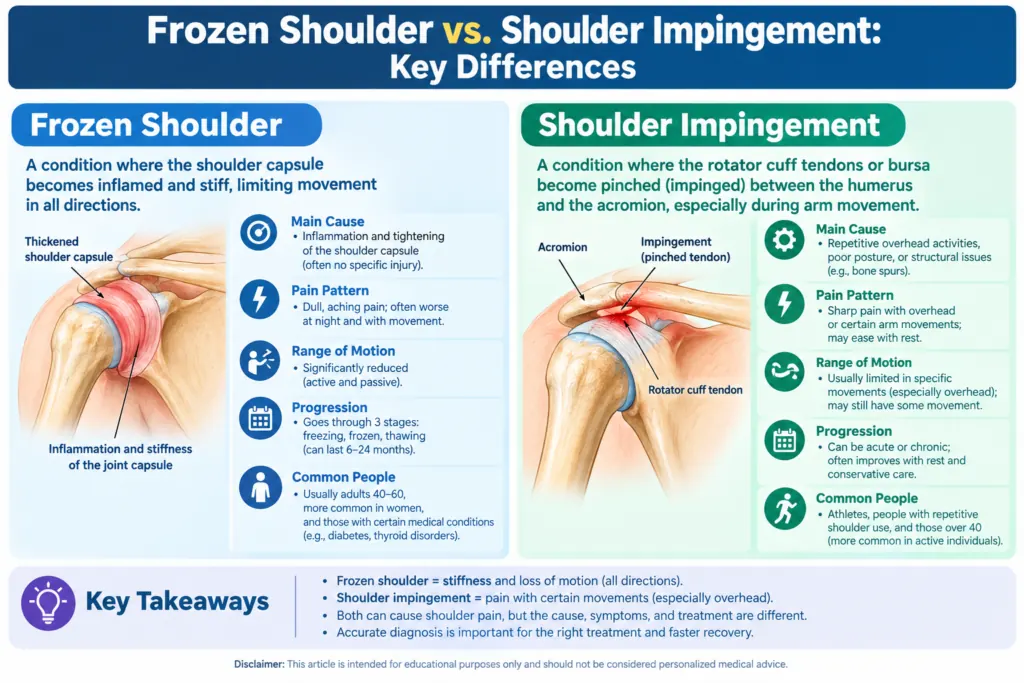
Although both can cause shoulder pain and difficulty moving the arm, they affect the shoulder in different ways. Frozen shoulder is mainly associated with progressive stiffness and loss of movement, while shoulder impingement typically causes pain during certain shoulder movements, particularly overhead activities.
Knowing the difference between frozen shoulder vs. shoulder impingement can help you understand your symptoms and recognize why treatment may be different. However, because several shoulder conditions can produce similar symptoms, persistent pain or restricted movement should be properly evaluated.
Disclaimer: This article is intended for educational purposes only and should not be considered personalized medical advice.
Frozen Shoulder vs. Shoulder Impingement: What Is the Difference?
The biggest difference isstiffness versus movement-related pain.
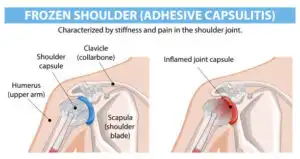
Frozen shoulder, medically known as adhesive capsulitis, occurs when the capsule surrounding the shoulder joint becomes inflamed and progressively tightens. This can significantly restrict both active and passive shoulder movement.
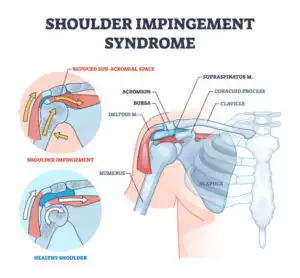
Shoulder impingement, meanwhile, describes pain associated with structures around the shoulder during certain movements. Rotator cuff tendons and the subacromial bursa may become irritated, particularly with repeated or demanding overhead activity.
| Feature | Frozen Shoulder | Shoulder Impingement |
| Main problem | Significant stiffness | Pain with certain movements |
| Movement | Active and passive movement restricted | Movement may remain relatively normal |
| Onset | Often gradual | Can develop gradually or after overuse |
| Overhead movement | Difficult because of stiffness | Often painful |
| Behind-the-back movement | Often very limited | May be painful but less restricted |
| Common treatment | Mobility, pain management, rehabilitation | Activity modification, strengthening, rehabilitation |
What Is Frozen Shoulder?
Frozen shoulder occurs when the tissues surrounding the shoulder joint become inflamed and contract, causing progressive stiffness.
It often develops gradually rather than immediately following a specific injury.
People may notice that reaching behind their back becomes difficult, or that they cannot raise their arm as easily as before.
Common symptoms include:
- Increasing shoulder stiffness.
- Dull or aching shoulder pain.
- Difficulty raising the arm.
- Trouble reaching behind the back.
- Difficulty putting on or removing clothing.
- Pain that may interfere with sleep.
- Progressive loss of shoulder movement.
The condition commonly progresses through stages, with pain and stiffness changing over time.
You can learn more about the early signs and stages of frozen shoulder to better understand how symptoms may develop.
What Is Shoulder Impingement?
Shoulder impingement generally refers to pain associated with structures around the shoulder during arm movement, particularly elevation or overhead activity.
The rotator cuff tendons and bursa can become irritated, and symptoms may be more noticeable when reaching overhead, lifting, or performing repetitive shoulder movements.
Common symptoms include:
- Pain when raising the arm.
- Discomfort during overhead activity.
- Pain on the outer or front part of the shoulder.
- Pain when reaching behind or across the body.
- Weakness caused by pain.
- Shoulder discomfort after repetitive activity.
For a more detailed explanation, see our guide to shoulder impingement syndrome.
Frozen Shoulder Symptoms vs. Impingement Symptoms
Symptoms can overlap, but the pattern is often different.
Frozen Shoulder Symptoms
The defining feature isprogressive loss of shoulder movement.
You may notice that movements that were previously easy gradually become difficult. The restriction can affect both movements you perform yourself and movements performed by someone else.
Pain may be worse at night, particularly during the earlier stages.
Shoulder Impingement Symptoms
Shoulder impingement is often more movement-dependent.
A person may be able to move the shoulder through a relatively broad range but experience pain during specific parts of that movement.
Overhead exercises, lifting, reaching, or repetitive shoulder activity may aggravate symptoms.
This distinction is useful, but symptoms alone cannot always establish the diagnosis.
Why Are Frozen Shoulder and Impingement Often Confused?
Both conditions can cause shoulder pain, especially when raising the arm.
The confusion becomes greater because people may use the term “impingement” to describe several types of shoulder pain, while shoulder symptoms can also occur alongside rotator cuff problems, arthritis, bursitis, or other conditions.
For example, a person with shoulder pain may assume that stretching will fix the problem. Another person may avoid all movement because they believe movement is damaging the joint.
Neither assumption is necessarily correct.
The appropriate approach depends on the underlying cause.
How Is Frozen Shoulder Diagnosed?
Diagnosis usually begins with a medical history and physical examination.
A healthcare professional may assess how far you can move your shoulder and whether the restriction occurs during both active and passive movement.
The pattern of restricted motion can provide important clues.
Imaging such as X-rays may sometimes be used to rule out other conditions, while additional imaging may be considered when another shoulder problem is suspected.
Because frozen shoulder can resemble other causes of shoulder stiffness, proper evaluation is important.
How Is Shoulder Impingement Diagnosed?
A clinician may assess your shoulder movement, strength, pain pattern, and response to specific movements.
Your history is also important. Repetitive overhead activity, sports, work demands, previous shoulder problems, and changes in training can all provide useful information.
Imaging may be used when necessary to investigate the possibility of rotator cuff problems, arthritis, or other structural conditions.
Diagnosis should not rely on one movement or one physical test alone.
Frozen Shoulder Treatment
Treatment generally focuses on controlling pain and gradually restoring shoulder movement.
Depending on the individual’s symptoms, treatment may include:
- Activity modification.
- Pain management.
- Gentle mobility exercises.
- Physical therapy.
- Progressive stretching.
- Strengthening as movement improves.
- Other treatments recommended by a healthcare professional.
For a broader overview of conservative and surgical approaches, see our article on shoulder pain treatment options.
One important point is that aggressive stretching is not necessarily better. Forcing a stiff and painful shoulder can increase discomfort.
Shoulder Impingement Treatment
Treatment for shoulder impingement often focuses on reducing irritation while improving shoulder strength and movement.
A rehabilitation program may include:
- Temporary modification of painful activities.
- Rotator cuff strengthening.
- Shoulder blade strengthening.
- Mobility exercises.
- Gradual return to overhead activities.
- Technique and workload adjustments.
Our guide to shoulder strengthening exercises for athletes provides additional information about strengthening the muscles that support shoulder function.
Treatment should be individualized because not every person with shoulder pain has the same underlying problem.
Can Exercises Help Both Conditions?
Exercise can be an important part of treatment for both frozen shoulder and shoulder impingement, but the goals are different.
With frozen shoulder, restoring comfortable mobility is often a major priority.
With shoulder impingement, rehabilitation may place greater emphasis on strength, movement control, activity modification, and gradually improving tolerance to loading.
If you have another shoulder injury, exercises should be selected carefully. For example, people with a labral injury should understand exercises to avoid with a shoulder labral tear rather than following a generic shoulder workout.
Which Condition Causes More Stiffness?
Frozen shoulder generally causes more significant stiffness.
A person with frozen shoulder may have difficulty moving the shoulder even when someone else attempts to move the arm.
With shoulder impingement, movement may be possible through a larger range, but certain movements can cause pain.
This difference is one of the most useful clues when comparing the two conditions.
However, severe shoulder pain from another injury can also make movement appear restricted, which is why a proper assessment is important.
Which One Is More Likely to Cause Night Pain?
Both conditions can cause nighttime shoulder discomfort.
Frozen shoulder is particularly well known for causing pain that interferes with sleep, especially during the earlier stages.
Shoulder impingement and rotator cuff-related problems can also become painful at night, particularly when lying on the affected shoulder.
If your shoulder pain has a burning quality, other causes may need consideration. Our guide to burning shoulder pain discusses several possible explanations.
Can Frozen Shoulder Turn Into Shoulder Impingement?
Frozen shoulder does not simply transform into shoulder impingement.
They are different conditions involving different mechanisms. However, prolonged stiffness can change how the shoulder moves, and altered movement patterns may contribute to discomfort in surrounding structures.
Likewise, someone with shoulder pain may reduce movement because of symptoms and subsequently develop additional stiffness.
This is another reason why treating the underlying problem rather than focusing only on the label is important.
Can Shoulder Impingement Cause Frozen Shoulder?
Shoulder impingement does not automatically cause frozen shoulder.
However, significant shoulder pain can cause a person to avoid moving the arm. Prolonged avoidance of movement may contribute to stiffness in some circumstances.
If your shoulder is becoming progressively harder to move rather than simply painful during specific activities, professional evaluation can help determine whether frozen shoulder or another condition may be involved.
What Exercises Should You Avoid?
There is no universal list of exercises that every person with shoulder pain must avoid.
The appropriate exercise depends on the diagnosis, severity of symptoms, stage of recovery, and individual goals.
In general, avoid repeatedly forcing movements that produce sharp or worsening pain.
If you are recovering from shoulder surgery or a significant injury, exercise restrictions may be more specific. Our guide on shoulder labral tear surgery recovery explains why rehabilitation and return to activity are typically gradual.
How Can Posture Affect Shoulder Symptoms?
Posture is not always the direct cause of shoulder pain, but prolonged positioning can influence how your neck, shoulder blades, and upper back move.
Spending long periods at a computer or looking down at a phone may contribute to muscular discomfort and stiffness.
Regular movement breaks and appropriate strengthening can be useful. You can also explore posture correction exercises for shoulder and neck pain for practical exercises and movement strategies.
When Should You See a Doctor?
Not every episode of shoulder pain requires immediate medical attention, but persistent or significant symptoms should not simply be ignored.
Consider professional evaluation if you have:
- Severe or worsening shoulder pain.
- Progressive loss of movement.
- Significant weakness.
- Pain after a fall or accident.
- Shoulder instability.
- Numbness or tingling.
- Persistent nighttime pain.
- Difficulty performing normal daily activities.
Urgent assessment may be appropriate after a major injury, especially if you cannot move the arm or the shoulder appears visibly deformed.
Frequently Asked Questions
1. Which is worse, frozen shoulder or shoulder impingement?
Neither is automatically “worse.” Frozen shoulder usually causes substantially more stiffness, while impingement may cause significant pain during activity.
2. How can I tell if I have frozen shoulder or impingement?
Progressive restriction of both active and passive shoulder movement is more characteristic of frozen shoulder. Pain during specific movements with relatively preserved motion may suggest another condition such as impingement.
3. Can frozen shoulder heal on its own?
Frozen shoulder can improve over time, but the course can be prolonged. Treatment may help manage pain and restore movement and function.
4. Can shoulder impingement heal without surgery?
Many people improve with conservative treatment such as activity modification, rehabilitation, and strengthening. Surgery is not automatically required.
5. Should I stretch a frozen shoulder?
Gentle, appropriate stretching and mobility exercises may be part of treatment. However, aggressively forcing a painful shoulder can make symptoms worse.
6. Can I exercise with shoulder impingement?
Often, exercise can be modified rather than completely stopped. Painful movements may need to be reduced while appropriate strengthening and rehabilitation are introduced.
7. Does frozen shoulder cause weakness?
It can. Pain and restricted movement may make the shoulder feel weak, although severe weakness can also indicate another underlying problem.
8. Does shoulder impingement cause stiffness?
It can cause some stiffness, particularly when pain limits movement. However, severe progressive stiffness is more characteristic of frozen shoulder.
9. How long does frozen shoulder take to recover?
Recovery varies considerably. Frozen shoulder can progress through several stages and may take months or longer to fully resolve.
10. When should shoulder pain be evaluated?
Persistent, worsening, severe, or unexplained shoulder pain should be evaluated, especially when accompanied by weakness, numbness, significant stiffness, or loss of function.
Conclusion
Frozen shoulder and shoulder impingement can both cause shoulder pain, but they are not the same condition.Frozen shoulder is primarily characterized by progressive stiffness and substantial loss of movement, while shoulder impingement is more commonly associated with pain during specific shoulder movements.
Because shoulder problems can overlap, symptoms alone cannot always provide a definite diagnosis. A healthcare professional can assess your movement, strength, symptoms, and medical history to determine the most appropriate treatment.Whether the problem involves stiffness, movement-related pain, or both, the goal should be to identify the underlying cause and use a gradual rehabilitation approach rather than simply pushing through pain.
Disclaimer: This article is intended for educational purposes only and should not be considered personalized medical advice.
This article is for education purpose only and is not a diagnosis or a substitute for medical advice.