
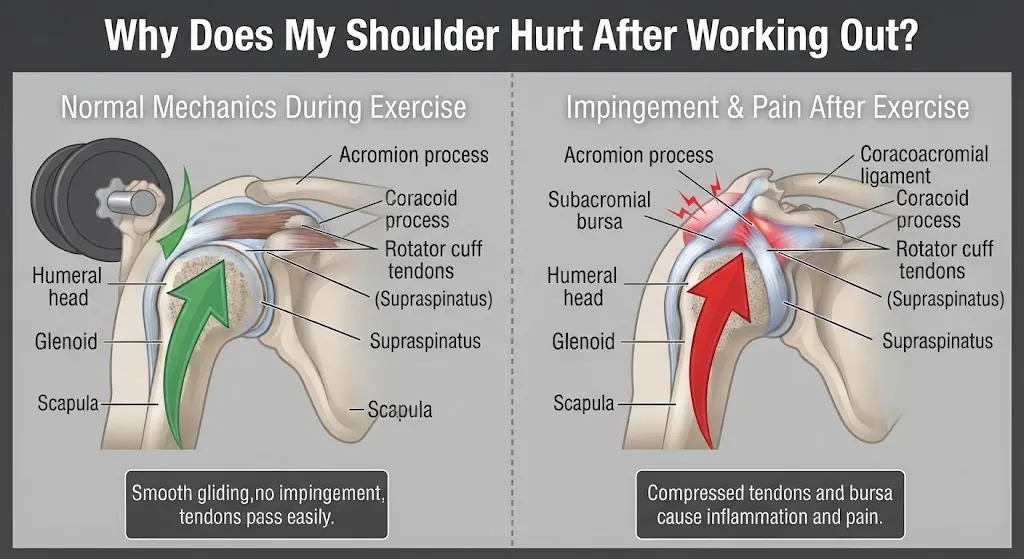
Mild soreness after unfamiliar exercise can be normal, but sharp, recurring, or worsening shoulder pain should not be ignored. Continuing to train through pain may aggravate irritated tissues, especially after increasing weights, repetitions, or workout intensity too quickly.
Understanding why your shoulder hurts after working out can help you adjust your routine, manage mild symptoms safely, and recognize when professional evaluation is appropriate. The cause may involve muscles, tendons, the shoulder joint, or structures around the neck.
What Causes Shoulder Pain After a Workout?
The cause often depends on where the pain occurs, which movements trigger it, and whether symptoms began suddenly or gradually.
| Possible cause | Common symptoms | Typical trigger |
|---|---|---|
| Muscle soreness or strain | Aching, tenderness, discomfort with movement | New exercises, heavier weights, excessive repetitions |
| Rotator cuff irritation | Pain lifting or rotating the arm, sometimes weakness | Pressing, overhead lifts, repetitive movements |
| Shoulder impingement-related pain | Pain when raising the arm, particularly overhead | Repeated lifting or limited movement tolerance |
| Shoulder bursitis | Tenderness and pain with movement or pressure | Repetitive loading or irritation |
| AC joint irritation | Pain at the top of the shoulder | Bench pressing, push-ups, or bringing the arm across the chest |
| Labral injury | Deep pain, catching, clicking, or instability | Trauma, forceful lifting, or repeated shoulder stress |
These patterns are clues, not a diagnosis. For example, shoulder tendonitis symptoms and treatment may help explain tendon-related discomfort, while rotator cuff tear symptoms and recovery describes symptoms that can require further assessment.
Other possibilities include shoulder bursitis symptoms or signs of an AC joint injury. Deep pain with catching or a sense that the joint may slip can warrant evaluation for a shoulder labral tear.
Is It Normal for Your Shoulder to Hurt After Exercise?
Mild muscle soreness can occur after a challenging or unfamiliar workout. Delayed-onset muscle soreness typically develops within 12–24 hours, may peak over the next 24–72 hours, and gradually improves over several days.
Pain is more concerning when it is sharp, localized to the joint, associated with sudden weakness, or repeatedly triggered by the same movement. Pain that worsens rather than improves may indicate more than routine post-workout soreness.
| Symptom pattern | What to do |
|---|---|
| Mild muscle tenderness that gradually improves | Reduce intensity and monitor symptoms |
| Pain during pressing or overhead movements | Stop the painful exercise and modify training |
| Persistent pain, reduced motion, or recurring symptoms | Arrange a clinical assessment |
| Sudden severe pain, deformity, or major weakness | Seek urgent medical evaluation |
How Can You Relieve Shoulder Pain After Working Out?
For mild discomfort without signs of a serious injury, start by reducing the activities that trigger pain rather than forcing your shoulder through a workout.
-
Pause painful exercises. Temporarily avoid heavy presses, overhead lifts, dips, or movements that reproduce symptoms.
-
Use a cold pack if helpful. Wrap it in a cloth and apply for 15–20 minutes at a time. Never place ice directly on your skin.
-
Keep comfortable movement. Gentle, pain-free movement can help maintain mobility. Avoid aggressive stretching or strengthening that increases pain.
-
Consider medication cautiously. Over-the-counter pain relievers may help some people, but anti-inflammatory medicines are not suitable for everyone. Ask a clinician or pharmacist if you have medical conditions, take other medicines, or are unsure what is safe.
For practical options, see these shoulder pain relief methods you can try at home. If movement remains uncomfortable, avoid starting a generic exercise routine before the cause is clearer; some exercises for shoulder pain relief may need modification.
How Can You Prevent Shoulder Pain During Workouts?
Review your training load, technique, and recovery habits. Increasing resistance or training volume too quickly can exceed what your shoulder is currently able to tolerate.
| Workout adjustment | Why it may help |
|---|---|
| Warm up with light, gradual movements | Prepares you for the demands of exercise |
| Increase weights and repetitions gradually | Limits sudden increases in training stress |
| Use a comfortable range of motion | Avoids repeatedly provoking painful positions |
| Allow recovery between demanding sessions | Gives irritated tissues time to settle |
| Maintain balanced shoulder and upper-back strength | Supports control during lifting |
A suitable warm-up before exercise should prepare you for the movements you plan to perform. You can also review ways to prevent shoulder injuries during workouts and shoulder-strengthening exercises for athletes when symptoms have settled enough for training.
If pain occurs specifically when lifting your arm, read about why shoulder pain happens when raising your arm. Pain during pushing movements may also relate to why shoulder pain can happen during push-ups.
When Should You See a Doctor?
Seek an assessment if shoulder pain keeps returning, affects daily activities, limits your range of motion, causes noticeable weakness, or does not begin improving after several days of reduced activity. Pain that persists for one to two weeks is another reason to arrange an evaluation, particularly if it interferes with sleep or exercise.
Seek urgent care after a significant injury, sudden severe pain, an obvious change in shoulder shape, inability to move the arm, or a hot, red, swollen shoulder with fever. New numbness or a pale, cold hand also needs urgent assessment.
Shoulder discomfort accompanied by chest pressure, shortness of breath, sweating, nausea, or pain spreading to the jaw or back may indicate a heart emergency. Call 911 in the United States rather than assuming the symptoms are workout-related; see when shoulder pain may signal a heart problem.
A clinician may assess your strength, movement, injury history, and pain pattern. Depending on the findings, an X-ray or other imaging may be appropriate. Treatment can range from activity changes and physical therapy to additional care for significant structural injuries; nonsurgical and surgical shoulder treatment options explains the general approaches.
Frequently Asked Questions
1. Why does my shoulder hurt the day after lifting weights?
It may be delayed muscle soreness, particularly after a new or intense workout. Joint-specific pain, weakness, or worsening symptoms deserve closer attention.
2. How long should shoulder pain after working out last?
Mild soreness often improves within several days. Tendon irritation or an injury can last longer, depending on its severity and the activities that aggravate it.
3. Should I keep working out if my shoulder hurts?
Do not push through sharp or worsening pain. Stop the painful movement and choose only activities that do not aggravate your symptoms.
4. Can poor form cause shoulder pain?
Yes. Technique that places excessive stress on the shoulder, combined with heavy loads or fatigue, may contribute to pain. A qualified trainer or physical therapist can help review your movement.
5. Can I train other body parts while my shoulder recovers?
Possibly, if the exercises do not involve painful shoulder loading or aggravate symptoms. Avoid movements that require you to brace, press, or support weight through the affected arm if those actions hurt.
6. Does shoulder clicking after exercise mean an injury?
Not necessarily. Clicking without pain may be harmless, but painful clicking, catching, weakness, or instability should be assessed.
7. Can shoulder pain happen without an obvious injury?
Yes. Repetitive loading or gradual tissue irritation can cause symptoms without a single identifiable event. Persistent discomfort may need an evaluation to clarify the cause.
8. Should I use heat or ice for shoulder pain?
A wrapped cold pack may help after a recent workout or injury. Heat may feel soothing for stiffness, but neither treatment should delay assessment of severe or worsening symptoms.
9. When can I return to lifting weights?
Return gradually when everyday movements are comfortable and shoulder strength and mobility are improving. Start lighter than usual, increase loads cautiously, and stop if pain returns.
10. Does shoulder pain after exercise always mean a rotator cuff tear?
No. Muscle soreness, tendon irritation, bursitis, and joint problems can produce similar symptoms. A clinician can determine whether further examination or imaging is needed.
Conclusion
Shoulder pain after working out can result from ordinary muscle soreness, excessive training stress, or an injury involving the shoulder joint or surrounding tissues. Reduce painful activities, maintain comfortable movement, and return to training gradually. Seek medical evaluation for persistent or recurring symptoms, and obtain urgent help for severe injury signs or possible heart-related symptoms.
Disclaimer: This article is provided for educational and informational purposes only.
This article is for education purpose only and is not a diagnosis or a substitute for medical advice.