
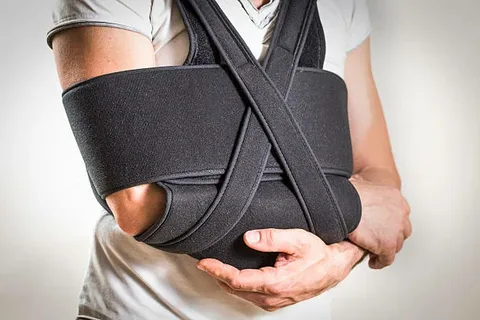
A shoulder labral tear can cause catching, clicking, pain with certain arm movements, or a feeling that the shoulder may slip out of place. Some people notice symptoms when reaching overhead, lifting, pushing, or sleeping on the affected side. If you are looking for a shoulder labral tear brace, the main question is usually whether external support can reduce symptoms or protect an unstable shoulder during daily activities.
A brace can provide support, but it does not repair a torn labrum. The right choice depends on the type of tear, whether shoulder instability is present, your activity level, and whether a clinician has recommended temporary immobilization. Wearing a brace continuously without guidance can also restrict movement and make shoulder stiffness harder to overcome.
A labral tear involves the ring of cartilage that helps deepen the shoulder socket and contributes to stability. This guide explains which types of support may be considered, when to wear one, what to avoid, and when bracing is unlikely to be enough.
What is the best brace for a shoulder labral tear?
There is no single brace that is best for every labral tear. A simple shoulder support may help with comfort during certain activities, while a sling or more restrictive immobilizer may be appropriate for a short period after an injury or procedure when specifically recommended.
| Type of support | Potential purpose | When it may be considered |
|---|---|---|
| Shoulder support brace | Limits uncomfortable movement and provides a sense of stability | Mild symptoms or selected activities |
| Functional stabilization brace | Provides more controlled support during movement | Some instability-related problems |
| Sling | Restricts arm movement more substantially | Short-term protection when prescribed |
| Postoperative immobilizer | Protects repaired tissues during early healing | After certain shoulder surgeries |
The important distinction is that a brace provides mechanical support, not tissue healing. If you have persistent pain or instability, understanding the early signs of a shoulder labral tear can help determine whether further evaluation is appropriate.
When can a brace help a labral tear?
Bracing may be useful when symptoms are strongly related to instability or when particular movements repeatedly provoke discomfort. It may also provide temporary protection while activity is being reduced or rehabilitation begins.
For example, someone who experiences a slipping sensation during certain sports may benefit from clinician-directed stabilization while working on strength and movement control. However, a brace should generally be viewed as an adjunct to rehabilitation, rather than the primary treatment.
A 2021 cohort study of 97 adolescent athletes with anterior shoulder instability found no statistically significant difference in successful return-to-play outcomes between athletes who used functional bracing and those who did not. The braced group returned successfully 80% of the time compared with 88% in the nonbraced group. The study involved young athletes with instability rather than every type of labral tear, so the findings cannot be applied to all adults with labral injuries.
Should you wear a shoulder brace all day?
Usually, not without specific medical instructions.
Extended immobilization can reduce shoulder movement and contribute to stiffness. Modern rehabilitation approaches generally emphasize restoring controlled motion and progressively strengthening the shoulder rather than keeping it immobilized indefinitely.
| Situation | Brace approach |
|---|---|
| Mild pain without instability | Usually focus on activity modification and rehabilitation |
| Shoulder feels unstable during a specific activity | A functional brace may sometimes be considered |
| Recent traumatic instability | Follow the clinician’s immobilization instructions |
| After labral surgery | Use the prescribed postoperative support and schedule |
| Increasing stiffness while braced | Contact your clinician for guidance |
If you are considering a brace because everyday activities are becoming difficult, information about living with a labral tear and managing daily activities may be more useful than simply increasing brace time.
What should you look for in a shoulder labral tear brace?
A useful brace should provide the amount of support actually needed without unnecessarily restricting the shoulder.
Look for:
- Adjustable straps that allow a secure but comfortable fit.
- Support that does not cause numbness, tingling, discoloration, or increasing pain.
- A design appropriate for the activity you need to perform.
- Enough freedom of movement for exercises your clinician has approved.
- Materials that allow reasonable ventilation during longer periods of use.
A brace that is excessively tight is not necessarily more protective. If it causes hand swelling, altered sensation, skin irritation, or increasing pain, remove it and seek professional advice.
For a suspected labral injury, it is also important to understand the different types of shoulder labral tears, because a brace cannot be selected appropriately from symptoms alone.
Brace vs. sling: what’s the difference?
A brace and sling are not interchangeable.
A sling primarily supports the arm and limits movement. A functional shoulder brace is generally designed to provide targeted support while permitting more controlled activity.
| Feature | Functional brace | Sling |
|---|---|---|
| Main purpose | Support and movement control | Immobilization and protection |
| Arm movement | Usually partly preserved | More restricted |
| Typical role | Selected activities or instability | Short-term protection |
| Long-term use | Not routinely necessary | Generally avoided unless prescribed |
After a significant instability event, management should be individualized. Expert consensus emphasizes factors such as the injury mechanism, number of instability episodes, activity demands, and associated pathology when determining nonoperative care.
If the shoulder repeatedly feels as though it is slipping or coming out of place, review the symptoms of shoulder instability rather than relying on a brace alone.
When should you avoid relying on a brace?
A brace should not be used to push through worsening symptoms. Stop or modify an activity if wearing the brace still produces significant pain, catching, weakness, or instability.
Be especially cautious with exercises that repeatedly place the shoulder in positions that provoke symptoms. A guide to exercises to avoid with a shoulder labral tear can help identify movements that may need modification.
For rehabilitation, controlled strengthening is usually more useful than prolonged immobilization. Depending on the injury, supervised labral tear physical therapy may focus on shoulder and scapular control, strength, mobility, and gradual return to activity.
Does a brace heal a torn labrum?
No. A brace does not reattach a torn labrum or guarantee that the tissue will heal.
Treatment depends on the tear, symptoms, instability, activity demands, and previous treatment. Some people improve with activity modification and rehabilitation, while others may eventually require surgical evaluation.
Research on shoulder instability supports rehabilitation as an important part of nonoperative management, but evidence specifically proving that functional bracing heals labral tears is limited.
If you are wondering whether surgery is necessary, learn about non-surgical labral tear recovery and how labral tear treatment compares with physical therapy versus surgery.
When should you see a clinician?
Arrange an evaluation if shoulder pain, catching, weakness, or instability persists despite reducing aggravating activities. You should also seek assessment after a significant injury, especially if the shoulder feels unstable or movement is substantially limited.
Urgent evaluation is appropriate if the shoulder appears visibly deformed, cannot be moved normally after an injury, or you develop significant numbness, weakness, swelling, or changes in hand color or temperature.
If imaging is recommended, an MRI for a shoulder labral tear or, in selected cases, an MRI arthrogram for a shoulder labral tear may be considered based on the clinical situation.
Frequently Asked Questions
1. Can a shoulder brace help a labral tear?
It may reduce uncomfortable movement or provide a feeling of stability in selected situations. It does not repair the torn labrum.
2. Should I sleep in a shoulder brace?
Not routinely unless a clinician specifically recommends it. Sleeping support should prioritize comfort without unnecessary restriction.
3. Can I wear a labral tear brace while exercising?
Sometimes, but only for activities that have been approved for your stage of recovery. A brace should not be used to ignore pain or instability.
4. Is a sling better than a shoulder brace?
They serve different purposes. A sling restricts movement more substantially, while a functional brace is generally intended to provide support while allowing controlled movement.
5. Can wearing a brace make my shoulder stiff?
Prolonged restriction can contribute to reduced mobility. This is one reason brace use should match the injury and rehabilitation plan.
6. Can a brace prevent a labral tear from getting worse?
It may limit provocative movements, but it cannot guarantee prevention of progression. If symptoms are worsening, reassessment is more important than simply tightening or wearing the brace longer.
7. Can I drive while wearing a shoulder brace?
Driving may be unsafe if the brace restricts steering, braking, shifting, or rapid arm movement. Follow medical and local driving guidance and avoid driving if you cannot safely control the vehicle.
8. What exercises are usually used during labral tear recovery?
Rehabilitation may include controlled range-of-motion work and progressive strengthening of the shoulder and scapular muscles. Appropriate exercises depend on the tear and stage of recovery; labral tear recovery exercises should be progressed carefully.
9. What if my shoulder keeps slipping despite the brace?
Repeated instability deserves clinical evaluation. A brace may provide temporary support, but recurrent episodes can require a broader assessment of the labrum, bone, muscles, and shoulder mechanics.
10. Can a labral tear need surgery even if a brace helps?
Yes. Symptom improvement with a brace does not determine whether surgery is necessary. Decisions depend on factors such as persistent symptoms, instability, functional limitations, the type of tear, and response to rehabilitation.
The bottom line
A shoulder labral tear brace can sometimes provide temporary support, particularly when symptoms involve instability or specific aggravating activities. The goal should not be to immobilize the shoulder indefinitely, but to use appropriate support while addressing the underlying problem through activity modification, rehabilitation, and clinical evaluation when needed.
If symptoms continue, become more frequent, or involve repeated instability, a brace should not replace an assessment of the shoulder and an individualized treatment plan.
Disclaimer: This article is provided for educational and informational purposes only. It is not a substitute for professional medical advice, diagnosis, or treatment.
This article is for education purpose only and is not a diagnosis or a substitute for medical advice.